
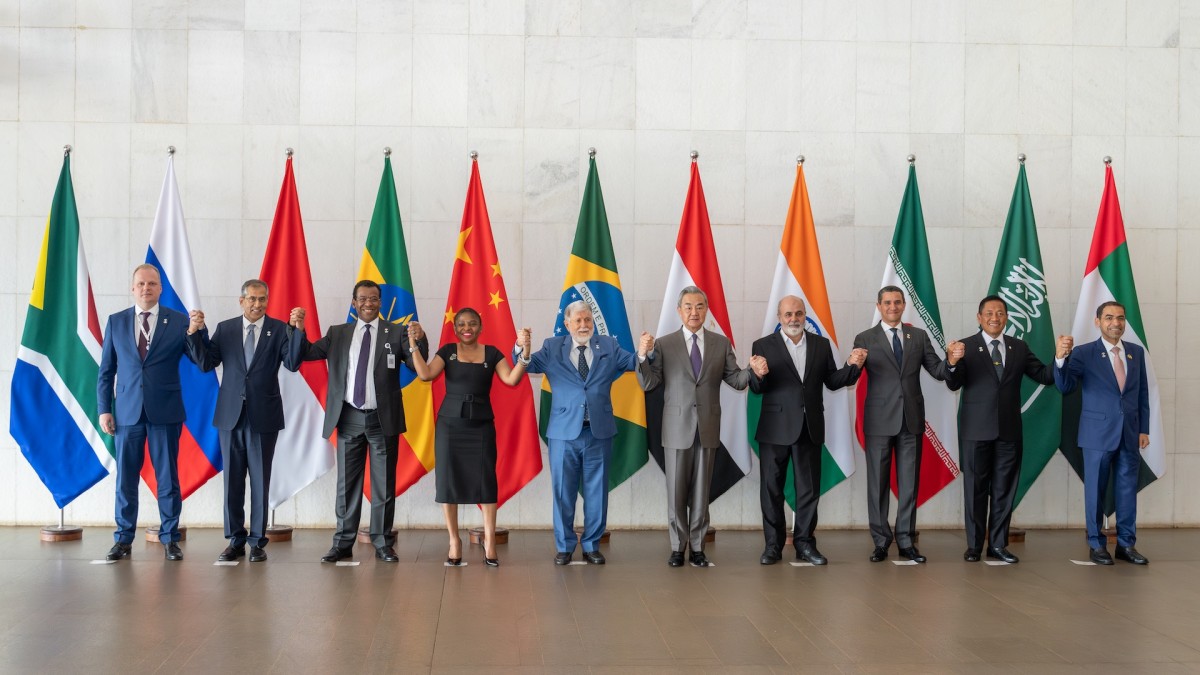
The era of unipolar hegemonic dominance that emerged after the fall of the Berlin Wall and endured for roughly four decades has come to an end. The United States, although still a significant power, faces a systemic and irreversible shift in the wake of rising new actors in the international system, primarily China —already consolidated as an emergent power capable of challenging economic and military primacy—, and the bloc of developing countries grouped within the BRICS, whose global influence is becoming increasingly evident.
“The era of unipolar hegemonic dominance that emerged after the fall of the Berlin Wall has come to an end”
This new scenario compels both the United States and its Western allies to rethink their geostrategic strategies, with the aim of safeguarding their national interests and security. Without detailing the structural causes that have produced this paradigm shift, we can summarize, in broad terms, the following factors:
First, the relative decline of the productive capacities of the U.S. and Europe has facilitated the economic and industrial ascent of China, as well as of other Asian economies. The massive outsourcing of production since the 1980s and 1990s led to a reduction in industrial jobs in the West, weakening the middle classes and generating strategic dependence in sectors critical to innovation and technological development.
In second place, Western economies have experienced uncontrolled rises in public spending without implementing the structural reforms necessary to sustain a welfare state adapted to the challenges of globalization. This has produced chronic debt that curtails the ability to invest in strategic sectors such as education, defense, and innovation.
To this is added a deep demographic crisis, especially in Europe, Japan and, to a lesser extent, the United States, characterized by low birth rates, a shortage of young and highly skilled labor, and mounting pressure on pension systems. This situation has fostered migratory flows that, in the absence of effective integration policies, have intensified social tensions, discrimination, and the rise of exclusionary political discourse.
Thirdly, excessive regulation and bureaucracy in Europe have created barriers to innovation and business competitiveness, in contrast with the dynamism observed in emerging countries. Militarily, the West is undergoing a phase of decline manifested in four fundamental aspects: the fatigue generated by prolonged conflicts without clear and effective outcomes, such as Iraq and Afghanistan, which has produced deep internal fatigue, loss of legitimacy, and growing public distrust of armed interventions; the reduction of defense investment, particularly in Europe —which has generated dependence and a lack of strategic autonomy—; technological stagnation in the face of advances by China and Russia; and a postmodern outlook that rejects the use of force even as a deterrent, thereby weakening structural and moral preparation of Western societies to meet current threats.
“This process of decline does not arise from spontaneous causes, but is the result of failed strategic decisions, inadequate economic models, and the loss of the Western society’s vital drive”
This process of decline does not come from spontaneous causes, but is the result of failed strategic decisions, inadequate economic models, and the loss of the Western society’s vital drive. By contrast, emerging nations have leveraged the benefits of globalization through strategies focused on economic growth and the improvement of material conditions, often subordinating individual freedoms to state control. In this way, two antagonistic models of political and social organization confront each other on the global geopolitical stage.
In this context, it is imperative to avoid direct confrontation between major powers. A return to traditional diplomacy presents itself as a strategic necessity for the West, especially in a global environment marked by multipolarity and China’s rising influence. The logic of deterrence, based on threat, must be replaced by a realistic and negotiator approach.
Historically, U.S. foreign policy and, by extension, Europe’s, have been oriented toward preserving their hegemony by weakening potential rivals, as evidenced by NATO’s expansion toward Russia’s borders, in contradiction with the commitments made after the Cold War. This generated distrust and a sense of encirclement in Moscow, intensified by Western interventions in countries within its strategic neighborhood. More than an imperial expansion policy, the Russian attitude can be interpreted as a defensive reaction to an environment perceived as hostile.
Today, Washington’s strategy toward Russia has evolved. While Europe maintains a confrontational stance toward Moscow, the United States has begun to explore a strategic rapprochement with Moscow, as part of its effort to contain the rise of China. Washington recognizes that a Russia overly dependent on Beijing loses strategic autonomy and becomes a subordinate partner within the euro-Asian axis. In this sense, the U.S. sees with interest the possibility of fostering a more independent Russia, capable of acting with greater maneuvering room. This strategy also seeks to revive the historic distrust and geopolitical competition between Moscow and Beijing, whose agendas and strategic interests, though today partially convergent, tend to diverge in the long run. This approach centers on three objectives. The first is to foster Russian independence from China. The second is to explore shared geostrategic interests, such as control of Arctic routes vital to China, which would give Russia mediation power and recognition as a global power. Note that whoever controls the Arctic routes will command a large portion of international goods traffic. Russia holds 50% of the Arctic coastline compared to 10% for the U.S., 20% for Canada, and 20% for Greenland. Hence the American interest in aligning with or controlling Canada and Greenland to reach 50% of those coasts and jointly dominate those routes with Russia. Finally, to build ideological affinity based on conservative and populist values.
“The global weight of the European Union is in decline, and its dependence on the U.S. for defense compromises its strategic autonomy”
The European Union, for its part, faces a complex scenario. Its global weight is in decline, and its dependence on the U.S. for defense compromises its strategic autonomy. This decline demands a profound transformation of the transatlantic relationship. Europe must redefine its role, aiming to become an autonomous power capable of countering the powers of Russia and China, and the economic competition posed by the BRICS developing countries. The reconfiguration of the international order requires the EU to assume a more active, coordinated, and sovereign role in defense, security, innovation, and economic development. However, its limited military capacity and internal fragmentation, with notable divisions among member countries, and externally with divergent interests in Ukraine, Georgia, and Moldova, hinder this process. Moreover, the exclusion of Russia from European security mechanisms, despite its size, population, and historical European ties, has contributed to greater regional destabilization. Finding a realistic compromise, based on mutual respect and distant from both capitulation and unilateral imposition, is essential for peace and stability on the continent.
The model of deterrence that dominates European policy, media, and outlook presents Russia only as an imperial threat. Although it is true that there has been a serious aggression that contravenes the essence of international law, which has been violated by both sides in recent decades, this view has contributed to worsening the conflict rather than curbing it. In this sense, the precedent of World War I, where alliance logic and chain reactions led to an out-of-control escalation, offers a clear warning.
“The Ukraine case illustrates the urgency of a Europe-led diplomatic solution”
The Ukraine case illustrates the urgency of a Europe-led diplomatic solution. Without effective commitment from Kyiv and Moscow, and without a common approach within the EU, any solution becomes unviable. The missed opportunities in the Minsk and Istanbul processes, bellicose rhetoric and the unconditional demand to revert the 2014 borders have prevented a viable resolution of the conflict. An American withdrawal from its pivotal role in resolving it, if no agreement is achieved between the parties, along with Europe’s unconditional support for maximalist positions—however justified they may be—would make it responsible for the consequences arising from prolonging a struggle whose battlefield resolution is highly unlikely.
A negotiated exit could contemplate, among other measures, despite their difficulties and sacrifices for all involved parties, Ukraine’s accession to the EU in exchange for its military neutrality and renunciation of NATO membership; the recognition of Crimea as part of Russia; respect for the autonomy and guarantee of the rights and specific political, cultural, and linguistic characteristics of the currently occupied regions; the creation of demilitarized zones along the common border; the establishment of compensation for the reconstruction of the devastated areas and how and who will fund them; and a new European security framework. Measures such as these could constitute a pragmatic negotiating possibility to guarantee political stability and economic progress in the region. There are historical precedents of neutrality and territorial cessions (postwar Austria and Finland) and territorial autonomy (Bosnia or the Hong Kong and Macao Special Administrative Regions) that could serve as a basis for such a solution.
“The European Union must consolidate itself as an autonomous, equidistant, and pragmatic actor on the international stage”
The European Union must consolidate itself as an autonomous, equidistant, and pragmatic actor on the international stage, actively promoting détente, cooperation, and collective security. To achieve this goal, on the one hand, profound structural reforms are required affecting governance and the policies—economic, monetary, financial, commercial, technological, energy, demographic, and cultural—within the Union itself. On the other hand, the emergence of a new generation of political leadership to place Europe as a relevant protagonist in shaping the global order of the twenty-first century. This constitutes the fundamental challenge of our era: to resolutely assume this historical responsibility or face the risk of a gradual and irreversible decline.
