
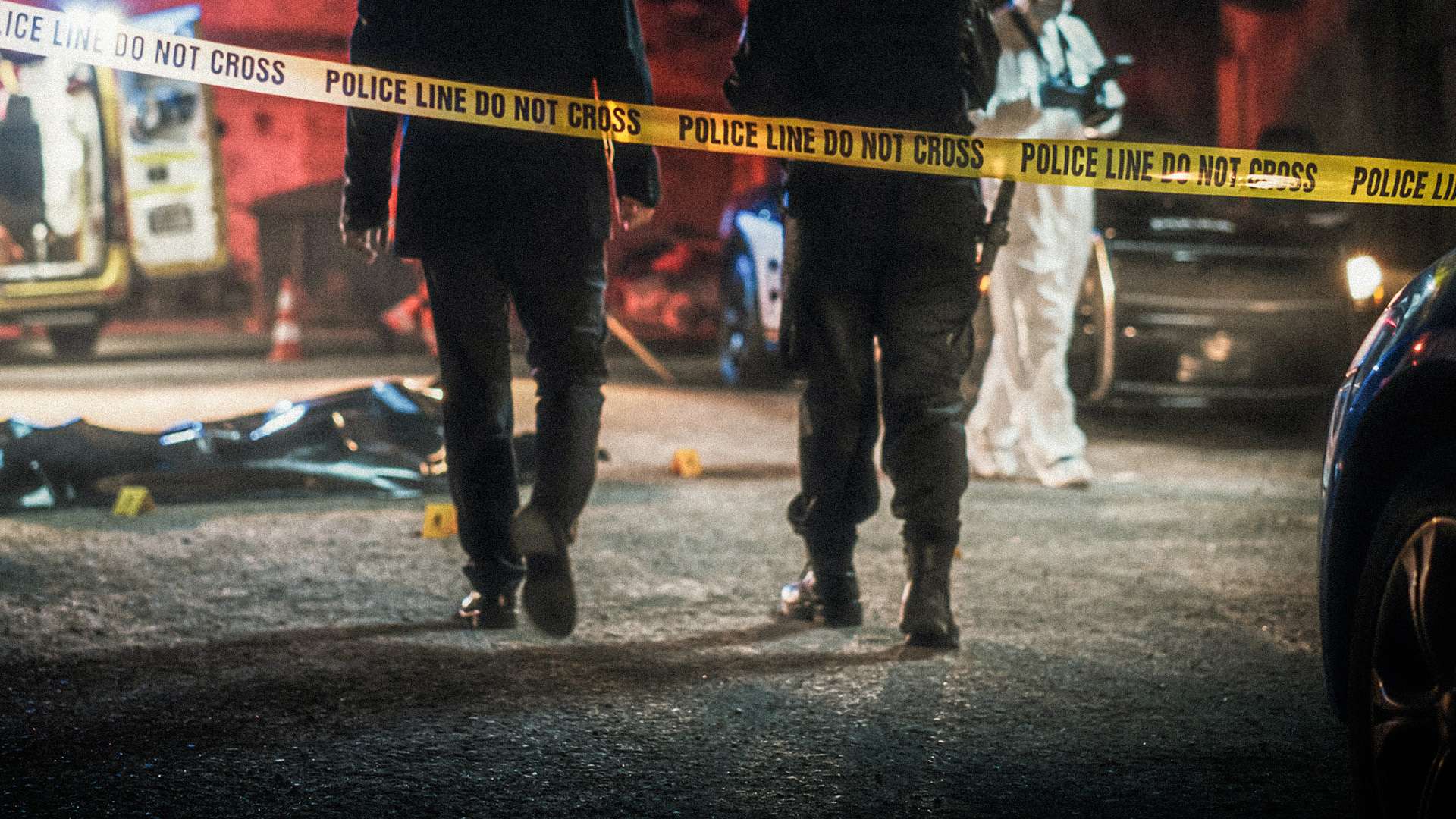
Survey respondents were skeptical about the policies the president claims produced the largest drop in violent crime in American history.
Following a spike during the COVID-19 period, the United States’ homicide rate has fallen notably in recent years, reaching a historic low in 2025. While President Donald Trump insists he bears responsibility for this welcome trend, a new report from the Council on Criminal Justice (CCJ) argues that factors outside his policies played a far more significant role.
Trump has shown a strong tendency to invoke the CCJ while asserting credit for the homicide decline. Yet he is unlikely to promote this particular study, which rests on a survey of 48 crime experts who gathered to evaluate around 40 potential explanations for the downturn. None of them considered the federal policies highlighted by Trump to be major drivers.
In August, the FBI reported an 18 percent drop in the homicide rate from 2024 to 2025, an unprecedented decline. “The 2025 murder rate of 4.1 per 100,000 inhabitants is tied with 1955 and 1956 for the lowest murder rate,” the FBI stated. The CCJ, drawing on criminologist Randolph Roth’s 2009 book American Homicide, goes further, asserting that the 2025 rate is the lowest observed since at least 1900—a conclusion Trump has repeatedly echoed.
Trump promptly claimed credit for that historic fall. “We have the numbers down because of what the federal government’s doing,” he asserted during a speech at the Nassau County, New York, police academy on August 14. “Everyone knows we’ve done an amazing job.”
Four days later, a White House press release reinforced that narrative. “President Trump Delivers the Largest Drop in Violent Crime in American History,” read the headline. The White House claimed that Trump “backed law enforcement, empowered the FBI to hunt predators instead of political targets, and rejected the failed Democrat lunacy that left communities reeling,” proclaiming, “The results are clear: fewer murders, fewer victims, and safer streets.”
Responding to a CCJ report based on first-half data from a sample of U.S. cities, the White House similarly described the continuing drop in violent crime as “the direct result of the Trump Administration’s relentless efforts to enforce the rule of law, back the police, and surge resources into communities long abandoned by Democrats.” It credited Trump’s National Guard deployments, stating that “the steepest homicide drops have come in cities where the Trump Administration stepped in after Democrat leaders failed to act.”
Trump “promised to make America safe again,” the White House stated, “and the data prove he is delivering faster and more decisively than any Administration in history.” To emphasize the point, a subsequent press release referred to recent crime trends as “the Trump Effect in full force.”
That “Trump Effect,” according to Vice President J.D. Vance, encompasses immigration enforcement. “When you get the violent criminals out of your country, you see the largest drop in violent crime in the history of the United States of America,” Vance said at a rally in Iowa last month, “because we got the bad guys out.”
Trump concurs. “We have the most secure border in American history,” he boasted during his September 22 address to the United Nations General Assembly. “Nobody comes in, unless they’re invited, unless they have permission….As a result, last year we achieved the largest drop in violent crime ever recorded.”
But there are several obvious issues with these claims. The downward trend in homicides began in 2023, two years before Trump took office. And if Trump deserves credit for continuing that trend, doesn’t he also deserve blame for the sharp 2020 spike in homicides that occurred under his watch? The reality is that neither conclusion is justified without further evidence, particularly since presidential influence over law enforcement is limited—policing is primarily a state and local function—and crime rates are shaped by many factors beyond federal policy.
The CCJ’s survey of crime experts, which examined 48 possible explanations for the recent homicide decline, adds additional reasons for skepticism. Although “no single factor was seen as the dominant cause of the decline,” the CCJ notes, 57 percent of participants labeled “easing pandemic-related social and economic disruption” as “a major contributor.”
That factor was the only one deemed a major contributor by a majority of the experts. Yet the CCJ also asked respondents to enumerate the five factors they believed had the strongest influence. None of the Trump administration policies that the president asserts as responsible for the homicide drop appeared on any of those lists.
In addition to the fading impact of the pandemic, which 51 percent of participants cited, the “top contributors” included the expansion of community violence prevention programs (64 percent), a greater use of “focused deterrence” aimed at “high-risk individuals and groups” (43 percent), improvements in local government capacity (40 percent), and increases in public safety and supporting services “relative to demand” (28 percent). The next five factors most frequently identified as top contributors were the expansion of city or state violence prevention offices (23 percent), a rise in proactive policing (the same figure), a reduction in “unstructured socializing” among teenagers (19 percent), aging of the population (17 percent), and higher mortality among people at high risk of violence (15 percent).
By contrast, none of the participants believed Trump’s National Guard deployments made a “major” contribution, and only one saw a “limited” impact. No one listed that factor among the top-five contributors. Likewise, none mentioned increased immigration enforcement as a top contributor, though two participants attributed it a “limited” role.
The CCJ did not specifically inquire about FBI arrests, another claim favored by Trump. The survey did examine improvements in homicide clearance rates, with 11 percent of experts deeming it a top contributor. Yet since the FBI accounts for a small share of violent-crime arrests (about 8 percent in 2025), Trump is likely overestimating the agency’s role in reducing homicides.
Less definitively, the White House maintains that Trump has “backed law enforcement,” a factor that would seem to fit into the category of “presidential public safety signals,” another potential element considered by crime experts. Through “rhetoric, public statements, and the way they frame personnel choices and enforcement priorities,” the CCJ explains, presidents may “influence the behavior of police and prosecutors,” “affect public trust and cooperation with law enforcement,” or “change how likely people believe they are to be caught or punished.” Three participants credited that element with a “limited” impact, and none viewed it as a top contributor.
Most of the proposed explanations “received little support,” the CCJ notes. In addition to National Guard deployments, immigration enforcement, and presidential signals, other factors rated low included removing homeless encampments, improving housing stability, electronic monitoring, GLP-1 medications (the theory being that they “reduce impulsivity, cravings, heavy substance use, or related behaviors”), reduced cash use, DNA databases, neighborhood crime alerts, increased incarceration, and expanded pretrial detention.
“The drop in homicide over the past four years stands as one of the most significant public-safety developments in decades,” says CCJ President Adam Gelb. “There are many theories and claims, and sorting through them is crucial if we want to sustain progress. This diverse group of researchers approached the task earnestly, testing competing explanations, weighing the evidence, and making tough judgments. Their work leaves the country with a much clearer picture of what likely contributed, what probably did not, and what we still need to learn.”
