
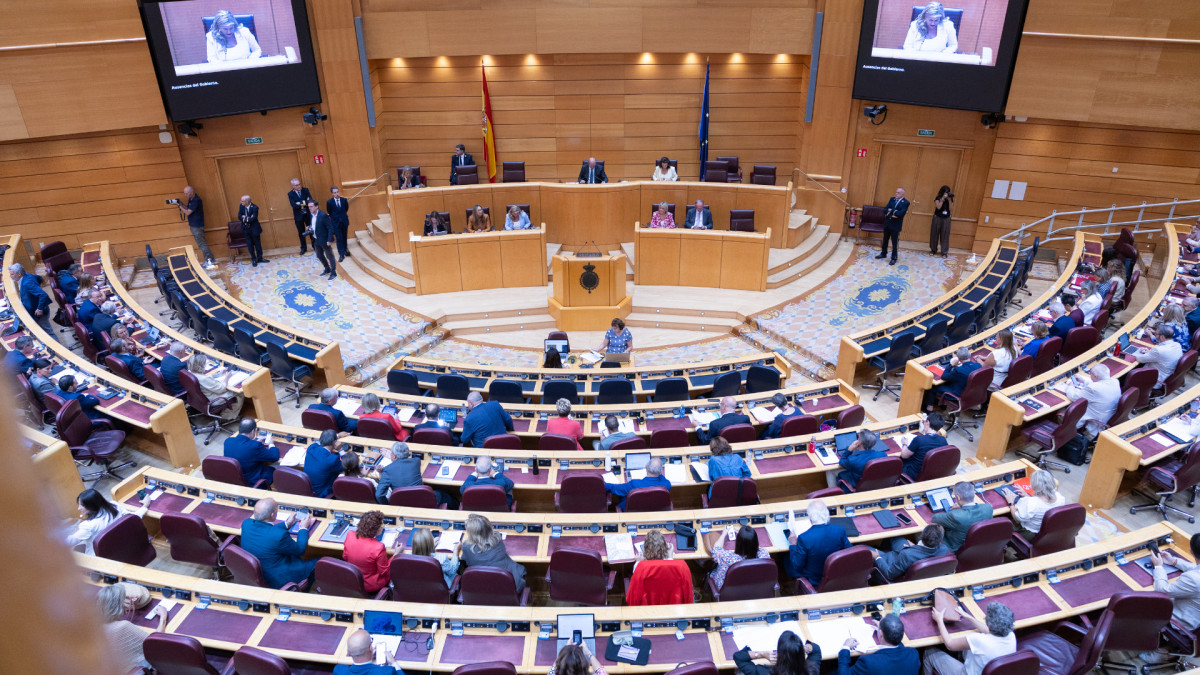
In the Spanish parliamentary system, the Congress of Deputies reflects in most legislatures a plural and progressive majority that has, in recent years, sustained successive coalition governments. The Senate, by contrast, remains entrenched as a stronghold where the Partido Popular wields an suffocating hegemony. Not due to a social majority, but because of the arithmetic of the electoral law. In the current legislature, this gap has reached levels of maximum institutional tension. The Upper Chamber has been transformed into a partisan ramrod for wearing down the Government — through censures, ad hoc commissions, and vetoes to the budgetary track — which distorts its constitutional mandate and has blocked the renewal of constitutional bodies. Ignoring how the electoral law works and the Political Reform Law that inspired it, one could attribute this conservative dominance to a supposed sociological tendency of inland Spain. The empirical reality, however, disproves it: the PP’s absolute majority in the Senate is not the expression of a conservative popular mandate, but the result of a pre-democratic electoral-design tool exploited effectively by the right amid demobilization and fragmentation of the left. The proposal recently launched from civil society by the platform “Senators and Senators for Democracy” places the debate in its proper terms: either progressive forces adopt a technical and tactical electoral coordination in the Senate, or the right will continue to veto constitutional bodies even while it is minority in votes.
The mirage of Conservative Spain
Desmontemos una falacia demasiado repetida: no, Spain is not a country of right-wing electoral majorities. In nearly half a century of democracy and across sixteen general elections, state-wide conservative forces have only achieved an absolute majority in two exceptional instances: in 2000, with José María Aznar at the peak of the pre-euro boom, and in November 2011, with Mariano Rajoy capitalizing on the financial collapse of the economic crisis.
“O las fuerzas progresistas asumen una coordinación electoral técnica y táctica en el Senado, o la derecha conservará el veto sobre los órganos constitucionales aun siendo minoritaria en votos”
In the remaining fourteen elections, the conservative space was unable to reach half plus one of the Congress seats. Moreover, since the fragmentation of the party system in 2015, the right and its difficulty in aligning with nationalist forces have never again held a parliamentary majority in the Lower Chamber. Not even Rajoy’s investiture in 2016 reflected a right-wing mandate, but rather the PSOE’s resignation and a precarious parliamentary survival —with only 137 PP seats— doomed to legislative paralysis and closed off by the 2018 motion of censure.
So why does the Partido Popular today display an absolute majority of 120 elected senators out of 208? Because of the unequal impact of the electoral system:
| Political bloc (23-J elections) | % of the Lower House popular vote | % of directly obtained senators | Senate seats won |
|---|---|---|---|
| PP | 33.05% | 57.7% | 120 |
| Progressive bloc PSOE, Sumar and allies |
31.70% 12.39% |
35.1% | 72 +1 = 73 |
In the 23-J elections, in the Lower House — which reflects the most proportional vote — the PP achieved 33% of the votes, the PSOE 31.7%, and Sumar 12.39% (progressives total 44%). By contrast, in the Senate the PP obtained 120 senators, while the PSOE and Sumar obtained 73 and Vox 0. The PP, with 33% of the vote, captured almost two out of every three senators. This enormous representational anomaly has a concrete institutional origin.
The engineering of the lock in the Senate: the origin of the LOREG
The Senate’s election system was born in the pre-constitutional laboratory of the Transition, far from the decentralizing spirit of the 1978 Constitution. Law 1/1977 for Political Reform — conceived by Torcuato Fernández-Miranda under Adolfo Suárez’s mandate — had a clear objective: to build a second chamber that would function as a conservative buffer against transformative majorities arising from the people’s mandate in the Congress of Deputies. It was also intended to accommodate, without stridency, some pre-constitutional politicians in a chamber without political initiative. And it served that purpose.
To safeguard that lock three barriers were erected:
- A uniform provincial allocation granting four senators to each province, regardless of its demographic size, structurally overrepresenting rural and interior votes relative to large cities and urban centers.
- The direct appointment by the king of up to a fifth of the senators during the constitutional process (now these are regional designations).
- A multi-member majority voting system with restricted vote, far from proportionality.
Explain this last mechanism, which later was fixed in article 166 of the Organic Law of the Electoral Regime (LOREG): it gives each elector three crosses in the peninsular constituencies where four senators are elected. Its operational logic is a steamroller, since the electorate, despite open lists, essentially votes en bloc for the candidates of the same party or coalition. Thus the first provincial force — even if it wins by a marginal lead of a few hundredths of a percentage point — takes 75% of the provincial representation (three senators), leaving a single representative to the second force and marginalizing any other option with 0%.
“The first provincial force — even if it wins by a marginal lead of a few hundredths of a percentage point — takes 75% of the provincial representation”
When the progressive space goes to the polls separately (PSOE on one side, Sumar or other left-leaning formations on the other), it mechanically fragments its mass of votes into a plurality of candidates, handing the first seat to the Partido Popular in constituencies where the combined left-wing social majority is undeniable. This is what tends to happen to the left; it happened to the PP exceptionally in the campaign when Ciudadanos was at its strongest, and the right’s support was fragmented, giving the Senate majority to the PSOE. Once Cs’ votes are absorbed by the PP, the PP again monopolizes two or three of the four senators in each province.
The lever of the judiciary and the false ideological sacrifice
The debate about the Senate has often been clouded by a faulty prejudice: the fear that a confluence would dilute the ideological profiles of the parties involved. However, as Javier Pérez Royo rightly notes, a rigorous analysis of the Senate’s powers in the Constitution proves exactly the opposite.
Under Article 90 of the Spanish Constitution, the Senate operates under an imperfect and asymmetrical bicameral model. All legislative initiative arises, is substantively debated, and is approved in a binding manner in the Congress of Deputies. The Senate only has the power to amend or to veto temporarily, since any modification introduced by the Senate can be reversed and overturned immediately by the Congress by a majority of absolute votes or after two months by a simple majority. In our parliamentary system, neither presidential investiture (Art. 99 CE) nor the motion of censure (Art. 113 CE) passes through the Senate.
Consequently, going to the Senate together does not require agreeing on a common economic, labor, or social program. Legitimate differences between socialists and the space to their left continue to be resolved and voted on with full sovereignty and visibility in the Congress. By contrast, an alliance in the Senate can deprive the right of its obstructive use of the Chamber and activate its exclusive powers.
It is here where the core of the Senate’s real power resides:
- The Senate unshareably appoints four of the twelve magistrates of the Constitutional Court (Article 159.1 CE) by a three-fifths qualified majority.
- The Senate designates ten of the twenty members of the General Council of the Judiciary (Article 122.3 CE), likewise by a three-fifths majority.
A conservative majority in the Senate guarantees a perpetual lock on these bodies, normalizing paralysis and partisan capture of the leadership of the judiciary. In this sense, Ignacio Cosidó’s controversial statements as PP spokesperson in the Senate, announcing that they would control the Supreme Court “through the back door,” were highly debated. Winning back control of the Upper House by a progressive majority would dismantle that institutional hijacking and restore the normal democratic balance.
The mathematics of the turning point: from twenty-three to thirty provinces and forty-five or more senators
The electoral viability of this alliance is not theoretical speculation: it rests on the consolidated data as of July 2023.
“A conservative majority in the Senate guarantees a perpetual lock on these bodies, normalizing the paralysis and the partisan capture of the leadership of the judiciary”
The technical study led by CSIC demographer Juan Antonio Fernández Cordón shows that, although the PP surpassed the PSOE in 38 provinces, the aggregated progressive vote (PSOE + Sumar) beats the PP in between twenty-three and thirty key constituencies: Bizkaia, Menorca, Valencia, Teruel, Asturias, Pontevedra, A Coruña, Huelva, Badajoz, Cáceres, Cádiz, Castellón, Mallorca, Zaragoza, Alicante, Córdoba, Granada, Huesca, Jaén, Guadalajara, Málaga, El Hierro, León, Toledo, Madrid, Cuenca, Burgos, Albacete, Ciudad Real and Valladolid.
| Parliamentary scenario | PP Senators elect | Left-wing Senators elect (PSOE + Sumar) | Direct absolute majority (105 of 208) |
|---|---|---|---|
| Real 23-J scenario (separate lists) | 120 | 73 | PP with absolute majority |
| Projected (unitary progressive list) | 75 | 117 | Coalition with absolute majority |
Reversing the order in these constituencies would directly seize about forty-five senators from the Partido Popular. Consequently, the PP would plummet from its current 120 direct seats to 75, utterly losing its absolute majority. In parallel, the left’s convergences would rise from 73 to 117 directly elected seats, reaching on its own the absolute majority of the people’s chamber (set at 105 seats) and totaling 128 direct seats alongside partners such as ERC, EH Bildu, and the PNV.
The viability of the pact: 100/50 and historical precedents
Negotiations could be very simple since the Senate provides an architecture that simplifies power balances through a 100/50 arrangement.
“The PP would crash from its current 120 direct seats to 75, losing its absolute majority”
By presenting three unitary candidates in each province to consolidate all progressive votes, the alliance would need to agree on 150 strategic candidacies:
- The PSOE would propose 100 candidates (two per constituency in almost all demarcations).
- The left space (Sumar, IU, Podemos, Más Madrid, Compromís, Més, Chunta and allied territorial forces) would designate 50 candidates (one representative in medium constituencies and intensified in metropolitan areas).
All this with the necessary adjustments according to each constituency’s scenario. Moreover, the political forces should be generous and bring in cultural, territorial, and social leaders who in each constituency could mobilize more voters and make the proposal more inclusive.
The result would be an indisputable gain for both sides. The PSOE would move from its 72 seats in 2023 to commanding between 95 and 100 direct seats (an increase of more than 30%), while the space to its left would jump from its current zero to securing between 20 and 35 senators with its own parliamentary group, resources, and institutional presence. The rallying cry for the progressive electorate is very clear: vote for the three people who make up the unitary list, which is facilitated by three-name lists. It’s easy to explain and easy to vote for; it should also be easy to agree upon.
This approach is backed by proven precedents of success. In 1977, the unitary candidacy Senadores para la Democracia (PSOE, PSP, PCE, and independent democrats) won in Madrid against the official UCD. In Catalunya, the Entesa dels Catalans of 1977 swept the right, winning 12 of the 16 direct seats—a pattern effectively repeated across four general elections in a row (2000–2011) through the Entesa Catalana de Progrés. More recently, on 23-J it was shown that where there was coordination, there was victory: the joint candidacy Eivissa i Formentera to the Senate (PSOE, Sumar, Esquerra Unida, and Ara Eivissa) successfully wrested a seat from the Partido Popular.
Rescuing the Senate for territorial politics
Breaking the Senate’s lock is not merely an arithmetic imperative; it is the urgent need to restore the original sense of the Upper Chamber. Having long been transformed into a sterile trench from which the Government could be harassed, dismantling the right-wing majority would allow the Senate to finally assume its pending mandate as a body of representation and territorial deliberation.
“Dismantling the right-wing majority would allow the Senate to finally assume its pending mandate as a body of representation and territorial deliberation”
With balanced dynamics, the Upper House will cease to be a veto machine and will become the ideal institutional space where to address the two major ongoing debates in modern Spain: the modernization of the autonomous state and the solidaristic reform of the autonomous financing model. The civil society has produced a precise diagnosis and a technically sound roadmap; it now falls to the progressive parties to overcome the inertia of tactical sectarianism and act with the audacity demanded by the historical moment.
