
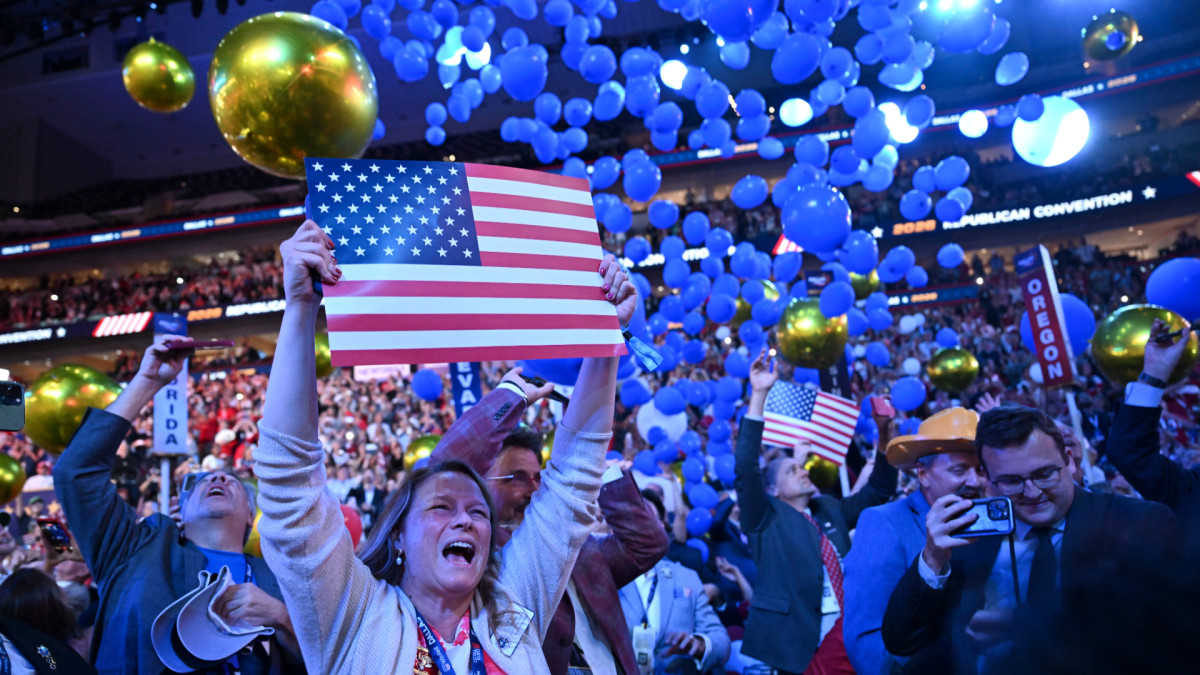
There are wounds that come from outside and scars that are born at home. The former tend to unite those who suffer them: in the face of the enemy, the tribe recognizes itself, tightens, protects. The latter are different. These are caused by someone who speaks your language, who shares your customs, who usually sleeps under the same roof. That is why they hurt and strike harder. That is why they leave deeper marks.
A few weeks before the November elections, the midterms, in the United States, the Republican Party discovers that the man who for a decade was its greatest political asset has now become one of its most visible wounds. Not because Trump stopped being Trump, but because he has continued being so, perhaps for too long.
“The Republican Party discovers that the man who during a decade was its greatest political asset has now become one of its most visible wounds”
As a machine of victories, doctrine and alignment. That is how Trumpism has operated for at least a decade. He won elections, redefined the vocabulary of the American right and has forced traditional Republicans to adapt to a leader capable of turning any scandal into fuel, of transforming any external attack into his own political victory. Each provocation has displaced the previous one; each crisis has opened the way to a new crisis. And, in that frame, the party has had to learn to live with that vertigo. Many of its leaders, who had come to believe that there was no possible future outside that orbit —the Donald Trump orbit, of course—, have now opened space for self-reflection. But the problem of building a house around a single man is that, sooner or later, the entire structure ends up at the mercy of the fragility or strength of that leader’s movements.
That calculation is already beginning to show its limits, its frailties. The war in Iran—and the deterioration of the presidential image as a direct effect of that conflict—, as well as the fatigue accumulated after years of permanent confrontation with other countries and other blocs, have introduced a worry that can no longer be hidden behind the usual incendiary speeches. In other words, they have led Trump down a path where it is impossible to ignore the political bill. And there are structural issues that can no longer bear more makeup: inflation, the housing crisis, the controversial debate about the possibility of universal and public healthcare, in addition to one of the most thorny topics in the country, namely Israel’s involvement (probably the most unpopular country in the world today) in U.S. policy. Today, the question circulating among many Republicans is whether Trump can reinforce—through party unity—his mandate in the November elections. The possible answers to that question are uncomfortable, because one thing is conquering a party and another very different is guaranteeing its survival in power.
“The question circulating among many Republicans is whether Trump can reinforce —through party unity— his mandate in the November elections”
On this phenomenon, the best explainer is Susan B. Glasser, in an article in The New Yorker. In her piece she suggests that Washington has begun paying less attention to Trump’s daily controversies and more to the political cost they have already inflicted on the governing party. And her diagnosis is revealing: Trumpism no longer seems an expansionary force, but a structure governed by the wear-and-tear logic. “This, for me, is the big surprise of 2026: the president may be defeated this autumn, but not by the Democrats, who would crawl over broken glass to defeat him, but by the very voters who brought him back to the White House. Iran, it would seem, is achieving everything that January 6 and the rest of his countless misdeeds could not,” the columnist muses, about a phenomenon that, in the weeks before the November elections, has sent tremors through American conservatism.
It is true that it is quite common that, when a party bets all its capital on a single figure, and that leader weakens, the organization forgets how to walk on its own. And, according to Glasser, the Republicans could be about to find out. And, if so, the most expensive bill of Trumpism would not be a defeat in November, but the late discovery that the most dangerous, the most painful divisions are never those that come from outside, but those that open up from within the party itself.
A Week That Was Snatched Away and Is Already Taking Its Toll on Trump’s Popularity
Glasser begins her piece with an intriguing exercise for readers: she invites us to listen to Donald Trump’s recent address to the United Nations General Assembly as if it were the first time one is hearing the president who still presents himself as the world’s mightiest power.
“The most expensive bill of Trumpism would not be, in any case, a November electoral defeat, but the tardy discovery of the most dangerous divisions”
As one might expect, the author argues that you could scarcely imagine it being an “boring,” “indifferent” or “less incendiary” speech than last year (if you hadn’t followed the instruction to listen as if for the first time). To sum up, among the many “bombs” Trump dropped, there were items such as the annihilation of the Islamic Republic of Iran, the necessary cession of Venezuela’s rights to exploit its oil resources for the United States (a discreet way to call for the appropriation of another country’s oil wealth) or renaming artificial intelligence as “superintelligence.”
But beyond whether the MAGA leader’s speech was boring or entertaining, what the author notes is that it closed a furious week in which his popularity fell at a moment in the electoral cycle when no one in his position can afford such political luxuries. A week, by the way, that began with Oval Office censorship of three major media outlets: CNN, MSNBC and POLITICO. That move, deemed a serious audacity by much of society and by voices within the Republican Party, had not been attempted by any of his predecessors. Despite that risky political move, a federal judge blocked the measure almost immediately, as Glasser notes, arguing that it does not comply with “any procedures consistent with the Constitution.”
But beyond the author’s opinion, when it comes to popularity, the best is to look at the numbers, which, as is well known, do not bode well at all for the American president, nor for his party, nor for his potential claim to the presidency in November. According to the data-analysis site RealClear Politics, Trump’s popularity sits in deeply unfavorable territory. For example, Reuters/Ipsos reports only 37% approval and 62% disapproval. CNN’s numbers are the same. Rasmussen Reports or Big Data Poll place his approval around 40%, but disapproval hovers around 55%. And for the rest of the polling outfits, the differential is essentially the same.
“Closed a furious week in which his popularity fell at a moment when no one in his position can afford such political luxuries”
Now then, taking into account those numbers and the political, economic and social phenomena described above, what can we expect for November? For Cook Political Report, one of the most influential electoral analysis publications in the United States, it is clear: “The Republicans are on track to lose their majority in the House of Representatives.” The same outlet notes that fifteen competitive districts are already headed toward a Democrat-dominated election. Nevertheless, the forecasts for the Senate are more favorable to the Republicans.
But, if elections were held today, Donald Trump would arrive at them as one of the most unpopular presidents in modern United States history. As we have seen before, his approval rarely climbs above 35% in many polling outfits.
What is clear is that the current Trump Administration bears little resemblance to the one that first occupied the White House between 2016 and 2020. Surprisingly, the first version of Trump as president appears, even, prudent and measured compared with the one who returned to power in 2024. As we have already argued in various analyses and coverage in Agenda Pública, since the international political eruption triggered by the release of the Epstein papers, Donald Trump’s arrogant reactions have been increasingly escalating. And, as we have also said, the Iran war is costing him far more than he imagined, to such an extent that today it is one of the main reasons for his constant disapproval at a crucial political moment like the final stretch toward the midterms.
What Parallels Does This Phenomenon Have in Other Parts of the World?
While Donald Trump is an undeniable leader, given his countless controversies and his populism that does not respect forums or circumstances, his modus operandi is not unique.
“The Iran war is costing him far more than he imagined, to the point that today it is one of the main reasons for his constant disapproval”
In Europe and in the Americas there are also allies, or leaders, who even imitate him. On the latter, the most extreme cases would be Javier Milei in Argentina, or Abelardo de la Espriella in Colombia. Trump is not alone, or rather, the United States is arriving late to a disease that Europe has been incubating for years. For more than a decade, a portion of the Western electorate has accepted leaders who promise to demolish institutions, discredit the “uncomfortable” media, oversimplify impossible problems, and offer strong identities to increasingly insecure societies.
That, at times, has worked. It worked in Viktor Orbán’s Hungary, in Matteo Salvini’s Italy (and later in Giorgia Meloni’s). It also worked in the part of France that believes in Le Pen’s family discourse. And yes, it has worked because the promise has been seductive: to return to each nation (a concept extremely strong in Europe) the imagined version of itself. But identity promises have an elementary problem: once power is won, the moment comes to govern, i.e., to fulfill what was promised. However, governing is something far less epic than the perpetual cultural battle. It consists precisely in addressing structural and inescapable issues such as inflation, wages, waiting lists in hospitals and schools, the price of energy, security or natural or health emergencies, etc. Because, after all, voters can forgive almost any rhetorical excess: what they never forgive is the sense of living worse than before. Put bluntly, contemporary politics is full of leaders who discovered (too late) that winning an election (or a rhetorical and cultural war) does not guarantee a full fridge. And this has also happened in the United States.
“Voters can forgive almost any rhetorical excess: what they never forgive is the sense of living worse than before”
Perhaps that is why Donald Trump’s problems look less like an exception in the country that has always promised liberty and abundance and more like a shared Western experience. The novelty in the American case is no longer the populist surge; the novelty is its wear. And the paradox is always the same: when leaders stop being opposition and become part of the system (which they once criticized and denounced) they face reality, a reality so harsh that no one seems able to resolve it. Not even in the United States. Then they begin to receive the same uncomfortable questions they directed at their opponents. And in the end, the numbers do not lie and the final verdict is decided at the polls. November is near.
