
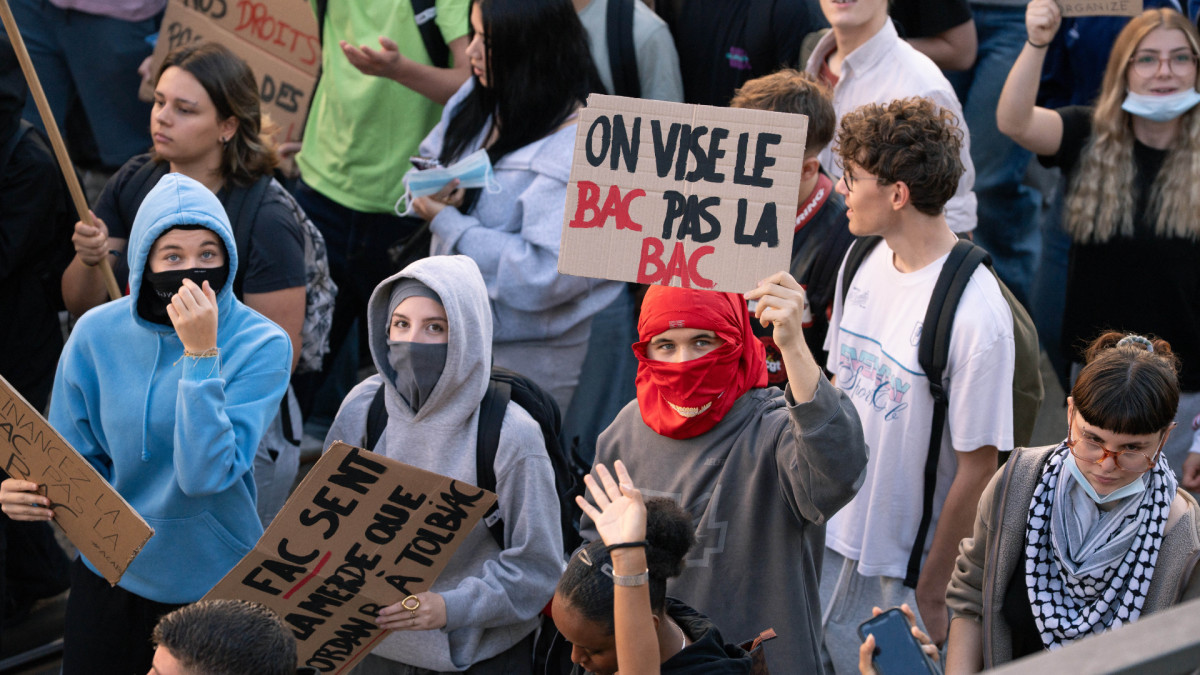
It is always risky to react in the heat of the moment to events like those currently unfolding in high schools. On one hand, there is not enough distance to analyze the situation calmly. On the other, political passions rapidly seize such matters and complicate both the understanding of the facts and their interpretation. It is therefore wise to proceed with great caution.
Still, some preliminary features can be highlighted. When they speak up, the students taking part in the blockades mainly mention material problems or issues related to their study conditions: inadequate or non-existent equipment, deteriorating facilities, absence or shortage of teachers, and overloaded schedules.
Is upper secondary education so under-resourced, especially in comparison with our European neighbors? At first glance and in broad terms, the answer seems more negative than positive. France allocates 1% of GDP to this educational stage, a figure higher than the European average, which stood at 0.91% in 2023. The student-to-teacher ratio is eleven to one in France, in line with the European Union average and below the United Kingdom, with thirteen, or Germany, with twelve.
This figure, which merely relates the total number of pupils to the number of teachers, should not be confused with the number of students who have a teacher in front of them in class, since the latter also depends on teaching hours. OECD data do not allow this indicator to be calculated comparably for the whole of Europe. However, there are data from the DEPP — the Directorate for Evaluation, Forecasting and Performance of the Ministry of National Education — available only for France: they place the number of pupils per teacher at 23.9 in general-education high schools and 15.3 in vocational training centers.
These figures are obviously averages, and the situation can vary greatly from school to school. The condition of the buildings can also be very uneven and exert a strong influence on the atmosphere inside them. Even so, it seems unlikely that this crisis originates solely from a lack of resources and material conditions. What other explanations might be explored?
“It seems unlikely that this crisis originates solely from the lack of resources and the material conditions”
Some commentators and political leaders have pointed to the role of La France Insoumise (LFI). There is little doubt that LFI has fanned the flames and perhaps lit the fuse in Seine-Saint-Denis. Its own members, moreover, do not hide it. The party finds fertile ground for this, because young people are by far the most receptive age group to its proposals. These are people somewhat older than high school students, but 41% of 18- to 24-year-olds who say they will vote in the upcoming presidential elections would choose Jean-Luc Mélenchon, compared with 8% among those over 50, according to Ipsos’s French Electoral Survey 2026.
However, the spread of the movement across the country makes it hard to think that it is solely the product of political instrumentalization. The embers were already there, though some may be fanned for political opportunism.
One notable aspect is the normalization of violence. Blocking a high school constitutes a violent act in itself, since it allows a group that may be in the minority to prevent other students from attending class and teachers from teaching. This form of violence has become normalized. A significant minority of young people — 22%, according to the 2021 study A Plural Youth — justify resorting to violence to “protest, express their anger, or defend their ideas.”
In this crisis, violence is taking on especially striking forms, with the almost systematic burning of containers, pallets, and other objects at the doors of schools, creating a risk of fires, as has actually occurred in some cases. We have also witnessed attacks on journalists who are perceived as hostile to the movement.
It is paradoxical that the schools themselves deteriorate at the same time that students complain precisely about their material conditions. This, at any rate, shows that those who carry out these acts do not feel the affection for their institute that one would expect toward a temple of knowledge that must be preserved. At best they are bored there; at worst, they detest it.
“Those who spearhead these acts do not feel the affection for their school that one would expect toward a temple of knowledge that must be preserved”
This crisis may be revealing the distance that has opened up between youth culture and school culture, between screen culture and the culture of books. How can this gap be closed? One proposed measure has been to ban mobile phones in high schools. One student I spoke with near a blocked school expressed opposition to this measure, viewing it as an intolerable restriction of her freedom.
Another explanation worth exploring is the effects on anxiety caused by the extension of schooling. As more young people continue studying, academic competition intensifies and, perhaps, the fear of falling behind or leaving the system also grows. Parcoursup concentrates much of those fears. This system makes tangible an academic competition that can be ruthless, subjected to the cold verdict of an algorithm, and it generates a great deal of stress among young people.
In the Montaigne Institute’s 2024 study on youth and work, 77% of the young respondents reported feeling this stress and 21% supported abolishing Parcoursup. Do students receive sufficient support during a process that resembles an obstacle course? It will be necessary, among other things, to evaluate the reform of vocational training and programs, such as AvenirPro, designed to help students prepare for entry into the labor market.
“This system makes tangible an academic competition that can be unforgiving, subjected to the cold verdict of an algorithm, and generates a great deal of stress among young people”
More broadly, one may ask whether the French educational system is adapted, in its structures and organization, to this new context of extended schooling and the growing diversity of secondary school students. This crisis shows that very different demands are now expressed in a way that can become violent, as if they had not previously been able to be voiced or heard through normal, non-conflictual channels.
The minister’s initiative to open a platform for secondary students to voice their complaints seems rather insufficient. What would the ministry do with them? Should these concerns not be raised and resolved within the school itself?
But do French high schools have the capacity to listen to those demands, respond when they arise, and take action to correct operational problems, for example in class organization or in adapting educational programs? The heavily centralized and uniform structure of the French education system and the limited powers available to school principals lead to a negative answer.
This crisis thus reveals a broader problem: the lack of autonomy of educational centers.
© Telos, 2026.
