
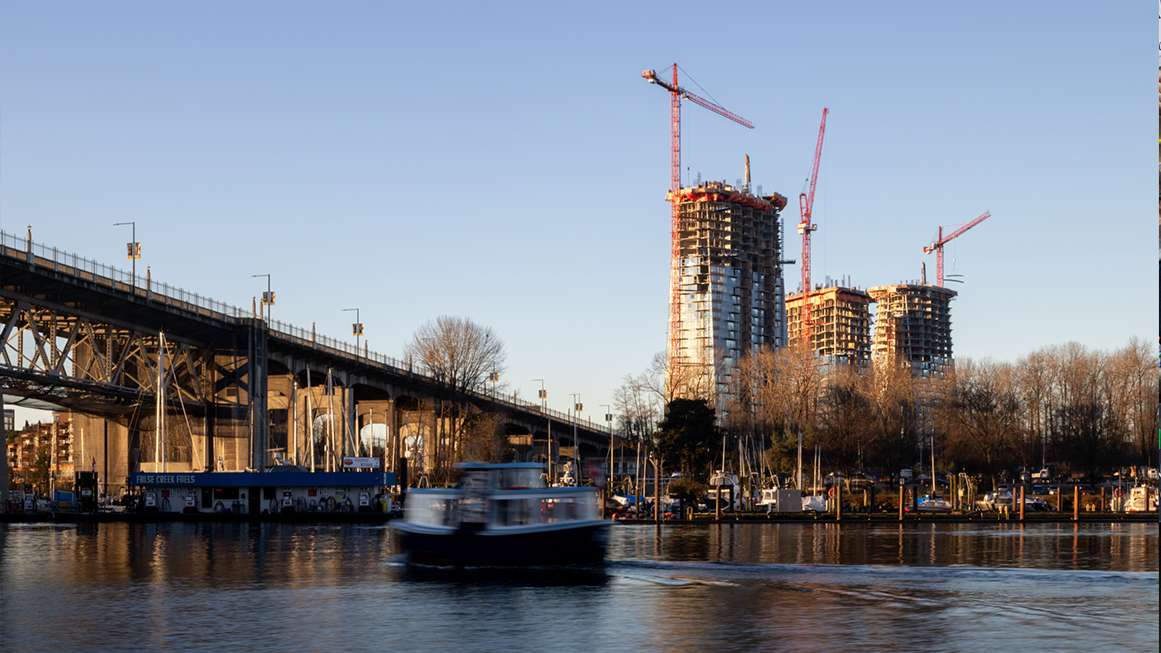
Free from Vancouver’s zoning restrictions, the Squamish Nation advances a 6,000-unit residential high-rise
It’s easy to fall into pessimism about whether zoning reform can fix America’s housing crisis. Time after time, headlines proclaim sweeping zoning changes that eventually prove ineffective.
For those craving a deregulation dose that actually works, a counterexample can be found in the First Nations housing projects sprouting around Vancouver, Canada.
In Vancouver itself, development is constrained by the usual tangle of zoning rules and urban-growth controls. That constraint does not apply to a 10-acre tract of land that used to house a rail yard but is now owned by the Squamish Nation. In 2002, a Canadian court ruled that the government must return part of land it had seized from the nation a century earlier. The transfer released Squamish land from the labyrinth of land-use regulations that restrict housing growth in the rest of the metropolitan area.
In 2019, Squamish Nation voters exercised their newfound freedom to build by approving, via a referendum, a 6,000-unit residential high-rise project known as Senakw. It stands as one of several First Nation housing developments taking shape in the exceptionally expensive Metro Vancouver region.
The project did not pass without controversy. Many homeowners living in the low-rise neighborhoods of Vancouver near the Senakw site resented density levels approaching those of Hong Kong in their backyards. Local elected officials criticized the development as little more than a vendetta by Indigenous communities.
Nevertheless, the Squamish Nation’s sovereignty over its own land deprived these complaints of legal effect. The best recourse available to homeowners was to petition the then-Queen to intervene; she declined.
The first residents began moving into Senakw this May. Across the broader Vancouver region and other parts of Canada, more First Nations are leveraging their freedom from land-use rules to bring new housing projects online.
In addition to the exclusively Squamish Senakw, MST Development Corporation—jointly owned by the Musqueam Indian Band, the Squamish Nation, and the Tsleil-Waututh Nation—is actively pursuing six separate developments across a 160-acre site.
Vancouver’s First Nation housing initiatives offer something for every political orientation. Leftists can celebrate communities transforming collectively owned land into social housing with dedicated units for low-income residents. Greens can appreciate the project’s minimal parking provisions. Libertarians can point out that this carbon-conscious, socialized housing model was enabled by bold deregulation and private, profit-seeking investors.
Senakw, like all corporations, sits as an island of centralized planning amid a sea of free markets. Though driven by a small nation-state, the project relies on private capital from investors who expect to profit from the rents the new units will command.
The only people who still seem unhappy are the NIMBYs.
