
True to its original mandate, NATO remains focused on its eastern flank as Russia’s invasion of Ukraine has persisted at the Alliance’s doorstep for more than four years. The conflict has not only reshaped NATO’s political priorities but has also pushed collective defence back to the forefront as its core aim in the 2022 Strategic Concept after decades spent dealing with crises outside the Euro-Atlantic area. It has also directly affected the security of Allied territory: numerous airspace incursions and other forms of hybrid aggression have occurred within NATO territory since the war began.
Last week, Moscow again threatened NATO with direct nuclear confrontation, this time over unproven claims that Kaliningrad could be blockaded, following routine Allied drills in the Baltic region near the Russian exclave that were not aimed at it. This geographic focus is reinforced by multiple assessments warning of a possible Russian attack on a country on NATO’s eastern flank before 2030. Nevertheless, NATO’s 360-degree approach makes clear that its deterrence responsibilities extend across all the areas it is legally bound to defend.
“NATO’s 360-degree approach makes clear that its deterrence responsibilities extend across all the areas it is legally bound to defend”
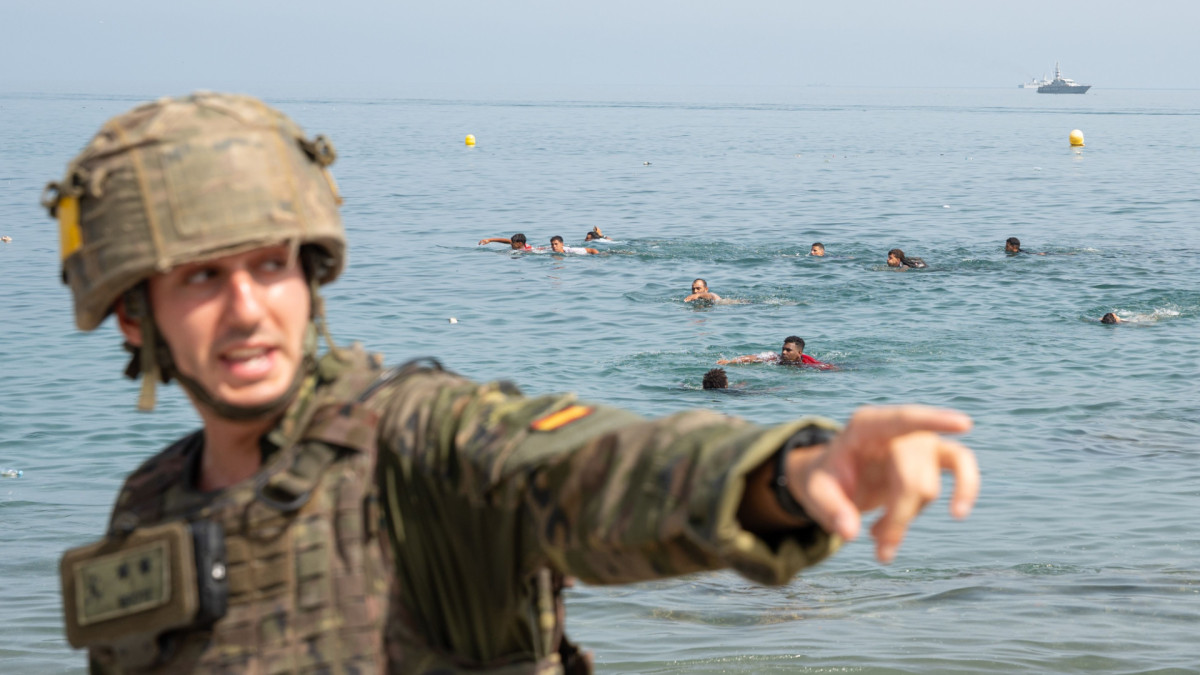
By coincidence, on 30 July 2026, the very day Poland faced yet another Russian missile incursion into Allied territory, an equally grave incident unfolded in one of NATO’s southern member states: the Spanish autonomous city of Ceuta was overwhelmed by roughly 80,000 people crossing irregularly from Morocco. The incident triggered one of Spain’s most serious political crises of the past decade and raised questions about the security arrangements protecting Ceuta on the North African coast.
The Alliance’s most explicit response came from Javier Colomina, the NATO Secretary General’s Special Representative for the Southern Neighbourhood, during a security dialogue in Madrid. Colomina declined to comment in detail on an Ally’s domestic affairs unless Spain first chose to bring the crisis before the North Atlantic Council (NAC). Nevertheless, he acknowledged the “reality” of the weaponisation of irregular migration as a form of hybrid warfare and said, speaking in a personal capacity, that he had “no doubt” NATO would respond if Spain decided to invoke Article 5 following an attack on Ceuta or Melilla.
First, it is important to remember that coordinating and managing migration and humanitarian crises is not NATO’s primary purpose. Regardless of the scale of the crisis or its consequences, requesting NATO’s assistance or classifying the incident as an “armed attack” would not be the most obvious institutional responses. However, Spanish prime minister Pedro Sánchez described the events as a “violation of Spain’s territorial integrity”, which is one of the grounds for convening consultations among Allies under Article 4 of the North Atlantic Treaty.
“Coordinating and managing migration and humanitarian crises is not NATO’s primary purpose”
Indeed, NATO has addressed episodes of mass border crossings in the past: in November 2021, the NAC publicly condemned Belarus’s weaponisation of migration flows against the Alliance’s eastern borders. The difference between NATO’s responses to the two crises reflects political caution in the absence of an official attribution of responsibility, rather than a split between the eastern and southern flanks. While Poland, Latvia and Lithuania accused Lukashenko’s regime of instrumentalising migrants, the Spanish government has repeatedly declined to attribute the planning or execution of the Ceuta crossings to Moroccan authorities, arguing that it lacks concrete evidence to support such a conclusion.
This is despite a Spanish National Police report pointing to the involvement of the Moroccan Gendarmerie in directing large groups toward the border between Morocco and Ceuta (Pedro Sánchez confirmed in the Congress of Deputies on 3 September that the Royal Moroccan Gendarmerie had temporarily allowed the border crossings). The European People’s Party (EPP), the largest political group in the European Parliament, also issued a statement asserting that “Moroccan authorities are responsible, whether by action or omission, as the invasion came from its territory”. Nevertheless, without the Spanish government’s official attribution of responsibility to a specific actor, NATO has little room to intervene.
Second, from a legal standpoint, despite being part of Spain and therefore of the European Union (EU), Ceuta falls outside the geographical area of responsibility of NATO’s Supreme Allied Commander Europe (SACEUR). Article 6 of the North Atlantic Treaty establishes that the geographical scope of armed attacks capable of triggering a collective response under Article 5 includes, among other cases, attacks on “the territory of any of the Parties in Europe or North America […] or on the islands under the jurisdiction of any of the Parties in the North Atlantic area north of the Tropic of Cancer”. This explains why the Canary Islands are considered NATO territory, while French Guiana technically does not.
“Without the Spanish government’s official attribution of responsibility to a specific actor, NATO has little room to intervene”
Consequently, the Spanish cities of Ceuta and Melilla, located on the African continent, are not technically covered by NATO’s protective umbrella. Since Spain was not a founding member of the Alliance in 1949, it was not possible to secure the explicit inclusion of these two Spanish coastal enclaves within the territorial scope of Article 6, as France did with its former Algerian departments (a provision subsequently removed by the NAC in 1963 following Algerian independence). It is worth noting that, when asked to clarify the Alliance’s position on Ceuta and Melilla during the Madrid Summit, former secretary general Jens Stoltenberg stated that “NATO is there to protect all Allies against any threats”.
Officially extending NATO protection to Ceuta and Melilla would require either an amendment to the North Atlantic Treaty or a political agreement among all 32 Allies. Given Rabat’s special relationship with Washington, Paris and the current Madrid government, this appears unlikely. Even so, there are two main reasons why NATO might signal its official support for the territorial integrity, security and stability of Ceuta and Melilla.
Strengthening NATO’s European dimension
After decades of excessive reliance on US security guarantees, Europe is taking greater responsibility for its own defence. This rebalancing of responsibilities within the transatlantic relationship has taken shape financially through the 2025 Hague Summit Declaration, which raised Allies’ defence and security spending commitments to 5% of GDP by 2035, and militarily through “NATO 3.0”, the US Department of War’s review of its military presence in Europe. This shift means that Europe must step up and ultimately take the lead within NATO.
“After decades of excessive reliance on US security guarantees, Europe is taking greater responsibility for its own defence”
According to NATO secretary general Mark Rutte, “to stay transatlantic, NATO is becoming more European”, a trend already apparent in the institutional ties between NATO and the EU. For the first time in history, US general Alexus Grynkewich, NATO’s SACEUR, addressed the European Parliament’s Committee on Security and Defence last week, marking a milestone in EU-NATO relations. This closer cooperation has also extended to joint efforts to counter Russian hybrid threats, including an attempted drone attack at Leipzig Airport, which prompted a meeting between Rutte and European Commission president Ursula von der Leyen.
During the 2026 State of the Union address (SOTEU), President von der Leyen expressed the EU’s full solidarity with the people of Ceuta and reaffirmed the autonomous city’s Spanish and European identity. The following day, the European Parliament adopted a resolution condemning “the instrumentalisation of irregular migration as a tool of hybrid warfare”. As with the crisis on the EU’s eastern border in 2021, it has become clear that part of the solution to the situation in Ceuta must, and will, come from Brussels.
The assessment offered by NATO’s Special Representative for the Southern Neighbourhood does not differ significantly from that of the European Parliament. And if NATO is indeed becoming more European, it has a vital strategic interest in strengthening EU unity and protecting the external borders of territories belonging to both organisations, including Ceuta and Melilla.
“If NATO is indeed becoming more European, it has a vital strategic interest in strengthening EU unity and protecting the external borders”
The political fallout from the responses of some European countries to the Ceuta crisis has led to accusations of a lack of European solidarity and reopened longstanding north-south divisions over how the EU handles migration crises. Such divisions only embolden the Alliance’s adversaries and undermine the unity needed to bolster Europe’s defence industry and bring transatlantic defence markets closer together.
In an increasingly complex geopolitical environment, NATO must address all threats to its Allies, regardless of who is responsible or where they occur. If such a small city can become such a major obstacle to European cohesion, the future of Ceuta and Melilla should matter to an increasingly European NATO.
Rekindling NATO’s defence ties with Spain
Spain’s accession to NATO has a complicated history. Spain officially joined the Alliance in 1982, the same year that the Spanish Socialist Workers’ Party (PSOE), which had initially opposed membership under the slogan “No to NATO, military bases out”, won the general election. Once in power, prime minister Felipe González changed his position, coming to regard Spain’s continued membership as a strategic necessity, but honoured his promise to allow the Spanish public a say through a referendum. In 1986, under the banner “In Spain’s interest, vote yes”, 56.85% of voters backed the government’s decision to remain in the Euro-Atlantic Alliance, much to the disappointment of the numerous anti-NATO political and social organisations that had arisen at the time.
Despite having proven itself a loyal and reliable Ally, and despite the fact that 85% of Spaniards support remaining in NATO, the legacy of this history continues to shape the present, particularly in the debate over defence spending. Since Sánchez challenged the 5% target and capped Spain’s defence investment at 2.1% of GDP, Pedro Sánchez and Mark Rutte have found themselves in an agreed disagreement over whether Spain can meet its capability targets with fewer financial resources.
Spain’s relationship with NATO has also been strained by disagreements between Pedro Sánchez and Donald Trump over Spanish defence investment and the Spanish government’s decision not to authorise the use of Spanish military bases at Rota and Morón in support of US operations against Iran. Both bases host significant numbers of US military personnel and assets. Taken together, these developments have created friction between NATO’s leadership and the Spanish government.
With Spain now facing a serious security challenge, the Ceuta crisis could offer an opportunity to rekindle NATO-Spain relations. Expressing solidarity with Ceuta in the face of threats to its sovereignty and territorial integrity could strengthen public confidence in the Alliance in Spain, where 55% of people regard Morocco as the country’s greatest external threat, by addressing one of the public’s most pressing security concerns.
“With Spain now facing a serious security challenge, the Ceuta crisis could offer an opportunity to rekindle NATO-Spain relations”
The same reasoning could apply to the Spanish government, which would see the Alliance as more committed to defending Spain’s national security interests. Spain has previously welcomed NATO’s efforts to pay greater attention to threats originating on the Alliance’s southern flank. At the 2024 Washington Summit, Pedro Sánchez welcomed the adoption of NATO’s first Southern Neighbourhood Action Plan, stressing that jointly addressing challenges from the south, whether related to terrorism, disinformation campaigns or climate change, is of major strategic importance to Spain.
Spain is an essential NATO member because of its participation in some of the Alliance’s most important initiatives and its cultural and political ties, which connect Europe and North America, as well as Ibero-America and North Africa. The key to mending NATO-Spain relations may lie in the Alliance’s recognition of Spain’s legitimate security interests in Ceuta and Melilla. This, in turn, could help steer the debate over defence spending in Spain in a more constructive direction.
