
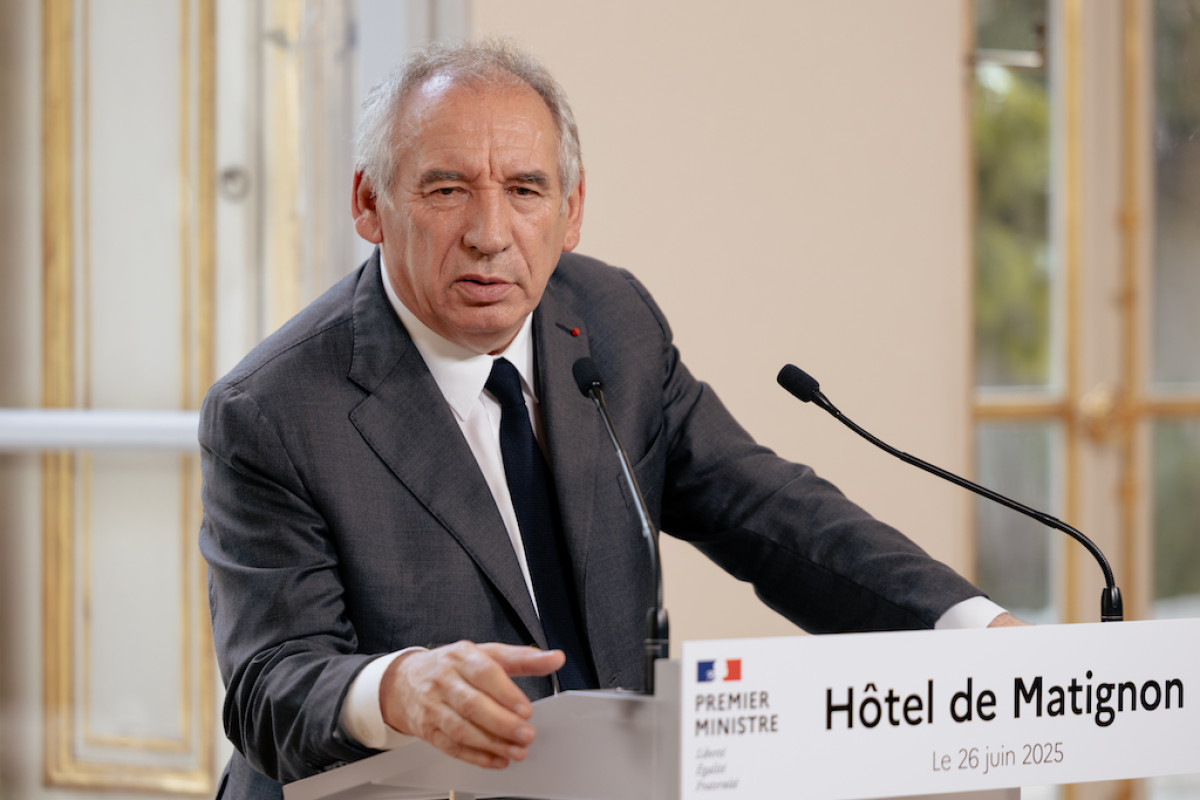
The new fiscal adjustment plan presented by the Bayrou government on July 15 did not catch anyone by surprise, except perhaps a few who were a touch distracted. It represents yet another effort to implement a roadmap to ease the growing public deficit and reduce the debt, in order to meet the 3% objective and approach 60%, as well as to begin the course laid out by the country-specific recommendations established by the European Commission. A titanic task, given that the deficit currently sits around 5.5% of GDP and that the plan contemplates lowering it to at least 4.6% in 2026, and to reach 2.8% in 2029; figures that seem hard to credit given the circumstances facing the French nation.
“The Government is aware of the severe revenue problem facing the French Treasury, which calls for reforms of real substance”
During the current fiscal year there were some concessions to the political parties that supported the 2025 budgets, such as revising the pension reform of the previous Cabinet or the commitment to seek broad consensus in the Assembly when drafting laws that would directly affect the population’s standards of living. However, the plans for 2026 are different, for two reasons that are not necessarily exclusive. On one hand, the Government is aware of the grave revenue problem facing the French Treasury, which requires deep reforms. On the other hand, the aim is to send a striking message to the population. In other words, the Government, by anticipating a frontal parliamentary rejection that is expected to be confirmed during the confidence motion on September 8, lays the groundwork for the message that hard adjustments are necessary to take root in the medium term, arguing that the delicate fiscal situation would end up compromising economic growth and job creation. In this way, similar to what Naomi Klein described in The Shock Doctrine, the Government takes advantage of a moment of political crisis, polarization, and loss of credibility in institutions to implement measures that otherwise could not even be contemplated.
But how difficult is France’s situation? In reality, it is an economy highly resilient to potential shocks, largely thanks to the dynamism of its strong domestic industry. Companies such as Saint-Gobain, Schneider Electric, Dassault Systèmes, or Airbus, supported and pampered for decades by the all-powerful French state, are genuine global benchmarks in innovation and productivity in their respective sectors. Moreover, it has a private banking system (historically known as Haute Banque) of notable international influence, which has supplied credit and liquidity at crucial moments. Added to this is an extremely advanced network of transport and interconnections that not only covers French territory but also operates beyond its borders. In energy terms, and despite recent criticisms of nuclear power, France has managed to maintain a stable and competitive supply for its industrial fabric precisely thanks to the use of that source. In fact, both the private and public sectors are investing large sums in optimization, as demonstrated by the France 2030 plan and the development plan for microreactor systems. This plan not only seeks to decarbonize the national industry in the long term but also to guarantee the supply of electricity and heat to cities in a completely autonomous manner. Added to this are the notable advances in research into hydrogen as an alternative to both conventional renewable energies and fossil fuels.
“It is, in short, a leading economy in sectors such as the chemical industry, transport, energy, or telecommunications”
So it comes as no surprise that the country has unemployment below 8% or that the State has managed to keep inflationary pressures in 2022 at bay without too much difficulty — though it is also true that the cost of living tends to be high relative to median wages. Therefore, it is not surprising that in European debates Paris consistently favors strategic autonomy that promotes self-sufficiency at the European level, reducing dependencies to a minimum and prioritizing dealings with European producers above all. It is, in short, a leading economy in sectors such as the chemical industry, transport, energy, or telecommunications, among others. Now, this requires certain nuances that would merit a more detailed analysis, such as the fact that the late-20th-century industrial reconversion further concentrated production in Paris and its vicinity, leaving many former working-class areas completely demobilized and depressed, which has provided a perfect breeding ground for the rise of the Rassemblement National (RN) in recent years.
So, why such persistence in reducing the deficit if the economy is capable of absorbing future shocks? One of the major arguments advanced by the Government is that the deficit is only an indicator, important to a degree, but that the real problem lies in the rising Debt-to-GDP ratio, which has only increased since 2008, as the following chart shows:
Paradoxically, the debt has risen and exceeded the 60% threshold coinciding with governments that have openly pursued austerity and the control of social spending — Sarkozy, Hollande, and Macron, whereas in the 1980s it remained at relatively low levels, during the height of Mitterrand’s dirigisme or Chirac’s inertia in the following decade. In the absence of reforms, debt is expected to climb to around 119% in two years. We must then question why it matters so much that this indicator falls. First, it is difficult for the debt level to decrease if the mechanisms that push up the deficit are not corrected, i.e., if spending continues to exceed revenues, the debt will only rise.
However, is this really a problem? Countries like the United States or China have debt levels near 120% and 100% respectively, and they do not experience major difficulties financing themselves in international markets or undertaking projects that require public funds. The EU, which since Maastricht openly embraced a German ordoliberalism imposed on the rest of the European economies without accounting for the immense heterogeneity of the union, aims to return to the 60% path, something impossible in a context of rearmament and protectionist reindustrialization. This is, and not something else, the key to it all.
France needs liquidity to continue investing to dynamize its own industry, as well as to—once accounts are settled—create a defense framework that is autonomous and not dependent on the United States or third parties, and to turn the French nation into the true military power of the EU. These kinds of actions require large public investments and a wide margin of maneuver regardless of the cost, something France currently lacks. This, together with the fact that the French economy has been seriously harmed by external events such as Covid-19 or the increase in geopolitical tensions following the Ukraine war, has led the Government to declare war on massive debt and to advocate for manifest austerity, contrary to what the country has done in the last eighty years.
“The aim is to save about 40 billion euros through cuts in the most significant social expenditures”
The potential reforms proposed by Prime Minister François Bayrou can be described, generous as one might be given the idiosyncrasies of the French working class, as “generous.” The plan intends to save around 40 billion euros by cutting the most significant social allocations: elimination of about 3,000 public jobs, not replacing a third of retiring civil servants, freezing pensions for the next year, increasing co-payments for medicines, privatization of public productive tissue, loosening of job protections, and the conspicuous elimination of two public holidays. Bayrou has also yielded to pressures from the presidency and proposes increasing defense spending, but has insisted that the budgets have nothing to do with the new direction promoted by Macron in this area, rather that it is about moving quickly and, as he said in April, “making joint efforts” to avoid the country’s collapse.
If we accept the first thesis as true, namely that the Government fears the fiscal situation is unsustainable and could affect long-term economic growth, it is a highly risky move. Assuming the very unlikely scenario that it survives the confidence vote on September 8, parliamentary support for this package of reforms will be minimal, counting only on the favorable vote—in principle—of Macron’s party and perhaps Les Républicains. However, the latter, who advocate tougher action against tax fraud and irregular immigration, prioritizing national workers, may withdraw their support for Bayrou if they believe aligning with him reduces their electoral options. If, on the other hand, we consider the second option probable and Bayrou sees passing a budget as impossible under the circumstances, it would not be far-fetched to think that his Government has decided to send a clear message about the state of the national accounts to force a more than likely parliamentary rejection and leave part of the work to a hypothetical incoming Government. It should be noted that François Bayrou was appointed prime minister with the aim of building bridges in an extremely polarized Assembly where the left — now divided — holds a relative majority, but governs a center-right minority backed by the far-right RN, who effectively control what can or cannot be approved in parliamentary settings. It is, therefore, a Government with a very limited room for maneuver, as the accompanying image shows.
In this case, and faced with a frontal rejection by the Assembly, it is not surprising that the prime minister would seek a repeat election if he is not allowed to conduct his work normally. And they will not allow him. Up to now, RN’s far-right had chosen not to vote in favor of motions of no confidence proposed from the left. However, since the Government itself will undergo parliamentary confidence, it is very likely that, as they have announced, they will vote against him, unless in the September 1 meeting between Bayrou and Bardella some kind of commitment is reached that gives the prime minister a breathing space. Because, realistically, do the Socialist Party or the Rassemblement National really want to back something that triggers broad social backlash and risk losing ground in the 2027 presidential race? Are such restrictive budgets logical in an economy characterized by high dynamism and productivity?
The French society, which in many respects can be classified as ideologically conservative, shows low tolerance for rising social inequalities and a clear opposition to advancing the interests of the most privileged and powerful segments of society at any price. Precisely in this direction the new budgets point: they target the welfare of the most disadvantaged classes, blaming them for the “ills” that affect France, while exonerating the great fortunes and the vast business network that, after decades of state support, have greatly benefited from public resources to consolidate their dominant and hegemonic position. The answer, therefore, will come to us from the Ids of September, which will arrive with sharp weapons and winds of change.
