
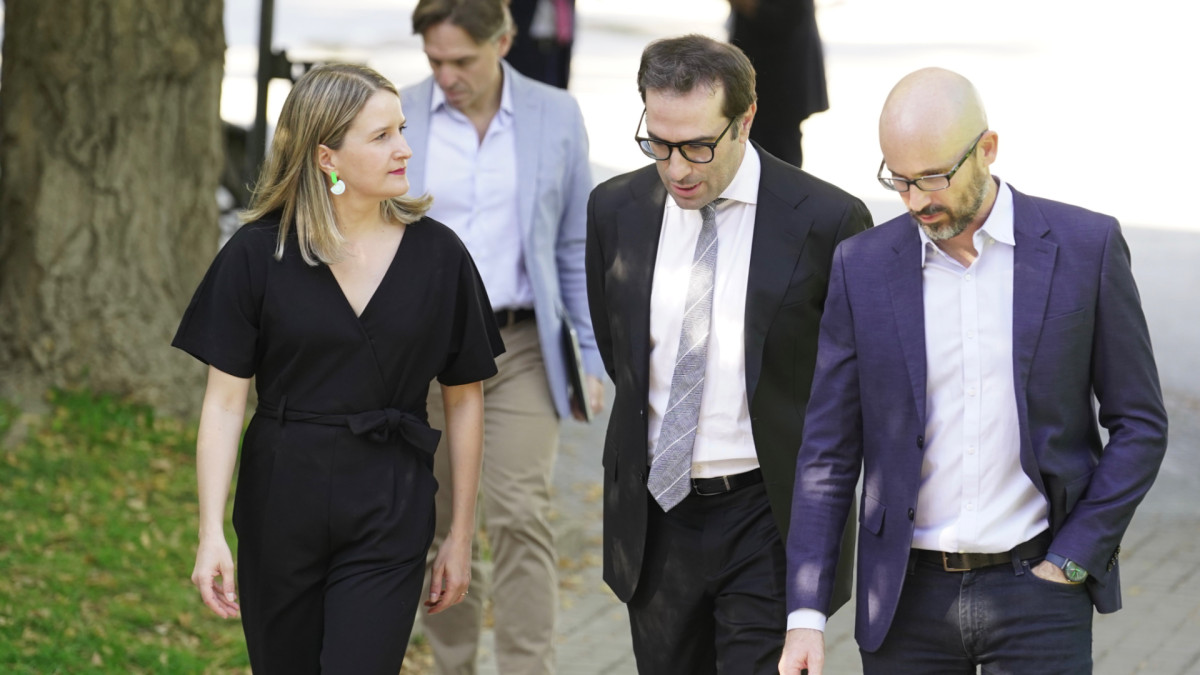
The Spanish economy has been delivering solid results for years, but there is an increasingly sharp gap between macroeconomic figures and the living conditions of many citizens. GDP growth and employment coexist with difficulties in accessing housing and with inflation that continues to bite into people’s wallets.
With this concern in mind, on Oct 13 the San Blas district of Madrid hosted the presentation of Accelerating Shared Prosperity, an initiative that brings together more than seventy economists and social scientists to study why a portion of the population is not benefiting sufficiently from growth and to propose public policies to correct it. To better understand the project, I spoke with two of its drivers: Mònica Martínez-Bravo, an economist and formerly the Counselor for Social Rights of the Generalitat of Catalonia, and , Professor of Applied Economics at the Autonoma University of Madrid and former Secretary of State for Social Rights.
Both have first-hand knowledge of how administrations operate and share the goal of bringing academic research closer to public policy design. During our conversation, Martínez-Bravo acknowledges the progress of the last few years, though she warns that there is still much to be done: “We are looking at a glass that is half full and half empty”. Álvarez focuses on the market rules that condition the distribution of wealth and on the political consequences of the lack of material well-being. We also talked about the rise of the radical right, the results of the economic policies implemented in recent years and how Spain can contribute to the new currents in international economic thought.
The project is born with the aim that growth reaches the majority of households.
Why have you decided to launch this think-tank on shared prosperity now?
Mònica Martínez-Bravo (M. M.-B.): I believe for several reasons. Shared prosperity is a matter increasingly claimed from different spheres. President Illa has made it one of the banners of his legislature, but even before, in the field of economic science, more and more economists were placing it as a central objective.
In recent years, increasingly powerful currents have emerged advocating a paradigm shift in economic science. Not every kind of growth is necessarily of interest to us. The evidence indicates that the framework of “grow as much as you can and then redistribute later” is becoming obsolete. We need the prosperity that is generated to be sufficiently shared from the very first moment. That does not mean that we should not continue investing in redistribution mechanisms later, but we must also act from the start.
“The evidence indicates that the framework of ‘grow as much as you can and then redistribute later’ is becoming obsolete”
We believed it was a good moment for these currents to land in Spain with greater clarity. There have been improvements in terms of shared prosperity over the last seven years, and it is important to value them. But there is also great uncertainty about which policies can foster it, which work and which do not. If we add doubts about the evolution of our economies and the impacts of artificial intelligence, it becomes evident that we need an ecosystem of thought and public policy that allows us to test innovative ideas. Economists have a lot to say, but we need structures that let us step out of the papers from time to time and figure out how to land these ideas in practice.
Nacho Álvarez (N. A.): I completely agree. In the last decade we have seen how the breakdown of social contracts in many countries around us has generated a situation where, although there was prosperity, it was no longer shared in the same terms as in previous decades.
Real wages no longer grow at the pace of productivity. Housing and, in general, affordability have become major problems. We see these same challenges in Spain. In recent years, GDP per capita has grown more strongly than in euro-area countries, but housing trends and inflation are posing significant challenges to the material living conditions of broad sections of the middle and working classes. We need to think about how to generate prosperity and also how to distribute what we generate. Hence this initiative.
To what extent does your initiative respond to the advance of radical right in many European countries? Do you think that the lack of shared prosperity helps explain the electoral results of the far right?
M. M.-B.: Logically, we are not immune to the political moment nor to the trends we are observing. The date of the event had been planned for a long time. It is not a reaction to the immediate situation, but we are not immune to it either.
I think at the launch [presentation of the project, held on Oct 13 in Madrid] we could explain that the current situation is not a complete absence of shared prosperity. The Spanish economy shows global trends that make prosperity not sufficiently shared, but there have also been advances in recent years. We are dealing with a half-full, half-empty glass. We see green shoots and we want more. Hence the initial expression we used, “accelerating shared prosperity.”
Regarding the wave of reaction in the world, I think it is being fueled, in part, by the fact that prosperity does not reach broad sectors of society with enough force. Precisely because of that, we need to identify the gaps and bring economic science closer to citizens. We have to explain which economic policies favor the interests of the working class and which go against them, although we should also subject some of our discipline’s approaches to self-criticism.
I find your definition of the working class particularly interesting. Traditionally, we might think of it as a specific social class, but your proposal seems to target a vast majority of society: all those people who earn or try to earn their living through work.
N. A.: Indeed. This proposal places at the center sectors that have sometimes been somewhat overlooked by economic policies, but are by no means a minority. They are the broad social majorities. We are talking about people who live from their wages, but also about self-employed workers who need a strong social majority with good jobs and a good standard of living to be able to develop their businesses.
It is essential to place this working class at the center because, when democracy does not deliver good economic results, monsters that question it appear. We have seen how a lack of material well-being makes part of these social sectors inclined to opt for extreme-right political projects that openly challenge democratic frameworks. That happens when the social contract has been broken and there is no feasible alternative on the table.
“It is essential to place this working class at the center because, when democracy does not deliver good economic results, monsters that question it appear,”
In Spain, I would say this process has not unfolded in the same way as in other countries because coalition government policies have allowed improvements in living conditions and delayed it. Inflation erodes the money in citizens’ pockets, but it also erodes the government’s effectiveness. Many governments that had to deal with the inflationary cycle stemming from the war in Ukraine fell. Spaniards did not experience that, to a large extent, thanks to the good performance of public policies during that cycle. However, housing problems and a second inflation shock in 2026 are bringing back to the table the issue of unshared prosperity, particularly for the working class.
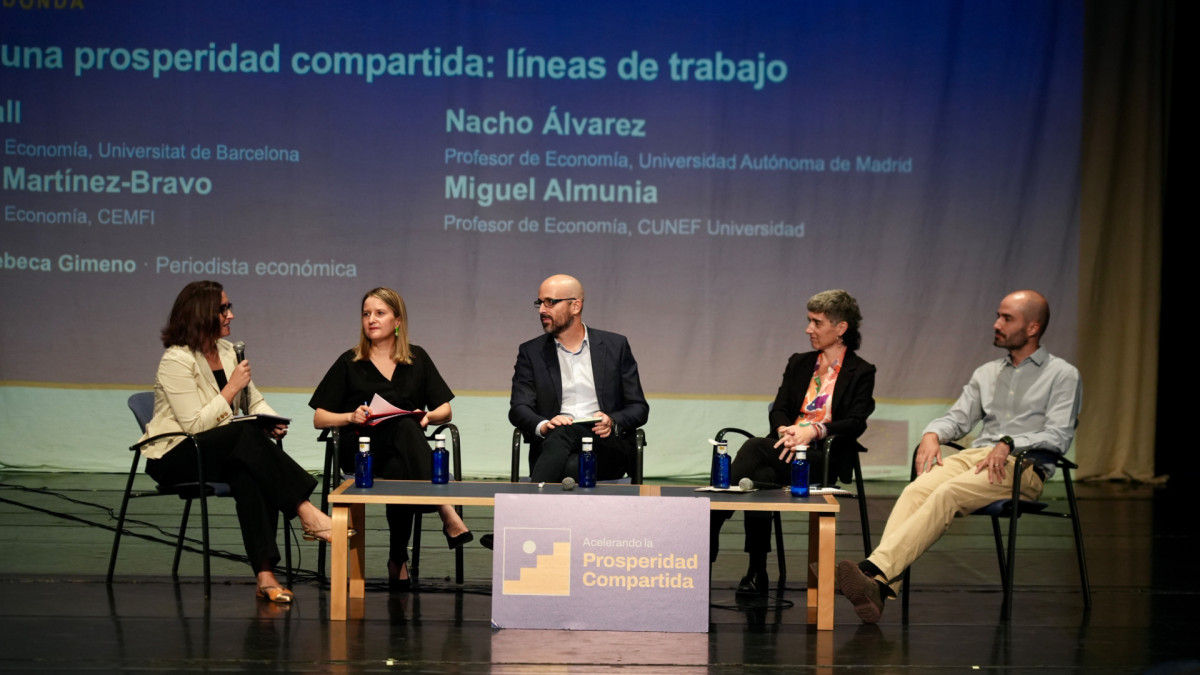
The first meeting of the project featured a roundtable with several of its members.
How do you explain this paradox? The Government and international organizations highlight the growth of the Spanish economy, but surveys show that many citizens feel their wages are stagnant and prices keep rising. After the first inflation shock, we face another one deriving from the Iran conflict. With a month and a half to the elections, is there a risk that the idea will once again take hold that the right manages the economy better?
M. M.-B.: As Nacho said, this group is precisely tasked with deepening the analysis and examining these questions in greater detail. It is true that there coexists very strong economic growth and a widespread perception that things are not going well. There are, however, interesting discrepancies: when you ask people how the economy is doing, they perceive it more negatively than when you ask them how they are doing personally. Many people consider their own situation to be quite good.
But economists’ first reaction cannot be to attribute this paradox simply to a perception problem. We cannot do so until we have analyzed all gaps, all grievances, and all groups. Those of us with a more microeconomic tradition know that aggregate figures hide important realities. When you start looking at sectors, specific problems, neighborhoods, or even census tracts, situations emerge where prosperity isn’t reaching everyone sufficiently.
“Those of us with a more microeconomic tradition know that aggregate figures hide important realities”
There are especially stark cases of people who have been left out of the system, who did not have a strong protection network and whom economic growth has not benefited sufficiently. Perhaps their salary has risen by a hundred or two hundred euros per month, but they lacked other things. Inflation and housing are fundamental, but we also need to study whether public services across all autonomous communities have expanded their supply at the same pace as demand, taking into account population growth and the increase in dependency.
There is also a classic question of distributive justice that perhaps we are not putting enough on the table. It may be that workers, even the most humble, are experiencing significant wage increases in percentage terms, but perhaps large fortunes are increasing their wealth at a much higher rate. There is evidence of strong growth in corporate profits that we want to analyze in more detail. Wages have risen too, but not as much.
There is another fundamental issue. These grievances are being instrumentalized to push economic policies that would go exactly in the opposite direction of the interests of those who suffer them. The early economic proposals from the radical right in this campaign are overwhelming in terms of what they would mean for destroying shared prosperity and the welfare state. In light of this reality, economists must go out to explain things. But that effort must start from a foundation of trust.
N. A.: There is an important issue related to the lack of shared prosperity that responds to a long-running trend. For many years, for the more conventional paradigms of economics, income distribution was secondary. It was thought that once the market had operated, public administrations could compensate the losers and redistribute part of the wealth generated. Yet we have found that this approach is mistaken.
For decades we have observed a large decoupling between productivity growth and wage growth. And this happens even before public administrations undertake their redistributive task. It is the market itself that is generating a large gap between the economic elites and broad sectors of the working class. That is where we must work: in pre-distribution, in the market rules that condition the distribution of wealth before the State intervenes.
“It is the market itself that is generating a large gap between the economic elites and broad sectors of the working class”
Nacho Álvarez
In Spain there have been meaningful advances, such as the reform of labor markets and the increases in the minimum wage, but there is still a lot of work to do. Economic paradigms have been changing and we have realized that distribution is not a secondary issue.
Is it a coincidence that two of the drivers of this initiative come from economic science and have held political responsibilities? I recall the early days of , when one of our goals was to link the academic world with public debate. What have you learned from your time in politics that has led you to push for a group like this?
N. A.: I don’t think it’s a coincidence. This proposal comes from the academic world, and not only from two scholars but from a broad group of researchers. Yet both Mònica and I also have experience being part of a government and we know directly how policies are formed and developed.
What we have seen is that sometimes it is difficult to build a bridge between academia and politics. There is not enough contact and there is much work to be done. We have been in both places. We have a lot to learn, but we can also offer the experience of having accumulated knowledge in both realms and help build that bridge.
M. M.-B.: Besides having experience in both realms, we share a strong sense of necessity. These are two worlds difficult to reconcile, but there is so much at stake and so much that economic science can contribute to solving the great challenges of the coming years that we need to involve academic talent in the matters that truly matter.
We are living in a moment when academics are also changing. Perhaps this is one of the positive aspects of polarization. When political debate takes place in a relatively centrist space, one can simply offer recommendations and let policymakers decide. But when polarization reaches certain extremes and we see projects like Trump’s arise, with dehumanizing policies and contrary to economic growth and shared prosperity, many people begin to think they want to contribute their bit.
This initiative is another step in that direction. We have gathered more than 70 economists, many of them with a track record linked to public policies and others with a more strictly academic profile. It is notable that people with such distinguished careers are getting involved in an initiative focused on Spain. As a possible precedent, Nada es Gratis comes to mind, which also responded to the need to bring economics closer to public debate. But I don’t know if that mobilization was as widespread as what we are seeing now.
Moreover, this initiative has another distinctive feature that I think demonstrates courage: we clarify a concrete objective. We speak explicitly of the working class. Ten years ago perhaps we wouldn’t have found so many people who saw the need to clarify for whom we work. That has also changed.
N. A.: We want to build a bridge between academia and public policy, but one of the things we’ve learned is that it must work in both directions. Economic science has changed significantly. New currents of thought have emerged and there is a greater intellectual openness to questions that a few years ago were not on the agenda. Economic policy has learned from those changes, but the reverse has also happened.
“We want to build a bridge between academia and public policy, but one of the things we’ve learned is that it must work in both directions”
Nacho Álvarez
During the last years, in Spain, public policies have been developed that many academics would have considered problematic. For example, it was said that raising the minimum wage would cause significant job destruction. It was also warned that the minimum vital income could reduce labor supply in certain social groups. And what we have seen is that this has not happened. Some academic premises have been questioned by the very dynamics of economic policy in our country.
We want economic policy to learn from the new currents in economics, from authors like Schumpeter, Piketty, or Mazzucato. But we also want academics to learn from the experience of economic policy. During the pandemic and after it, there was significant innovation and experimentation in public policies that have provided a great deal of information to theoretical economic reflection.
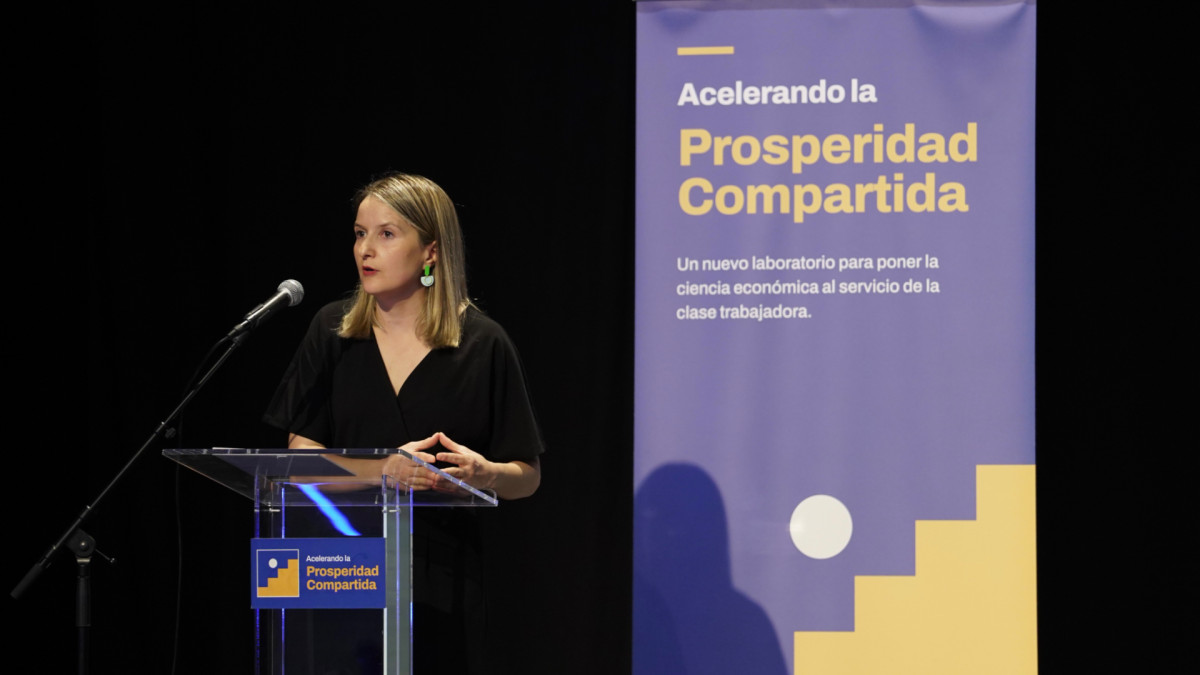
Martínez-Bravo holds a PhD in Economics from the Massachusetts Institute of Technology.
What will be the next steps? How will you organize yourselves and how can the public contribute to the reflections and proposals you are developing?
M. M.-B.: We are at a moment where we will be learning as we go, doing learning by doing. We have started with a first diagnosis of reality to identify where we need to focus our efforts. Once that advances, we want to create different study groups focused on the identified gaps and organize conferences and working sessions to share the results with the rest of the network members. The ultimate goal is to propose concrete policies that can be tested.
We have also launched the lab and opened its channels on social networks. We do not aspire to a very high-frequency public presence, but we do want channels that allow us to tell the public what we are doing.
There is another issue that is one of my obsessions: creating many more channels of communication with workers, with their daily lives and their real problems. I come from development economics. When you are going to run a randomized controlled trial in 600 towns, you first organize discussion groups. You talk to people, understand their problems, and then you run a pilot, check if it worked, and keep building from that experience. I think we have to do the same.
“There is another issue that is one of my obsessions: creating many more channels of communication with workers, with their daily lives and their real problems”
Mònica Martínez-Bravo
This is something I miss a lot from my time as counselor. Yesterday we took the first step by holding the presentation in the San Blas district and by inviting a longtime neighborhood leader. He spoke to us about Gran San Blas, its problems and its transformation. It is an example of prosperity and improvement, but progress is still insufficient and many people still have significant needs. We cannot stay only in the academic sphere. We must go to the ground and talk to people.
N. A.: Mònica has explained it beautifully, but I want to emphasize the aim of stepping out of the ivory tower in which academics sometimes find themselves. We have already held meetings with trade unions, and contact with them is essential, because they remain key actors in representing the working class.
At the same time, one of the network and lab’s projects is to present a report next year. We want to convey to the entire public the work of the various groups and formulate public policy proposals that promote shared prosperity. I think that report could become a significant milestone for Spain’s political debate.
I would like to finish with the international dimension of your initiative. From Spain to the world or from the world to Spain? In recent years Spain has pushed forward important policies and reflections. To what extent does your proposal seek to contribute to that Spanish experience and connect it with the new currents in international economic thought?
M. M.-B.: I would say in both directions: from Spain to the world and from the world to Spain. We want to bring to our country the new international currents of economic thought. But we are also at a time of great uncertainty and opening a new frontier in the management of economic policy.
I recall that, when we spoke with Dani Rodrik, I asked him which policies he thought could foster a good-jobs economy. His answer was that we had to try, experiment, and test new things. Spain has leading initiatives, for example, in the social economy and in the cooperative ecosystem. We need to test, evaluate, and learn. And I think Spain can be at the forefront of the process of identifying which public policies work.
“Spain has initiatives in which it is at the forefront, for example, in the social economy and in the cooperative ecosystem”
Mònica Martínez-Bravo
To some extent we have already done so. We have argued that raising the minimum wage and approving the labor reform were important measures, also because they could contribute to the proper functioning of the economy. But we need good evaluations. Nacho explained yesterday when talking about the PERTEs. There is evidence that they have contributed to transforming the economic model, but we need to evaluate them.
Perhaps that is one of the contributions Spain can make to the rest of the European and advanced economies: helping to identify which policies work and which do not. We need academics to help us evaluate, formulate the right questions, and understand their significance. Perhaps that implies setting aside some less relevant issues to focus our efforts on what really matters.
N. A.: I fully agree with Mònica. A good example of that two-way exchange could be industrial policy. In Spain, in recent years, a notably innovative industrial policy has been developed compared to our recent history. A few years ago it was said that the best industrial policy was the one that did not exist, the one the market did.
“In Spain, in recent years, a notably innovative industrial policy has been developed compared to our recent history”
Nacho Álvarez
Nevertheless, Next Generation funds and PERTEs have allowed incorporating part of the new strands of economic policy proposed internationally, in the line of Dani Rodrik or Mariana Mazzucato. At the same time, Spain is returning to the international arena an experience that could be very valuable: the attempt to develop missions around large driver projects, as proposed by Mazzucato and as has been attempted here, with more or less success depending on the PERTEs.
Now it is time to evaluate those projects. We have to check which ones are transforming our productive model, boosting productivity, reducing fossil fuel consumption, and enabling cheaper energy. And also identify which ones have not achieved those results.
I think the exchange has worked in both directions. We have incorporated new approaches to economic policy and, at the same time, we are generating experiences that can be useful for international debate. In some areas we have clearly succeeded, but we also need to analyze where we have failed.
