
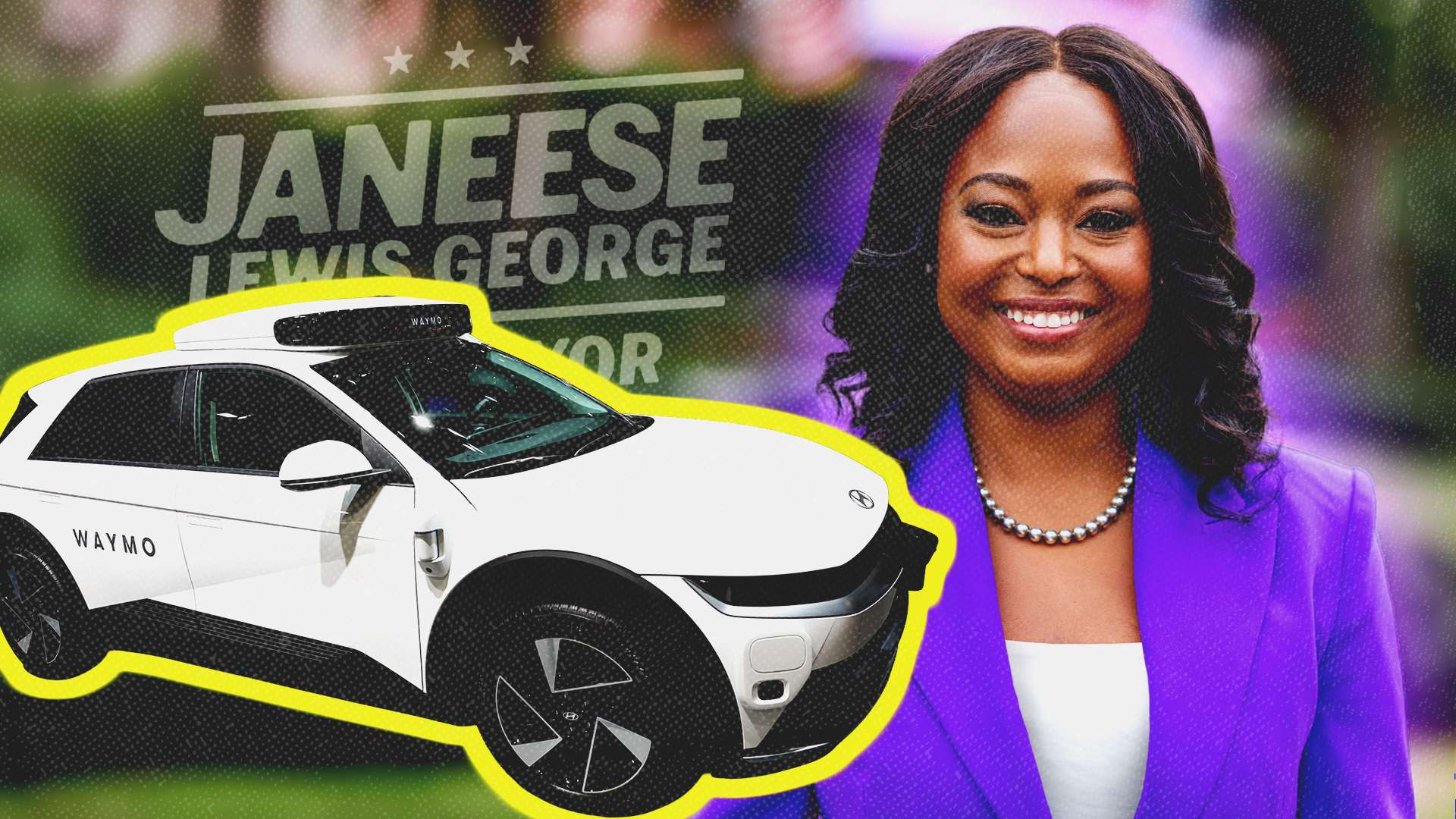
The DC council member with socialist leanings misreads the potential of autonomous vehicles to shrink jobs.
Janeese Lewis George, a member of the District of Columbia Council and the likely victor in D.C.’s upcoming mayoral race, has publicly opposed pending legislation that would permit autonomous ride-hailing vehicles to operate on city streets, arguing that the technology could erase the jobs of human ride-share drivers.
“DC is facing a jobs crisis. Advancing the legalization of autonomous vehicles without pause would be irresponsible given the anticipated AI-driven job displacement and the disruptions that could threaten a great many workers,” she wrote on X yesterday.
Washington, DC is confronting a jobs crisis.
Speeding up the legalization of autonomous vehicles is reckless in light of expected AI-related job losses and disruptions that could jeopardize numerous workers.
— Janeese Lewis George (@Janeese4DC) October 15, 2026
In a subsequent post, she urged the DC Council to delay consideration of a pending bill that would let Waymo, which is presently testing its technology on District streets with human safety operators, provide autonomous rides to residents.
Since Lewis George secured a decisive victory in this year’s Democratic mayoral primary, commentators have been trying to forecast how the self-described democratic socialist will govern in practice.
The city’s economy is currently navigating rough waters. Unemployment is elevated. The housing market has weakened. Population growth is slowing.
Lewis George’s remarks about Waymo suggest that she holds a markedly flawed view of the effects and benefits of technological innovation. Contrary to her assertion, allowing Waymo’s operation in the city is unlikely to deepen a supposed “jobs crisis” for at least three reasons.
The first reason is that the number of D.C. residents who work full-time as ride-share drivers is very small. In her Capital Commonsense Substack, Ashley Schapitl notes that, by Lewis George’s own estimate, only about 200 District residents are employed full-time as ride-share drivers.
For context, the District’s labor force is roughly 400,000 people. So even if Waymo were to replace every human driver in the District, the impact would be statistically negligible.
Consider that headlines rarely highlight that D.C.’s labor force contracted by about 1,000 people between May and June. They also seldom report that the labor force expanded by around 600 people between July and August.
Yet the mayor speaks of a “jobs crisis” over what would amount to an even smaller alteration in the city’s employment tally.
The second reason to doubt that Waymo legalization will worsen a looming “jobs crisis” is that autonomous vehicles (AVs) will not, in the near term, wholly replace human ride-share drivers.
In the cities where Waymo has operated for years, AVs still account for only a minority of ride-share trips. In Phoenix, where Waymo has offered autonomous commercial service since 2020, a Business Insider article from April cites one study that places Waymo’s market share at about 16 percent of ride-share rides.
In other words, 84 percent of ride-share trips are still performed by humans even six years after AVs entered the market.
That is not to say that the effects of AVs on human drivers’ earnings are necessarily favorable.
Another study by Gridwise, published in August 2025, suggested that AVs may have modestly reduced drivers’ hourly pay and the number of trips per hour. That indicates the ride market has grown more competitive, but it does not constitute proof of an impending “job apocalypse.”
Network design also matters. In Los Angeles and San Francisco, Waymo operates as a direct competitor to traditional ride-hail firms like Uber and Lyft. In Austin and Phoenix, however, Waymo collaborates with Uber to deliver rides through networks that blend human drivers and autonomous vehicles.
A report by EnoTrans, funded by a Lyft grant, found that in these latter cities’ hybrid networks, human drivers’ trips per hour actually rose. Their earnings per hour fell, but less steeply than in cities without hybrid arrangements.
All of this suggests that while Waymo, as a competitor to human-operated ride services, may not be expected to boost drivers’ earnings, it is not destined to cause a catastrophic loss of work either.
The third and final reason Lewis George is mistaken to think Waymo will worsen a future “jobs crisis” is that Waymo’s employment effects extend beyond its impact on competing human drivers.
If Waymo captures any market share, it will occur because it provides some travelers with a superior transportation option compared with what currently exists. A more convenient transport system within the city is likely to raise overall employment, not depress it.
If Waymo makes commuting from home to the office easier or cheaper, or simplifies trips to schools, residents might choose to live in DC rather than in neighboring Arlington or Silver Spring. If getting to the cinema or a restaurant becomes more convenient, locals may spend more at nearby businesses.
None of these effects even touches on the potential economic and human benefits of Waymo’s likely improvements to road safety.
The direct impact of Waymo on drivers’ employment must be weighed against the broader economic activity that autonomous vehicles are likely to enable.
In the long run, the economic implications of autonomous transport could be transformative. In the nearer term, they are likely to make the for-hire ride market somewhat more competitive.
Thus, a reasonable forecast is that Waymo will produce a modest but positive overall effect on economic activity and employment in the District, even if it imposes a modest but real dent on a small subset of full-time ride-share workers who reside here.
If the incoming mayor cannot tolerate that level of economic disruption, it does not bode well for DC’s economy under a Lewis George administration.
