
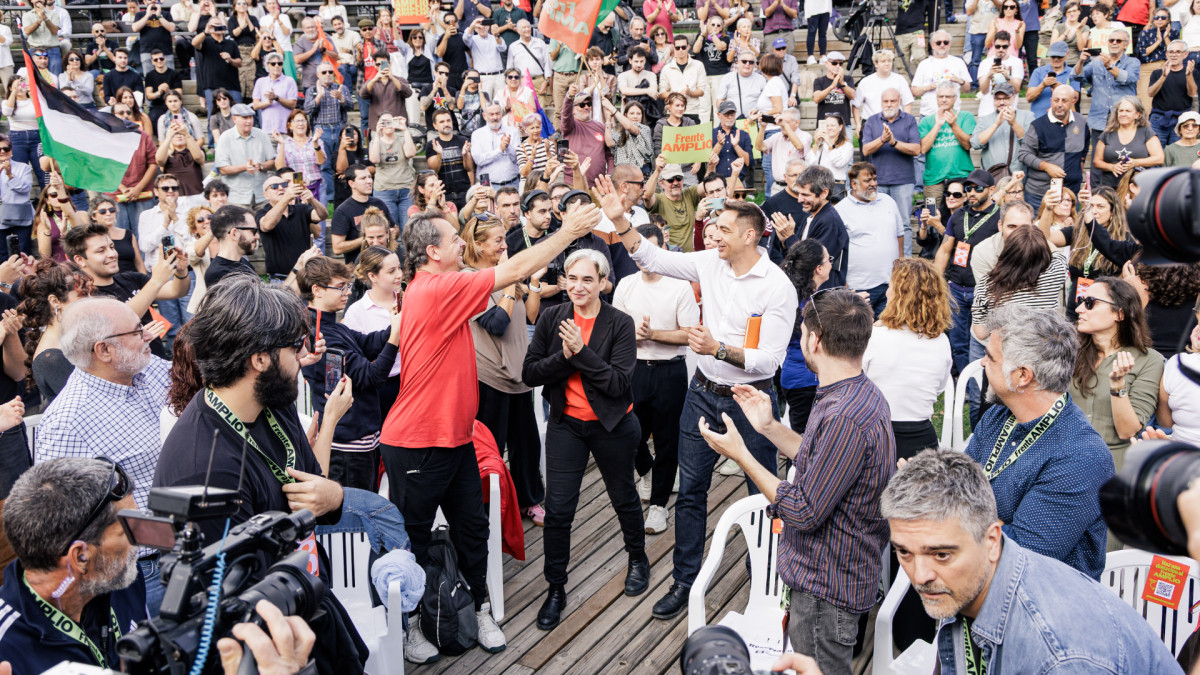
Last Friday at midnight, the deadline to register coalitions for the 29N had passed, and the left arrived at it, as was predictable, divided. Said like that, it might seem like the umpteenth fragmentation of a space accustomed to breaking apart, but what happened tells a different story. Almost everyone agreed with almost everyone; who was left out was Podemos.
Izquierda Unida, Movimiento Sumar, Más Madrid and the Comuns articulated the Frente Amplio. La Chunta, Més or the Andalusian leftists of Iniciativa del Pueblo Andaluz sealed territorial alliances with the new coalition. Before the deadline, a large part of that same bloc signed with the PSOE a joint Senate candidacy that could prevent a new PP majority in the Upper House. Therefore, the definitive perimeter of the agreement reached Ferraz and stopped at Podemos’ door.
A frontier drawn during this legislature
The line separating those who understood each other from those who didn’t is not ideological or programmatic. In matters like housing, taxation, or labor and social rights, any voter would struggle to distinguish the Podemos and Frente Amplio programs. What separates them is how each has evolved over the last three years. The Frente Amplio parties have shared the Council of Ministers, the parliamentary group, and votes. They have also negotiated public policies together and disagreements with the PSOE that were resolved internally. Being there was a strategic decision that gave continuity to the coalition government started in 2020. That translates into a habit of negotiating among themselves, a minimum trust between the political formations, and a shared interest in defending what has been done from within the Executive.
“The definitive perimeter of the agreement reached Ferraz and stopped at Podemos’ door”
On its side, Podemos followed a different strategic path. It stayed out of the Government at the start of the legislature and, weeks later, left the Sumar parliamentary group. In this sense, Podemos has conducted politics during this legislature from outside the Executive and, on occasion, in opposition to it. Since then, the Morada (Podemos) party has built its identity on that distance. It has supported the progressive coalition government when convenient, voted against when it deemed it appropriate to distance itself, and tried to present itself as a left distinct from the government.
All parties, without exception, are driven by incentives. Podemos is no exception. That is why, when the electoral call talks about preserving the progressive coalition government, it is overlooked that this is not an incentive particular to Podemos, since the formation has been detached from it. With that trajectory, the Friday outcome was predictable. Moreover, accepting a spot on a Más Madrid–led list would have meant relinquishing differentiation and also the contest for an electoral space that would allow its survival.
Obviously, all of the above rests on an expectation of the current scenario, namely to overcome the 3% electoral threshold in Madrid, which it is believed the events in which the now politically worn Gabriel Rufián can participate will contribute to.
“Accepting a spot on a Más Madrid–led list would have meant relinquishing differentiation and also the contest for an electoral space that would allow its survival”
The proof lies in the agreements that Podemos did close. Irene Montero’s party will go in coalition in the Valencian Community, with Compromís and the regional IU brand, and in the Canary Islands, with Nueva Canarias. In Catalonia it has preferred ERC over the Comuns for the logic already explained, which is also supported by the 2024 European elections scenario, in which Podemos surpassed Sumar in the Barcelona province. In all three cases, the partner is practically a territorial force outside the core of the Government and the leadership of Sumar.
Rufián, the ally who never wanted to lead
The alliance with ERC is the piece that best explains Podemos’ logic, and also the one that best portrays its partner. Rufián has spent the year at the center of the conversation of a left to which he does not belong. In February he shared with Emilio Delgado a public event that promised to overflow the parties and ended up in a calculated and self-interested restraint. On that occasion, he spoke in the conditional and did not take a single step that would commit him outside ERC. In May, after the Andalusian elections, he went further and declared himself willing to lead a unitary candidacy of the state and sovereignist left. In the same intervention he set a condition that explained it and made everything impossible: he would not leave his party until they expelled him.
“Rufián has spent the year at the center of the conversation of a left to which he does not belong”
It seems clear that the person who set that condition to lead the Spanish left had no real intention of building a national candidacy: he was raising his stock as a football player negotiating a renewal with his current club. In the last weeks he set conditions on his own party to run again, since Rufián sought, above all, to minimally control ERC’s electoral lists to avoid ending up, once again, in a parliamentary group that was rather reluctant to his leadership. Meanwhile, a leader close to Oriol Junqueras collected signatures to replace him. The ERC leadership ultimately confirmed him as candidate.
The agreement with Podemos sealed the operation. Rufián keeps his seat and gains the pretext he sought, one that would allow him to have national exposure without leaving ERC. Podemos does not run in Catalonia, placing two independents on the republican list for Barcelona and beating Rufián as a rally partner. What unites them is their stance toward the Government. ERC supported the investiture and Rufián has made that intermediate position, between the investiture majority and the Executive, his main asset. In that sense, the two recognize themselves in being with the progressive bloc without bearing the wear of governing.
“The two recognize themselves in being with the progressive bloc without bearing the wear of governing”
The cost is borne by the Comuns, who have suffered from Rufián and ERC a hostile takeover bid that aimed to unseat them. Ada Colau had invited the ERC leader in Congress to join the Frente Amplio and to use his leadership to unite the left under a coordinated candidacy. The final result has been an ERC list with Podemos by its side in its own constituency, where Colau herself will be a candidate. The campaign will also showcase an irony: the Rufián who in February shared a stage with Delgado will return to Madrid to ask for votes for Montero, who is precisely competing against Delgado. The question now is which left will come to applaud Rufián.
A rational bet with debatable premises
Discarding Podemos’ decision as sectarianism or egocentrism is convenient, but it does not explain it. The Morada leadership does not compete for a ministry, but for the hegemonic space that today does not reach 10%. Their bet rests on a very specific interpretation: the Frente Amplio is a governing alliance without a government to return to; its partners will split again after 29N, and whoever preserves branding, leadership and autonomy will be better positioned to pick up the wreckage.
“The Morada leadership does not compete for a ministry, but for the hegemonic space that today does not reach 10%”
The risk is evident. After two weeks of voters’ saturation with the exhibit rehearsed by the non-negotiations, surpassing the 3% vote threshold in Madrid, the minimum to win a seat, may be harder than expected today. The price of division is not negligible either. According to 40dB., separately the Frente Amplio and Podemos would sum between seven and nine deputies; together, between fifteen and nineteen. There is another less tangible variable, the emotional cost of not having produced the desired unitary candidacy.
The Senate as the first test
The other side of this story is the agreement that did close. The PSOE and the Frente Amplio formations agreed on a single ballot for the Senate, the Senate of Progress, in most of the country. The electoral logic is essential to understand it. In the Senate, each peninsula province elects four senators, and whoever wins the most votes usually gets three. In 2023, the PP, by overtaking the PSOE and being the first force in much of the territory, achieved an absolute majority in the Upper House. Now, a single ballot can concentrate those votes and, with a tiny margin, cause the progressive candidacy to beat the PP, reversing the situation. Let us not forget that during this legislature the Senate has allowed to curb, return or delay much of the legislative agenda. Add to this that the Senate elects by a three-fifths majority four of the twelve members that make up the Constitutional Court.
Podemos and the Comuns have also been left out of this agreement, completing the electoral map. The Frente Amplio has not been able to close a common list with Podemos for the Congress, but it has closed one with the PSOE for the Senate. This is no minor matter, as it shows that the left that is organized does so around Pedro Sánchez, and whoever is outside that orbit is left out of all the tables.
