
Entitlement, Defense, and Debt-Interest Outlays Keep Rising
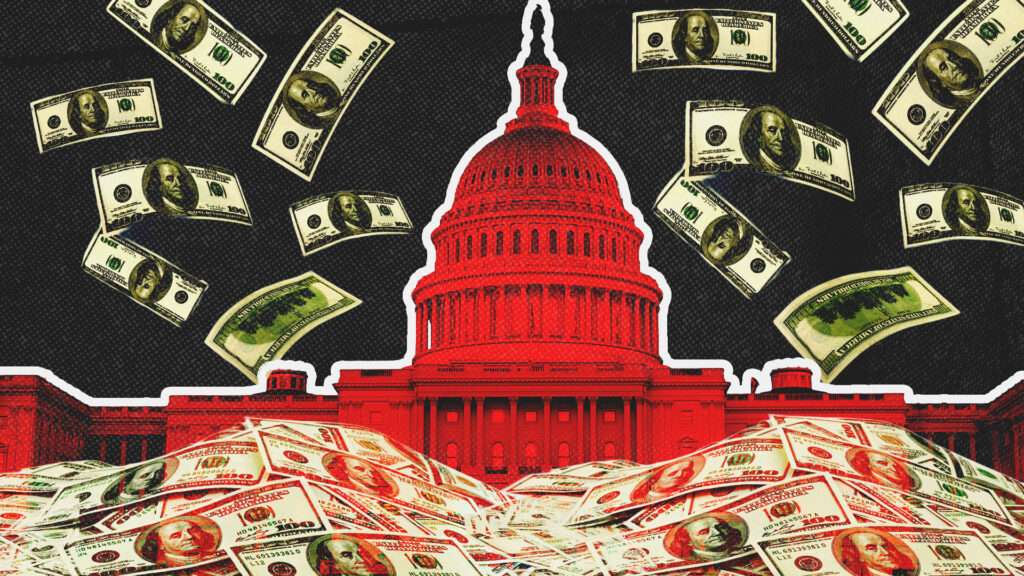
Fiscal year 2026 closed with a deficit hovering near $2 trillion, according to the Congressional Budget Office’s latest release from last Thursday. Only the pandemic years of 2020 and 2021 posted larger shortfalls. Today there isn’t a recession or an emergency to point to, yet these mammoth deficits have become the new normal.
The typical reaction to a warning about deficits is to insist the government simply needs more revenue. That isn’t the answer. Thanks to the private sector’s remarkable strength, federal receipts rose about 3%, topping $5.4 trillion for the year. But outlays grew by 6%, reaching $7.4 trillion.
Some will fault the Supreme Court for striking down much of President Donald Trump’s tariffs and obliging refunds. But even if Washington had kept the $130 billion in illegal levies, the amount would cover less than one-tenth of the gap. Tariffs were never a serious revenue source at our already extraordinary level of spending.
Take a look at where the money went. Outlays for the three big entitlement programs—Social Security, Medicare, and Medicaid—rose by 7%. That pace outstrips overall spending growth. Defense spending rose by 5%. Interest payments on the debt climbed by 11%, surpassing $1.1 trillion. That figure represents the cost of every prior year of borrowing—years when Washington signaled a lack of seriousness about fiscal discipline.
If you want a warning about where such recklessness can lead, consider France. The country that inflation hawks and prominent liberal commentators alike point to as proof that expansive government can work is now teetering on a serious crisis. France’s debt stands at roughly 120% of GDP, and interest obligations are rising rapidly. Weak growth and social unrest aren’t helping matters.
The United States, to be sure, enjoys advantages France does not—chief among them a vibrant private sector and a culture of innovation that fuels wealth creation. Still, debt that is spiraling out of control should worry us. First, the same anti-wealth and anti-growth currents that have dragged France into trouble are gaining traction here. Second, we are on a path where debt could reach 120% of GDP in a few years, and our interest payments are already swallowing a worrying share of resources.
A prudent Congress would seek to shore up the nation’s finances not only for prudence’s sake but because debt pushes up interest rates for everyone, from homebuyers to small businesses. That rise acts as a drag on growth and, in turn, on wages. In short, bringing debt under control should sit alongside deregulation as a cornerstone of any affordability agenda.
For lawmakers who want to take affordability seriously, a September Advancing American Freedom (AAF) report offers a practical starting point. Its discussion of fiscal restraint provides a useful kit of reforms, focusing on the programs that most heavily push the debt higher.
Begin with Social Security. Under present law, benefits would fall by roughly 20% once the program’s trust fund is exhausted in the early 2030s. No one believes Congress will allow such a cut to occur, but one must worry that the response would be to borrow the shortfall rather than reform the program.
Tax increases aren’t a viable option either. The payroll tax, which finances entitlements, now stands at 12.4% of wages. It began at 2% when Social Security first went into force. It remains the most onerous tax for many Americans. Enough already. The reforms proposed by AAF fellow Rachel Greszler are worth considering: tie the retirement age to life expectancy, employ a more accurate inflation measure for cost-of-living adjustments, and gradually shift toward a flat universal benefit that protects low‑income retirees while ending Social Security’s de facto welfare for the very wealthy.
Next come Medicare. More than 40% of its funding already comes from general revenue rather than payroll taxes. The plan would convert the program to a premium-support model, giving beneficiaries a fixed contribution to spend on traditional Medicare or on competing private plans. It would also raise the eligibility age to 67, aligning with Social Security, and trim subsidies for affluent seniors. That would be a start.
Medicaid presents a pricing challenge. Yet price-based competition—the strongest tool for cost control—has never been seriously attempted. Washington underwrites about 90% of the cost of states’ expanded Medicaid programs for adults. A state can obtain a dollar of coverage for only about ten cents of its own money. Reorienting the states’ incentives is essential. Implementing risk-adjusted per-capita caps, whereby the federal government provides a fixed amount per enrollee, would accomplish exactly that. States would pay for their own inefficiencies or would reap the savings from becoming more efficient.
The same logic supports returning more welfare programs to the states, starting with the federal share of the Supplemental Nutrition Assistance Program. State governments must balance their budgets in some form.
None of these reforms come without pain. Yet the alternatives would be far more painful. The United States will either keep bearing a slow, inflation-driven tax or face a rapid, ugly fiscal crisis if bond buyers lose confidence and stop lending to Washington.
COPYRIGHT 2026 CREATORS.COM
