
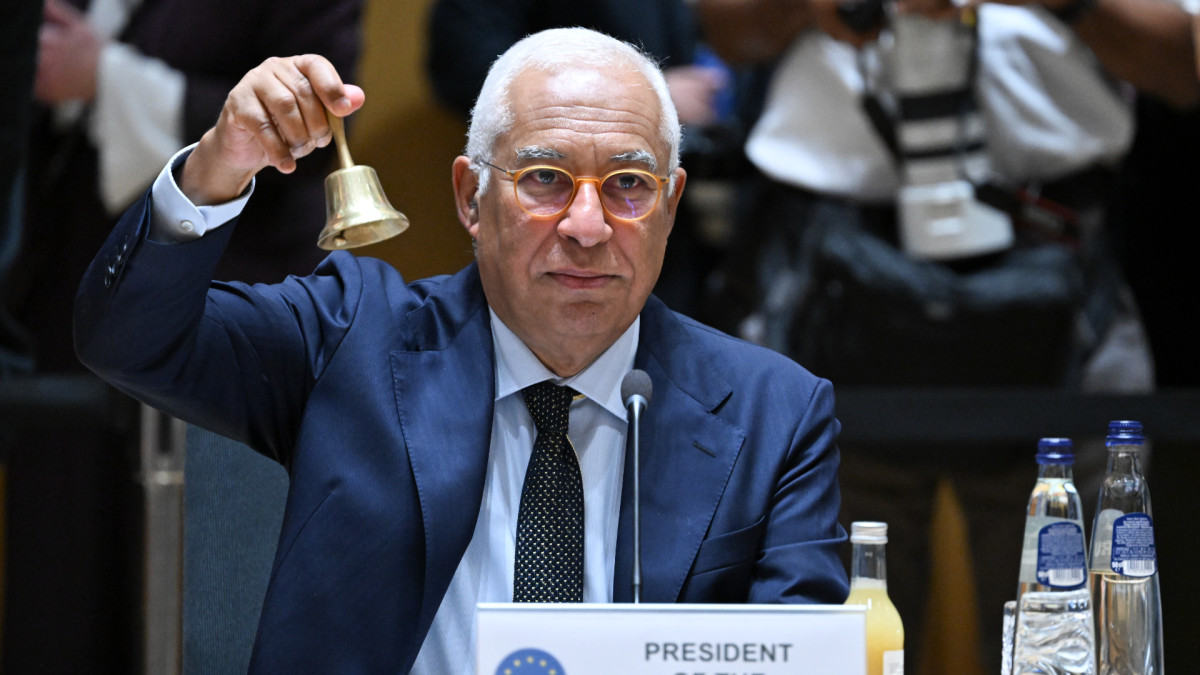
The heads of state and government of the European Union met last Thursday and Friday at a summit that was exceptionally dense, packed with matters that will shape the coming months of the European agenda through 2027. Topics ranged from defense and Ukraine to energy prices, migration, and competitiveness. But many eyes were fixed on the discussion surrounding the next multiannual financial framework (MFF), which will cover the 2028-2034 period, and for which António Costa, President of the European Council, wanted an agreement before the year ended.
That objective seems increasingly difficult to achieve. The summit served to confirm that there is no obvious path toward a deal, and that Costa’s team, now taking the lead in the negotiations, will have to perform numerous balancing acts to hit the right note. Although the Portuguese leader’s aim remains to secure a pact before 2027 begins, there is growing skepticism around that goal. “The European Council invites its president to push the negotiations with a view to reaching an agreement in time. An agreement before the end of 2026 would enable the adoption of legislative acts in 2027, which is necessary to ensure that EU funding reaches beneficiaries without interruptions in January 2028,” the conclusions state, which avoids presenting the end-of-year date as something inevitable.
The stalemate stems from the fact that the positions of the two main negotiating camps appear impossible to reconcile. On one side, the so-called frugals, wealthy and orthodox countries, predominantly Nordic, are dedicating nearly all their political capital to achieving cuts in the framework. On the other, they want to channel those cuts toward traditional budget lines, those less oriented toward the future from their viewpoint: the Common Agricultural Policy (CAP) and the cohesion funds. Across from them stands a larger but less cohesive group, the friends of cohesion, who argue that the MFF should be sizeable and that traditional allocations must be respected.
“The blockage stems from the fact that the positions of the two main negotiating camps seem impossible to reconcile”
The think tank Bruegel believes that both sides are making it exceedingly hard to reach an agreement, and while each has a point, their red lines make progress toward a compromise very difficult. “The ‘friends of cohesion’ are right to demand an increase in the EU’s joint debt issuance for European public goods, but they are not prepared to accept substantial cuts in traditional spending [the CAP and the cohesion funds] to obtain it. The ‘frugals’ correctly argue that the budget structure must shift toward spending on European public goods, but they want a budget far smaller than what the Commission has proposed,” lament Zsolt Darvas and Jeromin Zettelmeyer of Bruegel.
The disagreement intensifies because the frugals are not giving ground on a point that could bring positions closer together, namely increasing the so-called own resources of the Union, essentially pan-European taxes that would directly fund the common budget. These own resources could help reduce the national contributions that member states must make, but the frugals insist that any new own resources should only serve to decrease those capitals’ contributions.
The Commission’s initial proposal, unveiled in the summer of 2025, raised the next MFF from the current 1.2 trillion euros for 2021-2027 to about 2 trillion. Part of the increase was allocated to service the debt on a common European debt issued to finance the Recovery Fund, created during the coronavirus pandemic. The Cypriot presidency’s first negotiation box with figures — a negobox in EU jargon — for the bargaining process already proposed cuts that appeared insufficient to the frugals. The Irish presidency, which succeeded Nicosia, presented its own negobox a few days ago, which angered everyone: too many cuts for the friends of cohesion, too few for the frugals, with the added complication that it cut precisely in the non-traditional areas toward which spending was meant to shift.
Spain stands out somewhat among the friends of cohesion: indeed, it wants a large MFP and wants to avoid cuts in the CAP and cohesion, but several government sources have expressed strong disagreement with the Irish presidency’s decision to trim modernizing budget lines, such as the Competitiveness Fund or the Europe Global program, intended to fund the Union’s external action. Spain also has the peculiarity that in the upcoming MFF everything points to it joining the net contributor club, i.e., the group of member states that contribute more to the EU budget than they receive.
“Spain also has the particularity that in the next MFP it is likely to join the club of net contributors”
It now falls to Costa and his team to try to square the circle. Some diplomats suspect that the former Portuguese prime minister will be more amenable to the positions of the so-called friends of cohesion, and that he will have less appetite for deep cuts. The frugals, who weeks ago demanded cuts of “several hundreds of billions of euros”, have already left a veiled threat in that letter, indicating that their voice should be listened to more: “We would like to reiterate that negotiations over the MFF are characterized by a fundamental asymmetry,” they explain. “Our six countries fund almost 40% of the contributions of all member states. Although the net contributors as a group are a minority, they bear around three-quarters of the total financial burden.”
