
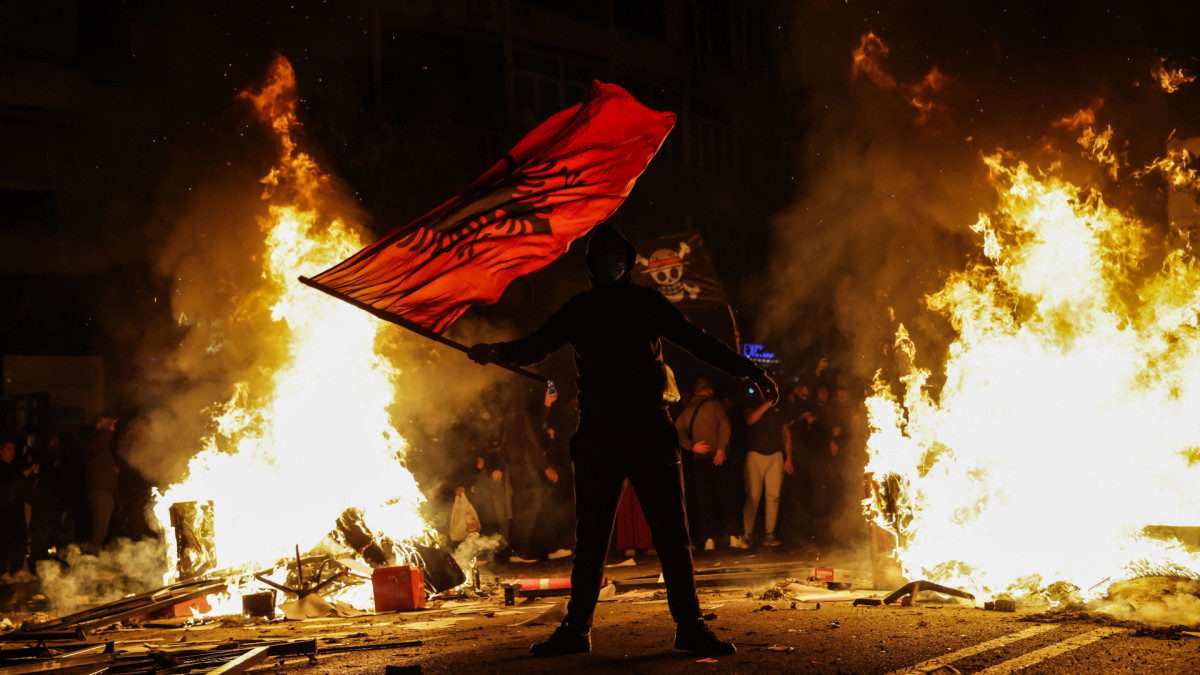
What is happening in Albania is a paradox in itself. While the European Union celebrates the country’s progress in the accession negotiations, thousands of young people take to the streets to denounce corruption, the deterioration of public services, and the lack of future prospects. The government of Edi Rama presents European integration as a success story, but a portion of Albanian society is beginning to wonder who is really benefiting from that modernization. Two images of the same country that seem to be moving in opposite directions. One of a government displaying its international successes and the other of a society questioning the priorities of those who govern it.
The protests did not spring from nowhere. For months, the so‑called Flamingos Revolution has been denouncing a controversial tourist project on the Albanian coast, linked to the business interests of Jared Kushner, Donald Trump’s son-in-law. What began as an environmental protest against turning a protected natural area into a luxury complex ended up including demands related to corruption, real estate speculation, and the model of economic development. In essence, the call is to define who decides over the territory and its resources and who reaps the benefits of their exploitation.
“The Government presents European integration as a success story, but a portion of society is beginning to wonder who is really benefiting from that modernization”
The inclusion of students starting on October 13 has given a new dimension to the protests. The high university tuition fees, the deteriorating educational infrastructure, and the scarce job opportunities have nourished a dissent that goes beyond the classroom. The demonstrations have spread to several cities and have led to clashes with security forces, attacks on government buildings, and numerous arrests. What began as a localized mobilization has become a much broader challenge to the Albanian political model.
Violence has come to dominate a large part of the media coverage. The Government accuses a destabilization strategy and points to its political opponents, while the protesters accuse authorities of having ignored their demands for months. Attacks on public buildings cannot be justified, but they cannot be used to turn a political and social conflict into a mere public order problem. When the institutional response concentrates on condemning the disturbances and delegitimizing those who protest, the risk is that the reasons that led thousands to mobilize disappear from the debate.
The social price of Albania’s modernization
To understand what is happening, one must look at the transformation Albania has undergone during Edi Rama’s thirteen years in power. Since coming to power in 2013, the socialist leader has built a narrative of economic modernization, international openness, and proximity to Europe. Tirana has become a showcase for major urban development projects, while the Albanian coast attracts tourist investment and foreign capital. However, behind that image of prosperity appear contradictions that are increasingly hard to hide. The rising cost of housing, low wages, regional inequalities, and emigration continue to shape the lives of a large portion of the population.
“Attacks on public buildings cannot be justified, but they cannot be used to turn a political and social conflict into a mere public order problem”
The problem is not that Albania is modernizing; it is who decides the priorities of that modernization and how its benefits are distributed. The transformation of land into a financial asset can improve certain economic indicators, but it can also displace local communities and hinder access to housing. For many young people, the promise of prosperity has translated into a choice between accepting precarious working conditions or leaving the country. Emigration, for decades an escape valve against social frustrations, remains one of the most evident symptoms of the limits of this model.
The EU accession of Albania and its democratic contradictions
And here the European dimension of the crisis appears. Albania is one of the most advanced countries in the Western Balkans enlargement process. It has opened all negotiating chapters and has begun to provisionally close some of them. Rama aims to conclude the negotiations in 2027 and has made EU accession by 2030 one of his main political promises. But technical progress does not necessarily translate into a democratic and social transformation of the same intensity.
The contradiction is particularly striking because one of the chapters provisionally closed in July was precisely the education and culture chapter. Barely three months later, thousands of students protest on the streets about the conditions of their education system. The regulatory adaptation to EU demands can advance without necessarily delivering a corresponding improvement in the material conditions of the population. The institutional europeization and social prosperity do not always move at the same pace.
“Rama aims to conclude the negotiations in 2027 and has made EU accession by 2030 one of his main political promises”
For too long, European policy toward the Western Balkans has privileged the stability of certain government interlocutors over a more demanding assessment of democratic quality. This is what academic literature has identified as ‘stabilocracy’, a model in which leaders with authoritarian tendencies or clientelist practices gain international legitimacy in exchange for ensuring stability and strategic cooperation. Serbia is probably its most well-known example, but Albania forces us to pose similar questions, even though its circumstances and its European trajectory are different.
Rama has managed to navigate that scenario extraordinarily well. His ability to maintain fluid relationships with leaders of very different political orientations, from Giorgia Meloni to Donald Trump, has strengthened his international position. Albania has become a relevant partner in European migratory management and an attractive destination for certain investments. But cooperation with Brussels should not function as a free pass against domestic democratic demands.
The prime minister’s response to the protests reveals precisely that tension. Rama has refused to resign and has presented the mobilizations as a threat to the country’s European future. In doing so, he tries to establish a false opposition between gubernatorial continuity and European integration. As if questioning the Government equaled questioning the accession. As if citizen mobilization were a threat to democracy rather than one of its fundamental expressions.
“Cooperation with Brussels should not serve as a free pass against internal democratic demands”
It is not the first time, but it would be a mistake to interpret the Albanian protests as a Balkan exception. The concerns expressed by Albanian society connect with those experienced by other European societies, where housing, education, wages, and the deterioration of public services have become central issues of social contestation. The recent protests in France, Belgium, or Spain respond to different political contexts, but reveal a shared generational anxiety about precarity, the weakening of the welfare state, and uncertainty about the future. An uncertainty intensified by technological transformations, artificial intelligence, and an increasingly unstable geopolitical context. The responses governments are giving to these protests also converge in their levels of repression and criminalization. The difference is that, in Albania, these concerns are expressed in a society that still hopes European integration will help resolve them. The convergence with Europe does not consist solely in adopting its rules, but also in sharing its contradictions, and there, Albania is fully Europeanized, both in its citizenship and its elites.
The outcome of the Albanian crisis remains open. Rama retains a solid parliamentary majority and the traditional opposition does not seem to offer a sufficiently credible alternative for a large part of the demonstrators. The movement’s main challenge will be to maintain its autonomy, prevent violence from displacing its demands, and transform discontent into the capacity to influence political decisions.
For decades, many Albanian youths have responded to the lack of opportunities by leaving. Now, some of them have decided to stay and protest. They are not necessarily rejecting Europe. They are demanding that that Europe of which so much is said also exist for them. Because the true measure of the success of enlargement should not be only how many chapters are closed in Brussels, but how many people can build a decent future without having to leave their country. But now, these young people are not alone: many others also demand the same in other parts of the continent.
