
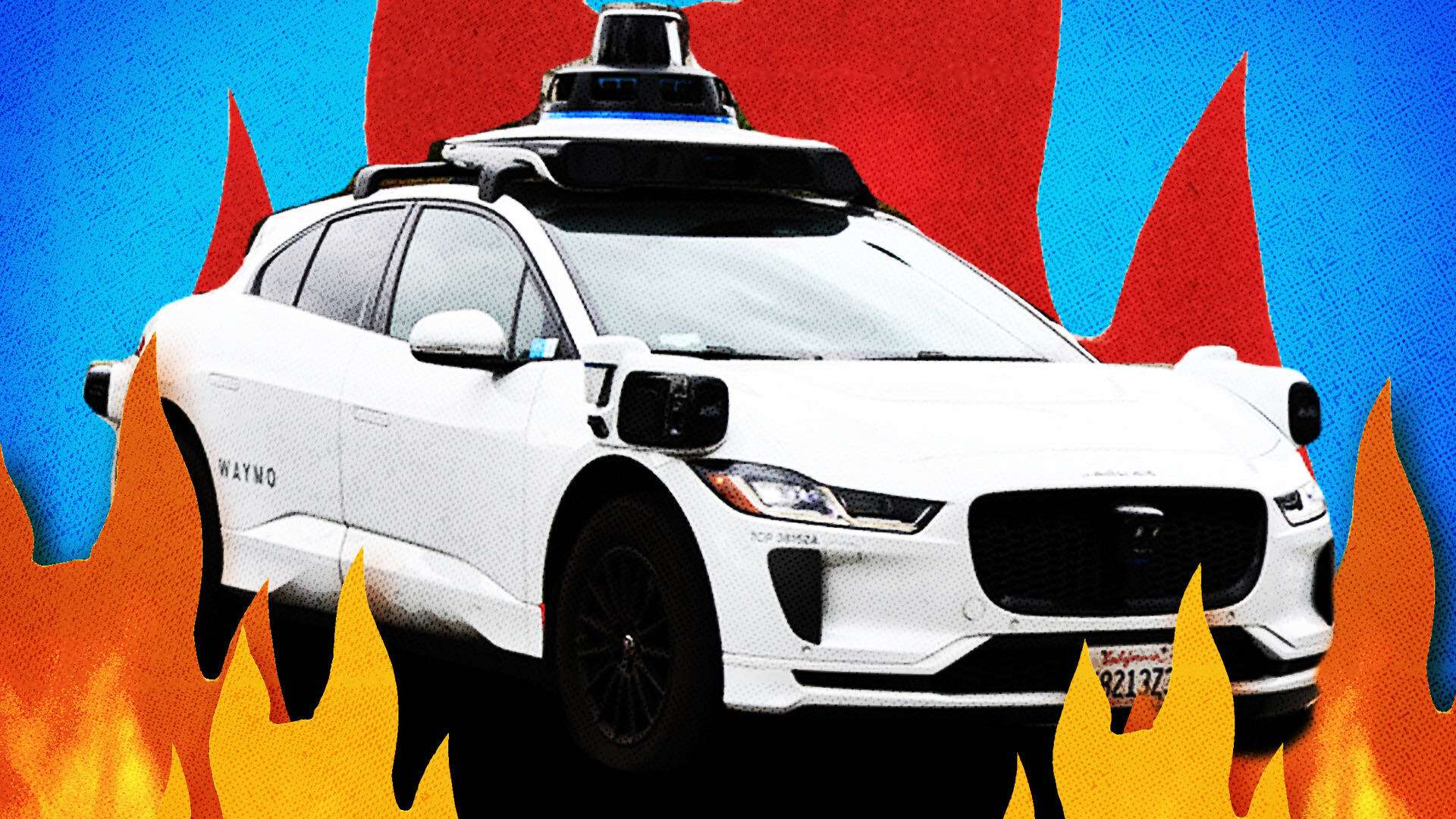
Even though its assertions about job losses and safety aren’t supported, the organization has persuaded the likely next mayor of D.C. to slow down Waymo’s progress.
At a demonstration against a bill to legalize Waymo in Washington, D.C., earlier in October, the prominent slogan was: “Robotaxis don’t vote; we vote.” Not much is known about the group behind the message, prompting questions about who is backing the resistance to robotaxis in America’s major cities.
People First Transportation Alliance (PFTA), the organization in question, portrays itself as a “statewide coalition of labor unions” devoted to prioritizing “people over untested technology.” The PFTA describes itself as a “coalition of community organizations, safe-streets advocates, and faith leaders.” However, as The Washington Post reported on Monday, the group appears to have overstated its connections with four of the thirteen individuals and organizations listed as its founding members.
“Several groups and individuals said statements made about them on the Transportation Alliance website were inaccurate,” the Post reported, adding that the PFTA “appears to be newly formed, with a limited social-media footprint. Its website domain was registered in late April, according to the Internet Corporation for Assigned Names and Numbers.” The group launched its social accounts in May, but there are no posts and no followers.
Beyond its focus on the capital, the PFTA lists New York and Philadelphia as priorities, two cities led by lawmakers who publicly oppose Waymo’s presence. Yet for a relatively unknown, recently formed organization, the PFTA has found success in its bid to keep autonomous vehicles like Waymo out of the Northeast corridor.
In February, the New York Post reported that Gov. Kathy Hochul (D–N.Y.) withdrew her own proposal—which would have allowed commercial robotaxi services such as Waymo to operate in smaller upstate New York communities—after a PFTA-led coalition generated enough backlash to derail support for the measure. A Hochul spokesperson told the Post that it was “clear that the support was not there to advance this proposal.”
The PFTA told the Post that the group would press the state to “pass legislation mandating a human driver behind the wheel in every vehicle and a thorough study that would lead to a plan addressing how driverless cars would affect New York State.”
The group’s stance comes even as consumer support for autonomous vehicles persists: a 2025 Obi study on Waymo, Uber, and Lyft—an app that aggregates real-time ride prices—found that 70 percent of Waymo riders preferred the service to Lyft or Uber and 42.7 percent of all respondents were willing to pay Waymo’s premium up to ten dollars extra for the service.
In spite of such consumer backing, autonomous vehicles aren’t guaranteed a favorable reception from lawmakers in some of the country’s biggest cities. In New York City, Waymo’s permit to run a pilot on public streets expired in March. Mayor Zohran Mamdani has remained noncommittal about renewing the permit. At a press conference that month, he stated that his administration would prioritize workers such as the city’s taxi drivers who “for far too long, have been sold a dream of climbing into the middle class, only to have the rug pulled out from under them.”
Despite the opacity surrounding the PFTA, its D.C. protest drew enough public support to prompt a response from a figure who is likely to be the city’s next mayor, current D.C. Councilmember Janeese Lewis George. In a post on X, Lewis George said D.C. was “facing a jobs crisis” that would be worsened by “rushing the legalization of autonomous vehicles.” She urged the D.C. Council—currently weighing a punitive measure to legalize commercial autonomous vehicles—to “get this right and not rush Waymo legislation this year.”
It remains unclear how long Lewis George intends for District residents to wait before autonomous vehicles become available. D.C.’s path to legalizing commercial robotaxis does not appear to be hurried.
Waymo began testing its vehicles in the city nearly two and a half years ago, in the spring of 2024. The company’s co-CEO Tekedra N. Mawakana said its fleet has logged “more than 300,000 miles in Washington, D.C.” Meanwhile, the District Department of Transportation (DDOT) has been conducting studies and coordinating working groups on autonomous vehicles for close to a decade. Yet the agency has been unable to craft a regulatory framework that would eventually permit commercial robotaxi services in the capital. In March, UrbanTurf reported that DDOT would undertake a long-awaited study on autonomous vehicles—originally due in 2022—and “expects to propose recommendations on AV deployment later this year.”
Opponents of autonomous vehicles, including Lewis George and the PFTA, frequently cite job losses as a reason to block the technology. Yet, with only about 200 full-time ride-share drivers in a city of roughly 400,000 workers, as Lewis George has purportedly claimed, the issue hardly amounts to a crisis.
As for PFTA’s public-safety claims, Waymo’s independently reviewed data show that, relative to an average human driver over the same distance, its vehicles produced 95 percent fewer crashes resulting in serious injuries or worse and 93 percent fewer pedestrian crashes with serious injuries.
PFTA asserts it represents the people most directly affected by transportation policy. The limited publicly available information suggests the group is more focused on safeguarding its members’ standing in the ride-share market than on improving rider experiences, who are increasingly choosing robotaxis when given the chance.
