
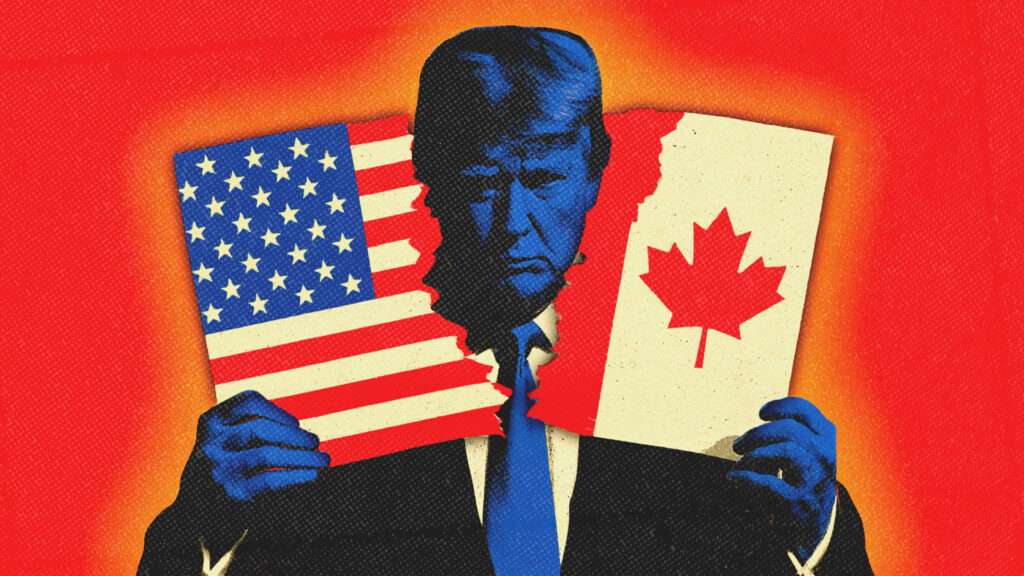
Illustration: Midjourney
Today, the Liberty Justice Center (LJC) initiated Gellert Global Group Corp. v. Trump, marking the first legal challenge to President Donald Trump’s expansive Section 338 tariffs placed on a range of Canadian imports. The suit was filed in the United States Court of International Trade, the tribunal with jurisdiction over tariff-related disputes; Gellert Global Group operates as a Canadian cheese importer affected by these duties. The LJC is the same public-interest organization that partnered on the earlier challenge to Trump’s IEEPA-based tariffs, which ultimately were invalidated by the Supreme Court. Although not directly participating in the current case, the author notes support and believes the action warrants success. In addition, LJC has pursued lawsuits contesting Trump’s Section 122 and Section 301 tariffs. They have grown into America’s leading public-interest law outfit dedicated to safeguarding free trade and curbing executive power over trade restrictions.
Section 338 traces its origins to the infamous Smoot-Hawley Tariff Act of 1930, a measure widely blamed for exacerbating the Great Depression. It has never before been employed, most likely because subsequent statutes rendered it superseded. Previous writings have argued that Trump’s Section 338 tariffs are harmful and unlawful. See the recent Montreal Economic Institute publication on this matter, along with earlier analyses here, here, and here. In brief terms, the Canadian tariffs are argued to be illegal for five fundamental reasons: first, that Section 338 has been displaced by later legislative changes; second, even if the provision remains in force, the tariffs fail to satisfy its criteria because the Canadian measures they purport to respond to do not “discriminate” against U.S. goods, as the statute requires; third, the tariffs do not “offset” the Canadian actions as required by Section 338, but instead extend far beyond that purpose; fourth, the administration’s interpretation of Section 338 appears to breach the “major questions” doctrine; and fifth, if Section 338 were operative and authorized these actions, it would contravene the constitutional nondelegation doctrine, which limits the transfer of legislative power to the executive branch.
The LJC complaint advances all five arguments. To prevail, the plaintiffs need only one favorable ruling. The document also contains several additional technical points that are not exhaustively discussed here. LJC seeks a class-action certification covering all importers subject to the Section 338 tariffs. If granted, such certification could halt enforcement of Section 338 tariffs across the board, not merely the duties paid by Gellert. This litigation does not directly challenge Trump’s broader expansion of Section 338 to categorically ban certain Canadian imports in conjunction with the tariffs. Based on current understanding, Gellert does not appear to be importing goods that are subject to the ban (as opposed to those under the tariff regime). Nevertheless, as explained in other analyses, the legality of the bans depends on the legitimacy of the initial tariffs.
A recent Lawfare examination outlines why executive-imposed import bans face nearly the same set of legal constraints as executive-imposed tariffs. Like IEEPA, Section 122, and Section 301 tariffs, Trump’s deployment of Section 338 can be viewed as an attempt to transform a narrow delegation of authority into a blank check that enables tariff impositions at the president’s discretion. Courts should reject all such power grabs. The LJC deserves recognition for pursuing this significant case, and there is reason to believe the legal contest to Section 338 measures may continue. Future challenges could well address the import bans directly, in addition to the tariffs themselves.
