
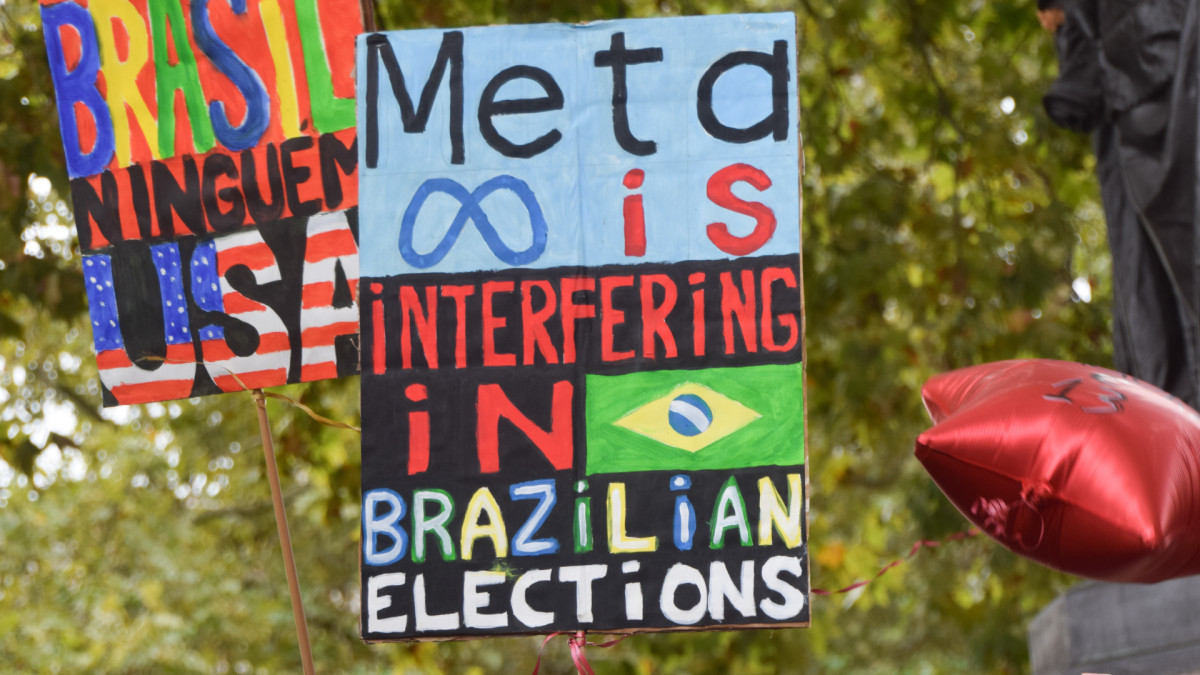
This week, hundreds of people demonstrated at Meta’s headquarters in São Paulo under the banner “META, don’t meddle.” On their platforms, Facebook (with more than 175 million active users in Brazil) and Instagram (around 147 million), a fundamental part of the political and electoral battle is being fought. There are indications to support that the tech giant could be favoring one side, a suspicion linked to the tensions between the company and Lula’s government over the latter’s attempts to regulate social networks in Brazil, as well as Meta’s ties to Donald Trump. Money and politics. And now money, technology, and politics. The new trident that erodes our democracies.
A Review of the Fight against Meta
During Lula’s government, a series of tensions with the company date back to January 2023, when the assault on the Praça dos Três Poderes by Bolsonaristas took place. From that moment began a dispute between Lula’s government, the Federal Supreme Court, and Meta over the company’s possible responsibility for the fake news that led to the Bolsonaristas’ assault. This partially ended when a bill, circulating in the legislature since 2020, was shelved; it sought to hold companies accountable for content that could be false.
“There are indications to support that the tech giant could be favoring one of the sides, a suspicion related to the tensions between the company and Lula’s government”
But Meta’s confrontation with Lula’s government reached its peak in January 2025, when the Office of the Attorney General of the Union gave the company seventy-two hours to explain why they were ending the veracity-verification protocols for what was being published. Lula’s government said it would respond with various institutional, judicial, and legislative actions. One of them was a lawsuit they filed against Meta for 1,770 ads with scams that used government symbols and manipulated images on social media.
The Elections
In August this year, one month and a few days before the first-round elections, Amnesty International published a report showing how Meta failed to block disinformation ads on Facebook. And on October 10, Lula’s campaign accused Meta of influencing the elections since last December. They noted that even at that moment the president’s accounts and those of other leftist leaders in Brazil were restricted in search systems. Something similar happened in the second round, when many users reported that searching for “Lula” on Instagram yielded many accounts that were not the president’s, while searching for “Flávio” yielded Flávio Bolsonaro’s account first and without issue. In the same complaint, the PT campaign said that Lula’s advertising had been restricted by the platform. Lula then announced he would escalate the interference to the OAS so that the company could be judged.
“On October 10, Lula’s campaign accused Meta of influencing the elections since last December”
Meta has acknowledged mistakes. The platform has admitted that there were some errors with Lula’s account, but vehemently denied that its algorithms had taken sides in favor of any candidate. Folha de S.Paulo revealed internal messages in which Meta employees admit serious errors with Lula’s campaign and that there were problems solving them. In the messages, it is clear that the employees knew exactly what was happening and that they should show other errors affecting Flávio Bolsonaro to counter the narrative that Meta was interfering in the elections. Errors or biases? Errors or technopolitical decisions?
The Lula Army’s Response
We have tracked very closely the response to all of this, which has been carried out from Lula’s campaign, or rather, almost outside of its control, in a campaign partly liberated from the rigid supervision of a strategic command. In the face of an increasingly visible tech-political alliance (platforms and political options), there is only a minimal option with a large hybrid mobilization (in the streets and online in a process of creative complementarity).
“In the face of an increasingly visible tech-political alliance (platforms and political options), there is only a minimal option with a large hybrid mobilization”
A very solid answer is the organization led by André Janones, the commander-in-chief of Lula’s Army, a WhatsApp channel with nearly eight million followers, which has managed to survive and not be shut down by order of the Superior Electoral Court on more than one occasion.
On the channel, Janones sends audio messages saying “Pessoal, Urgente, Explodam” (“People, urgent, explode it”) to Lula’s most loyal followers so they replicate messages and interact with the president’s videos, so that an initial push reaches more people. And civically hack the algorithm’s logic and biases in an organic way. It isn’t just about digital coordination and viral dynamics. It’s about accepting that in the digital battle there are some options to compete — and to win? — if cyber-activists’ actions are coordinated with military efficiency to dodge and reverse the platforms’ political bias.
But the strongest response to all this is flooding the area with AI-made content and citizen action. Janones’s approach is part of it, but Lula’s campaign, regardless of the outcome, has managed to organize and activate a large portion of its electorate with digital guerrilla tactics. There are videos of Lula dancing in all kinds of video game clips, musical numbers, and viral videos.
“The Lula campaign, regardless of the outcome, has managed to organize and activate a large portion of its electorate with digital guerrilla tactics”
A prime example was on October 17, when Lula’s Army saturated social networks with Lula supporters wearing Brazil’s national team jerseys, used simple elements like stars and red backgrounds in Instagram notes, boosted WhatsApp statuses, and turned any bored voter with a mobile phone into a key advocate.
Now, they even produce memes about the mobilization itself using Janones’s military language. And this is the result: it is possible to disrupt algorithms by filling networks around a candidate with content, with only a few original campaign posts circulating.
The best part is that algorithmically Meta has no way to respond to Lula’s Army’s red invasion. There’s no way to remove Lula’s face from their platforms, because even if they do, with a humorous song dramatized in a children’s video game and a TikTok dance, the message spreads from the bottom up, with organized commanders and solid leaders on social networks. But above all, with such strong popular support that allows facing the world’s largest companies on their own turf.
What Meta’s Interference Means for the Region
This isn’t the first time a tech company has been accused of meddling in an election. Years ago, Mark Zuckerberg himself had to testify before the United States Congress over the Cambridge Analytica scandal, for which the company has been condemned, a decade later, by a New Mexico court. Nor will it be the last if digital platforms continue to operate without clear regulation, as private spaces with the power to condition public debate without fully assuming the responsibility that power entails, a situation similar to the judicial vacuum in which prediction markets exist, as discussed in “Polymarket and Kalshi: prediction markets and political and electoral manipulation”.
“Nor will it be the last if digital platforms continue to operate without clear regulation, as private spaces with the power to condition public debate without fully assuming the responsibility that power entails”
The issue is no longer just whether Meta can interfere in a political campaign, but who controls those who have the power to alter the conditions in which opinions are formed, information circulates, and the vote is decided. Because when a company can influence public discourse without answering for its decisions, the line between content moderation and political intervention becomes increasingly blurred. And with it, one of democracy’s essential conditions weakens: that citizens can decide freely, without opaque private interests tilting the balance. This isn’t just about Brazil; it’s about now and here. Everywhere. And in every campaign.
