
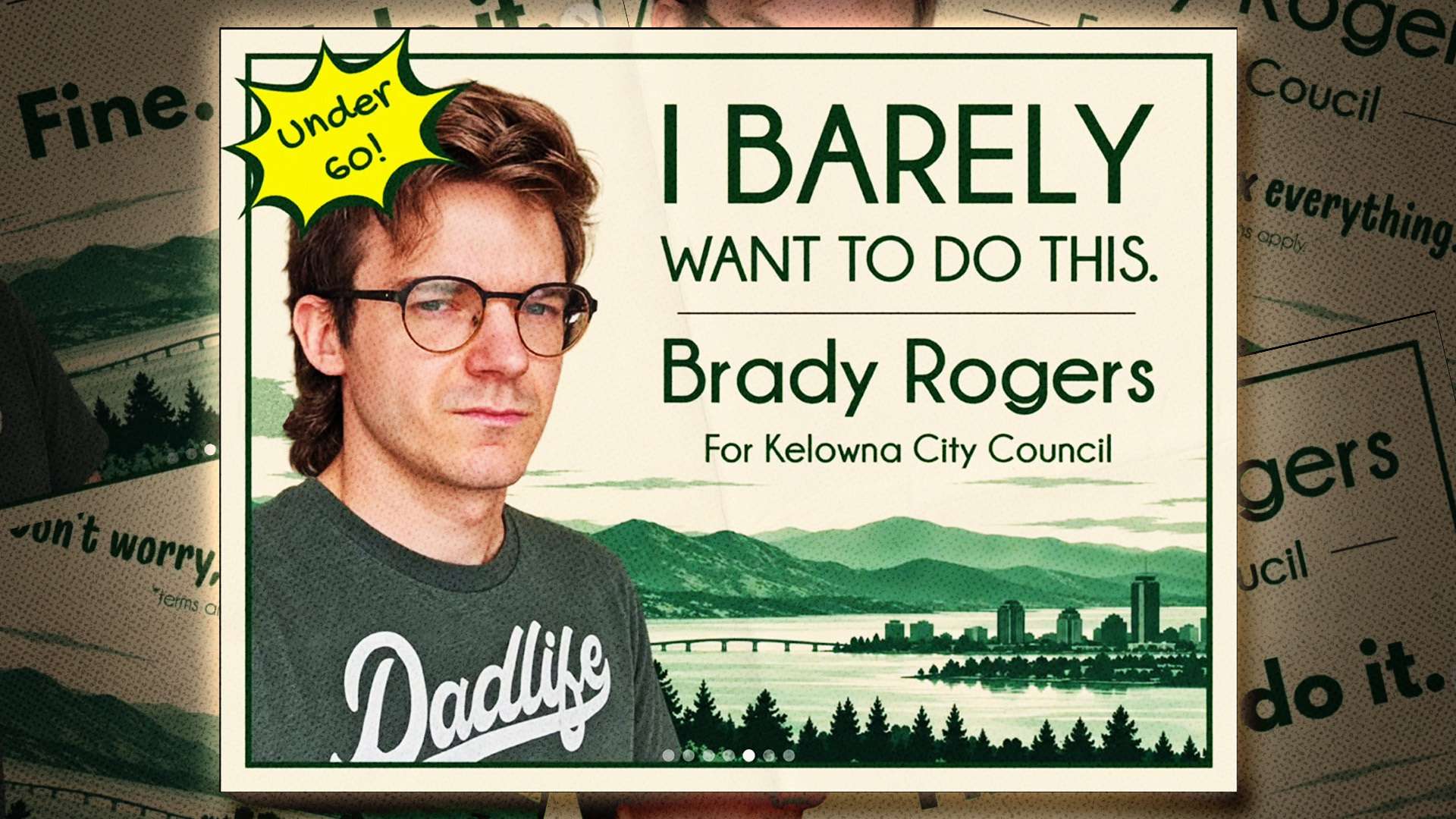
“I hardly want to take this on,” Brady Rogers conceded. Voters seemed to respond to that level of candor.
To many people—especially libertarians—the act of voting can feel draining. After all, every person who appears on the ballot is seeking some degree of influence over others’ lives.
That may be why it feels oddly refreshing to encounter a candidate who genuinely seems uninterested in the job itself.
Brady Rogers spent four years working as a robotics engineer before stepping away in 2019, deciding that the corporate world wasn’t the right fit for him.
“It felt a little unsatisfying,” Rogers told Reason. “I wanted to use my skills to make a more meaningful impact…So I left to pursue something that felt worthwhile.”
He launched The Rogerie, a retail shop in his hometown of Kelowna, British Columbia—a city of roughly 170,000 people. Rogers and his wife gather shredded plastic waste and turn it into filament for 3D printers, which they then use to manufacture new household goods to sell in the store.
Earlier this year, Rogers again sensed he could apply his abilities in a way that would benefit others. This time, the avenue was a bid for a seat on the Kelowna City Council.
Yet he needed to stand out in a crowded field: 37 candidates were vying, with only the eight highest finishers earning a council seat.
He devised a bold tactic: be upfront about his lack of qualifications and his own ambivalence about the job.
“I’m running for Kelowna city council,” his campaign site announced. “I’m not fond of meetings, I dislike having to be at specific places at fixed times, and I’m allergic to stuffy offices. But I love Kelowna, and I believe I can contribute something positive.”
“Do I enjoy politics? No,” he added. “Do I know what I’m doing? No. But am I qualified? Also no.”
That laid-back approach extended to his campaign signage: yard signs bore pictures of Rogers with a downturned mouth and a shrug, paired with lines like “I barely want to do this” and “Let’s see what happens.” One sign even cheekily touted that he was “Under 60!” in a nod to political longevity.
The tactic caught fire, and the campaign quickly went viral.
“I thought the idea was clever and I assumed it would work, but it really reflected how I felt at the outset,” Rogers says. “I grappled with committing to a four-year term without fully understanding all the details, yet I also saw a real opportunity to make a bigger impact. So I was torn, and I figured that honesty was a strong starting point for a campaign.”
In the end, he won a seat, finishing fourth out of 37 candidates and defeating three incumbents, one of whom lost her position.
The irony of Rogers’ outwardly nonchalant demeanor is that he does possess a policy platform. On his website, he advocates addressing homelessness not merely through heightened spending but by making smarter use of the resources already available from the city and the province. He also notes that Kelowna taxes land and improvements at the same rate, which, in his view, taxes someone for improving property while rewarding those who keep valuable land underutilized. This argument found a similar echo in Reason columnist J.D. Tuccille’s piece this week.
Of course, the claim that Rogers was underqualified and disinterested is only partly true—he did, after all, want the job or at least viewed it as a viable means to improve his city.
Still, his example offers a refreshing reminder that public service does not always have to be portrayed as a sacred calling.
Ultimately, Rogers believes authenticity fueled his campaign’s resonance and helped secure voter support in a landscape where many campaigns struggle to create viral moments or ride social-media trends. Perhaps others could learn from his approach.
“I think the reason mine resonated so deeply is that there’s humor at play, yet behind it stands a genuine platform, a real person with skills, and a sincere desire to contribute,” Rogers reflects. “I think that struck a chord. I think people are hungry for a new kind of politics.”
