It’s easier to understand others’ positions when there’s no ocean in between. While the La Toja Forum manages to remove the Atlantic from the equation, listening to Carlos Díaz-Rosillo, it’s clear that still there are, not an ocean, but perhaps a sea of differences between the United States and Europe. Perhaps it isn’t as big as we think.
Our continent has spent years debating how to depend less on the United States, but it’s hard to have that conversation without first talking about Donald Trump, whom Díaz-Rosillo knew very well when he was Director of Public Policy at the White House. During that first Trump Administration, the political scientist immersed himself in the already well-known The Art of the Deal, the art of negotiation, and I asked him to turn it on its head to explain to us Europeans how to deal with Trump: “It’s easy to know what [Trump] wants, and once you know the other side’s objectives, negotiating becomes much easier”, he replied.
We also touched on other points of U.S. foreign policy. Díaz-Rosillo, who is currently the founding director of the Adam Smith Center for Economic Freedom, believes that the upcoming midterm elections could push Trump to focus his efforts outside the United States and is convinced that some of his policies, such as tariffs, will survive even a Democratic presidency.
We also talked about NATO, China, and a Europe that, in his view, has more opportunities than threats in its relationship with Washington. And, since we both share Cuban origins, I asked him about the island’s geopolitical situation and Trump’s possible steps. In this case, the former presidential adviser foresees a political shift that would not involve direct military intervention, in the style of Venezuela, but a move “from within”.
After listening to him, one can think that the distance between the two shores, the European and the American, lies not so much in their interests as in what each side expects from the other.
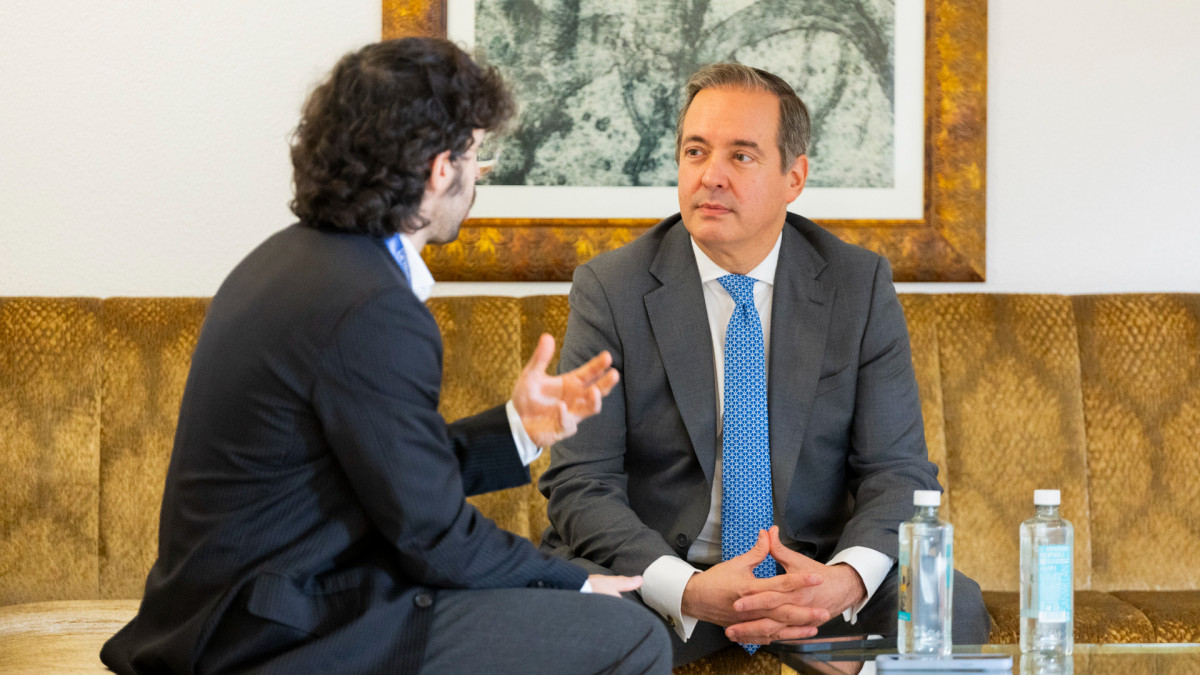
Díaz-Rosillo is the founding director of the Adam Smith Center for Economic Freedom, a think tank at Florida International University. Photo: Agenda Pública / Yanka Soto
I want to start with a question raised during the forum that I found very interesting: the Trump 3.0 version. What consequences do you think this new phase could have, first in U.S. domestic politics and then in relations with Europe?
In domestic politics I think we will see very little legislative activity. To implement deep changes in public policy you need the Congress. If the Democrats win the Congress, Trump will not have the majorities required to pass bills and he will focus on what he can do through executive power, which in domestic policy isn’t much. He can apply existing laws with more or less intensity and give priority to certain topics, but he cannot change public policy by decree.
“If the Democrats win Congress, Trump will not have the majorities required to pass bills, and he will focus on what he can do through executive power”
That situation will likely frustrate him and drive him to focus on the realm where he has a broad unilateral margin: foreign policy. The president wields a lot of power there and I believe he will devote a large portion of his time to it.
And do you view this as a problem or an opportunity for Europe?
It’s a great opportunity. Although his comments and statements generate controversy, I think there is a lot of truth to what he says. We can argue about whether he phrases it in the best way, but, for instance, in NATO, a fundamental issue for Europe, I think the Alliance is stronger today because Trump has pressed its members to spend on defense what they had promised to spend. We can discuss the methods, but the substance of his message contains a good deal of truth.
You said here in La Toja that Trump has laid down some ideas that will not disappear with the end of his presidency. What pillars will stay there, even if a Democratic presidency arrives?
I’d highlight two issues. First, the tariffs, which I believe are here to stay. They may go down, they may change percentages, but I don’t see a Democratic administration renouncing those revenues. That gives the president a lot of flexibility to fund projects that matter to him. That’s why I don’t think tariffs will fall to zero, even with a Democratic Government.
“They can go down, they can change the percentages, but I don’t see a Democratic administration renouncing those revenues”
Secondly, the “America First” policy. The average American voter feels that other countries have taken advantage of the good faith of the United States. And while the United States has gained from free-trade deals and globalization, it’s clear that other countries have benefited more. So there will continue to be a strong emphasis on prioritizing the United States over the rest of the world and on requiring that any foreign policy deliver a tangible benefit to American voters. That orientation will endure.
You have worked in the White House, very close to Trump. If you had to come to advise us in Europe, how would you say we should approach Trump?
Negotiating with Trump is relatively straightforward. He is a quite transparent man, who says what he does and does what he says. As I mentioned, in his first book [Trump: The Art of the Deal] he clearly explains what his strategy is. It’s easy to know what he wants, and when you understand the other side’s objectives, negotiating becomes much simpler.
The first step is to understand why he does what he does and says what he says, including his frustration with what he perceives as a world that takes advantage of the United States’ goodwill. He was elected to be President of the United States, not to be popular in Brussels or Paris, but to defend the interests of his citizens. He does not care at all about his popularity in the world’s capitals. Understanding that can help any leader a great deal.
“He was elected to be President of the United States, not to be popular in Brussels or Paris, but to defend the interests of his citizens”
There is also an emphasis on the importance of personal relationships for him. Getting along with his counterpart matters, but that does not mean telling them what they want to hear. Trump respects strength, and he does not like leaders who show weakness or try to please him. He likes others to project strength and to understand how important the personal relationship is to him.
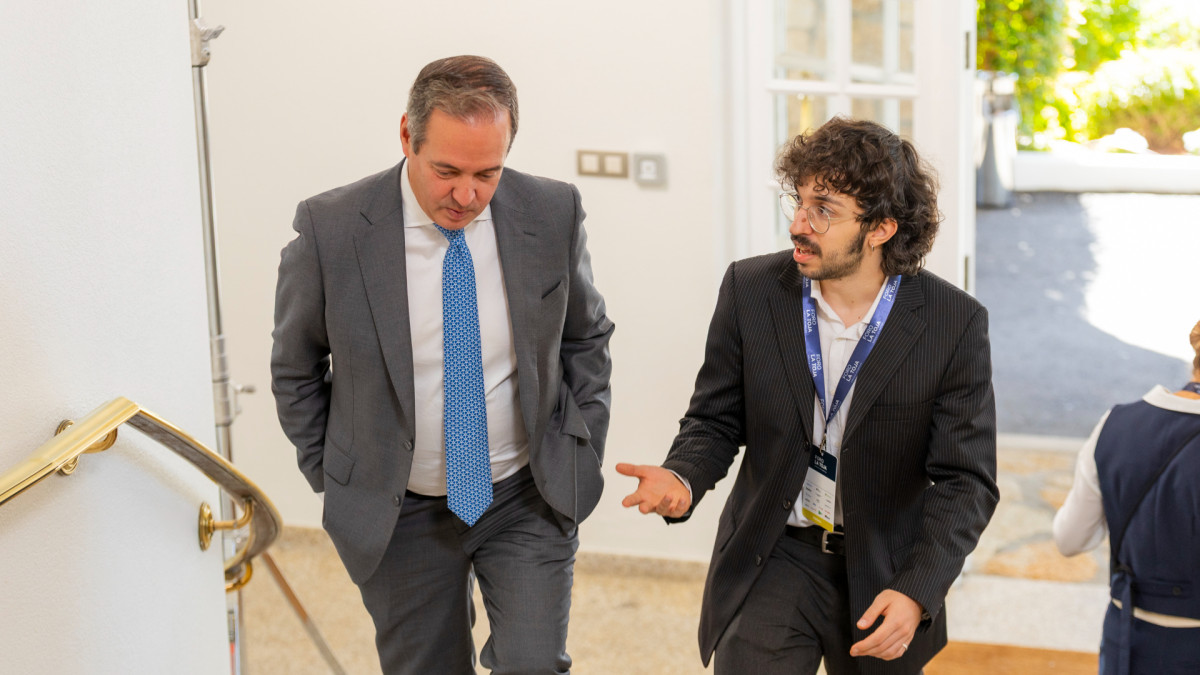
In addition to his political roles, Díaz-Rosillo has taught at Harvard University. Photo: Agenda Pública / Yanka Soto
It’s clear that Europe is not currently competing with the United States, whose main rival is China. But precisely, if the United States’ rival is China, and given that Trump has also taken a particular approach to Europe, wouldn’t it be easier for the United States to compete with China if Europe were closer to Washington?
Undoubtedly, and I think that is precisely what he desires. However, as I mentioned in the panel, the question of reciprocity stands in the way. Trump would like to have an even closer alliance with Europe, but he believes that today that relationship is not reciprocal.
“Trump would like to have an even closer alliance with Europe, but he believes that today the relationship is not reciprocal”
The great danger of his strategy is that Europe becomes disillusioned and ends up moving closer to China. But if Europe is prudent and understands that its logical military, trade, and cultural ally is the United States, I think that won’t happen. There is a risk that would be quite dangerous, especially for Europe, though no strategy is without risks.
You, like me, are of Cuban descent: what do you think will happen on the island? What is on Trump’s mind?
I am convinced there will be change. The Iran conflict has delayed his arrival relative to what many of us expected, because the United States is very focused on that conflict. Trump has said clearly, again and again, that Cuba will be the next country in the Western Hemisphere where change will occur. I have no doubt that it will come. I don’t foresee a military invasion, nor do I think it will unfold exactly as in Venezuela. It will be somewhat similar in the sense that there will be change, but I don’t think it will involve toppling the leader, because there are many differences.
“Trump has clearly, again and again, said that Cuba will be the next country in the Western Hemisphere where there will be change”
Today’s Cuban leader is not the one calling the shots in Cuba, unlike Maduro, who did govern Venezuela. Moreover, we’re talking about a regime that has been in power for almost seventy years. That is why I believe the change will come from within. Trump will catalyze it from inside the system so that the U.S. government can work with someone who is likely to come from within to ensure the country’s operational control. Over time, a democratic process will arrive, but it won’t happen overnight or in a week or two: it will take months, if not years.
So, do you think, at heart, the incentive is democratic, or are there other interests behind it?
There is no doubt that, for both Trump and Secretary of State Mike Pompeo, and for whom Cuba is a personal matter, the ultimate objective is a free and democratic Cuba. But to reach that point, first one must guarantee the operational control of the country, and at this moment, the only ones capable of doing so are the country’s own military, who come from within the system.
“For both Trump and Secretary of State, Mike Pompeo, for whom Cuba is a personal matter, the ultimate objective is a free and democratic Cuba”
Therefore, although the aim is long-term democracy, the short- and medium-term priorities are to seize operational control of the country and revive the economy. And that economic recovery must benefit not only Cubans, who obviously must benefit, but also the United States. Because Trump is the President of the United States, not of Cuba.
In partnership with