Javi López and Dave Keating: The Future of Europe Will Also Be Decided on November 29
October 25, 2026
In Brussels there is a paradox that is hard to hide. The European People’s Party supports with Socialists and Liberals the majority for Ursula von der Leyen, but it seeks votes from the radical right to push through certain policies. It is a formula that is generating increasing tensions and that could become even more problematic if the elections on November 29 leave Pedro Sánchez out of La Moncloa.
To understand how far this situation can be sustained, I traveled to the European capital to talk with Javi López and Dave Keating, two voices who understand how the European institutions work from very different places: one participates in their decisions and the other follows them as a journalist from Brussels. Yet both agree on the influence of the Spanish president on the European center-left, although López insists that the debate goes beyond who governs Spain: “Right now, the last thing the European Union needs is an institutional crisis.”
The balance of the European Parliament is only the starting point. The conversation also delves into the advance of the radical right in Germany, the possibility of Marine Le Pen’s presidency in France, trade relations with China, and the consequences of the American elections for Europe. And it stops in Ceuta, where the community response has again brought onto the table the solidarity among member states. Keating explains the underlying mechanism: “There is an official majority backing Von der Leyen and an informal right-wing majority that serves to approve certain measures.”
Editorial note: This interview has been edited for length and clarity. Therefore, the written version may differ from the video.
Spain is heading toward general elections and Pedro Sánchez has become one of the main leaders of the European center-left. Considering how much national politics conditions decisions in Brussels, what would a change of government in Spain mean for the European Union?
Javi López (J. L.): Pedro Sánchez is probably the most important and influential figure of the European center-left since Tony Blair. Not only for his electoral successes at the head of one of Europe’s major countries, but also because his political orientation has heavily influenced the European center-left as a whole.
We have shown that economic growth and a solid social model are not incompatible. One can grow without lowering wages or cutting public investment, and combine an industrial policy, the ecological transition, and a voice of one’s own in the world, committed to defending international law.
“Pedro Sánchez is probably the most important and influential figure of the European center-left since Tony Blair”
Sánchez has questioned some established approaches to Gaza, migration, transatlantic relations, Iran, or the green agenda. He has also helped maintain a certain political balance in the European Council, where the bloc’s progressives have very few representatives. I hope he remains at the head of the Spanish government. Otherwise, we risk consolidating the hegemony of the center-right, with an increasing influence of the radical right at the core of European decision-making.
Dave Keating (D. K.): I agree that Sánchez is the most important center-left leader since Tony Blair. But I think that says as much about the poor state of the European left as about Sánchez himself. Who else could aspire to that role? Olaf Scholz? François Hollande? Sánchez has, in a sense, become the last one standing.
The center-left has very little weight in the European Council. Mette Frederiksen has moved considerably to the right on several issues, Malta has limited political weight and Sweden could have another center-left prime minister. But without Sánchez, the traditional center-left would lose almost its only prominent voice at that table.
“Without Sánchez, the traditional center-left would lose almost its only prominent voice at that table”
There could also be consequences in the European Parliament. According to some reports, Iratxe García, head of the S&D group, wants to abandon the centrist deal that sustains Ursula von der Leyen. Many socialist MEPs are frustrated because the European People’s Party (EPP) cooperates increasingly with the radical right to pass legislation. Some want a formal pact with the EPP that limits that cooperation.
According to those reports, Sánchez has been an important figure in preventing a rupture. So, even if he is not particularly enthusiastic about Von der Leyen, he may have helped keep his parliamentary majority united. His departure could change things.
Javi, conservatives, socialists, and liberals have long been the political families that pushed European integration forward. But their relationship is going through a period of strong tensions. How fragile is that majority and where is the main problem?
J. L.: It is incredibly fragile. We’re in a precarious balance. But the real question isn’t who governs each country, but in which direction European policies are moving. If the agenda focuses exclusively on hardening migration policies, deregulation, and weakening the European Green Deal, the Socialist group will withdraw its support.
“If the agenda focuses exclusively on hardening migration policies, deregulation and weakening the European Green Deal, the Socialist group will withdraw its support”
I’m proud of what we achieved in the previous legislature: common borrowing, NextGenerationEU, our response to Russia’s invasion of Ukraine, and the European Green Deal. By contrast, the agenda of the current term is disappointing. We talk constantly about competitiveness and European sovereignty, but we do too little to advance both.
Our response to the new geopolitical context has been weak. We have not found the political will needed for Europe to have a credible voice in the world. Right now, the last thing the European Union needs is an institutional crisis. We want to help, but keeping a pro-European majority requires an agenda capable of uniting it.
Dave, precisely when Europe needs more unity, the alliance that has traditionally sustained European integration is under immense pressure. What would happen if the socialists broke with the centrist majority backing Ursula von der Leyen?
D. K.: The first question is what it would really mean to move into opposition. If that break led to a successful no-confidence motion, the whole European Commission would have to be replaced. It would be a long process; there is no clear successor to Von der Leyen, and the socialists could lose their most important representative on the Commission, Teresa Ribera. The risks are considerable.
“If that break ended up triggering a successful no-confidence motion, the entire European Commission would have to be replaced”
But the EPP has dominated European politics for more than two decades. We haven’t had a center-left European Commission president since 2004, and the EPP has been the largest group in the European Parliament since 1999. Now, the Parliament is the institution where S&D retains the most influence because it remains the second-largest group.
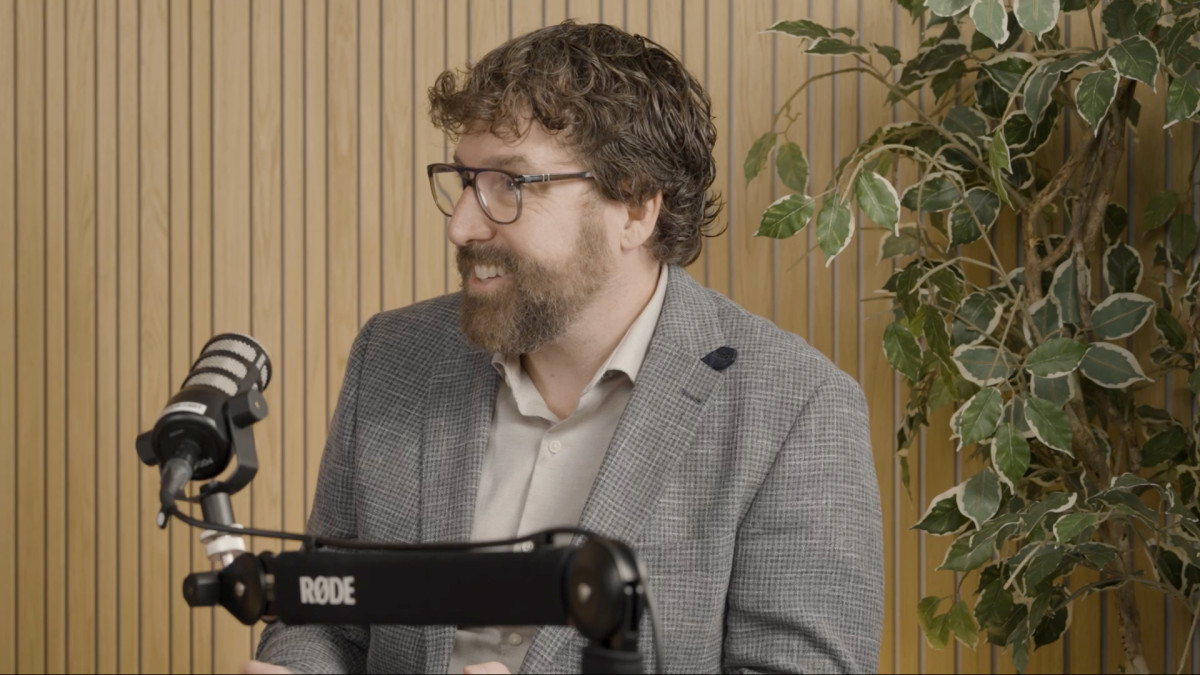
Javi López, Vice President of the European Parliament, explains the tensions between the forces sustaining von der Leyen. Photo: Agenda Pública
He described the European Parliament as the main instrument of influence left to the socialists. Is that because the Council is politically unbalanced or is it simply a reflection of the governments chosen by European citizens?
D. K.: Europeans continue to elect center-right governments. That is democracy. The European Council reflects the governments that voters choose, although I’m not sure they are fully aware of how long they have kept the center-right in power at the European level.
The European Parliament is more politically balanced. That’s why some socialists believe they should use their leverage: at least threaten to withdraw support if the EPP does not accept a more stable coalition arrangement and stops cooperating with the radical right. That is the argument I am hearing.
J. L.: Exactly. No Parliament can function sustainably with two opposing government majorities. Yet the EPP wants to cooperate with the radical right on deregulation and migration, while at the same time relying on the pro-European majority for institutional appointments and the EU budget. That cannot work indefinitely. Sooner or later it will lead to a serious political accident.
“No Parliament can function sustainably with two opposing government majorities”
Midterm negotiations in the Parliament are an opportunity to rebuild a stable majority. What matters isn’t only who holds each position, but whether we can agree on a political program: investment, industrial policy, ecological transition, and more sovereignty in areas such as security and digital technology. For that, resources, proper rules, and above all political will are needed.
D. K.: And the contradiction is striking. After the 2024 European elections, the EPP said it would keep the political cordon against the radical right and would work with liberals and socialists. Yet since then it has allied with the radical right in concrete votes more and more. There is an official majority backing Von der Leyen and an informal right-wing majority that serves to approve certain measures.
In Germany, Friedrich Merz’s CDU/CSU continues to reject governing with Alternative für Deutschland (AfD) and instead cooperates with the center-left. In Brussels, that same political family cooperates with parties situated further to the right. I don’t think public opinion fully understands that contradiction.
In Germany, the CDU still rejects any collaboration with AfD, but that divide seems less firm in other countries and even at the European level. Could what we’re seeing in Brussels end up spreading to the German federal government?
D. K.: Germany is increasingly the exception. In other countries, center-right parties have already struck deals with the radical right. In Sweden, the center-right has depended on the Sweden Democrats. In Italy, Forza Italia governs with Brothers of Italy, Giorgia Meloni’s party. There are also examples in Finland.
J. L.: I agree. Collaborating with the radical right has become normal for much of the European center-right, even in Brussels. I think that undermines the democratic consensus on which European integration was built and can also harm traditional conservative parties. Just look at what has happened in countries like Italy or France.
But does that mean the cordon sanitaire is enough to defeat the radical right? Not at all. It can limit its influence over core political decisions, but it does not answer why people vote for it. We have to understand the fear and insecurity of those who opportunistically support these parties and offer protection, stability, confidence in our institutions, and a credible future hope.
D. K.: There’s an argument against the cordon sanitaire: parties permanently excluded from government can criticize everything without having to take responsibility for anything. The Netherlands is an interesting test. Geert Wilders’ party entered government, that government fell, and afterward the party lost support. But it didn’t disappear.
“Governance can expose a party’s limits, but no one guarantees it will weaken them”
I imagine in Spain some defend something similar: giving ministerial responsibilities to Vox and letting voters see the difference between rhetoric and governance. The problem is the risk. Governing can reveal a party’s limits, but no one guarantees that will weaken it. Wilders’ party remained the second force.
J. L.: I remain in favor of the cordon sanitaire. It’s an important tool to protect a democratic consensus, though it cannot be our only electoral strategy. That’s another reason why the Spanish elections matter: they will influence both the voice of the center-left in Europe and the balance of power in its institutions.
Dave Keating, France 24’s Brussels correspondent, analyzes the center-right’s cooperation with the radical right. Photo: Agenda Pública
Imagine AfD becomes the leading force in Germany in the next federal elections, even if it cannot govern alone. Could that change Berlin’s relationship with Russia or its support for Ukraine? How realistic is that scenario?
D. K.: For now, the traditional parties say they would keep AfD out of government even if it were first. The German electoral system also makes an absolute majority highly unlikely.
Could the CDU/CSU shift its stance and admit AfD into a coalition? It’s possible. Perhaps it believes that governing responsibilities would expose AfD’s weaknesses. But I find it hard to imagine the CDU handing over the ministries of Foreign Affairs or Defense, which have direct control over relations with Russia and support for Ukraine. Their influence would depend a lot on the role AfD would play in government. Right now I don’t see a realistic scenario with an AfD chancellor. Javi, do you agree?
J. L.: In general, yes. I think Germany still has sufficient institutional checks. AfD is one of the most extreme parties on the European radical right. I have deep disagreements with Brothers of Italy, Meloni’s party, but they are not the same as AfD.
D. K.: And Meloni supports Ukraine.
J. L.: Exactly. She also, in general terms, accepts the current EU framework. A Germany governed by AfD could represent something completely different, even the end of the European Union as we know it.
“A Germany governed by AfD could represent something completely different, even the end of the European Union as we know it”
But the question that most interests me is how to avoid reaching that situation. Germany has years of economic stagnation. The radical right blames migration, European regulation, China, and other external factors, but the underlying problem is that the traditional German economic model no longer works.
It depended on cheap energy from Russia and a certain form of globalization. Those conditions have changed. Germany and Europe invested too little for two decades and failed to build genuine economic and strategic sovereignty. Solving those structural weaknesses is more useful than constantly speculating about AfD.
Javi just described the problems with the German economic model and the need for a stronger European industrial policy. Dave, France and Germany have now presented a joint position on China. Why is Berlin’s shift so significant and how can other member states respond?
D. K.: It is a major shift in German policy. France has long argued for stronger measures to protect European industry from Chinese competition. Germany resisted, partly because its economy is tightly linked to China. That Merz’s support for the joint statement surprised Brussels. The French position was predictable; the German one, not.
There is growing concern about Europe’s economic dependence on China, though the Nordic countries and others remain skeptical of protectionist measures. But we must be realistic. China is deeply integrated into European markets and supply chains.
The idea of a kind of economic decoupling switch raises a fundamental question: if Europe shut its market to China, how would our economy withstand the impact? I think that question has not been adequately answered and, without an answer, I’m not convinced the strategy is credible.
J. L.: First of all, it’s good news that France and Germany have reached an agreement. It has not happened with the necessary frequency, and the lack of understanding between Paris and Berlin has been one of Europe’s great problems. But leading means bringing others on board, not imposing a position on them.
Second, our huge trade imbalance with China is about one billion euros a day. Europe needs to regain industrial policy and rebuild its strategic industrial capacities. After decades of minimizing the role of the public sector, it is encouraging that this debate is changing.
“I wouldn’t recommend opening a third geopolitical front with China”
But threatening to disconnect China from the European market does not seem like a credible strategy. We need to negotiate a rebalancing that benefits both sides. China has shown extraordinary ingenuity in responding to economic challenges, and Europe must be equally imaginative.
Our relationship with the United States is changing and we need to become a stronger power to continue being a credible ally. Russia is already a direct and existential threat after its invasion of Ukraine. I wouldn’t recommend opening a third geopolitical front with China.
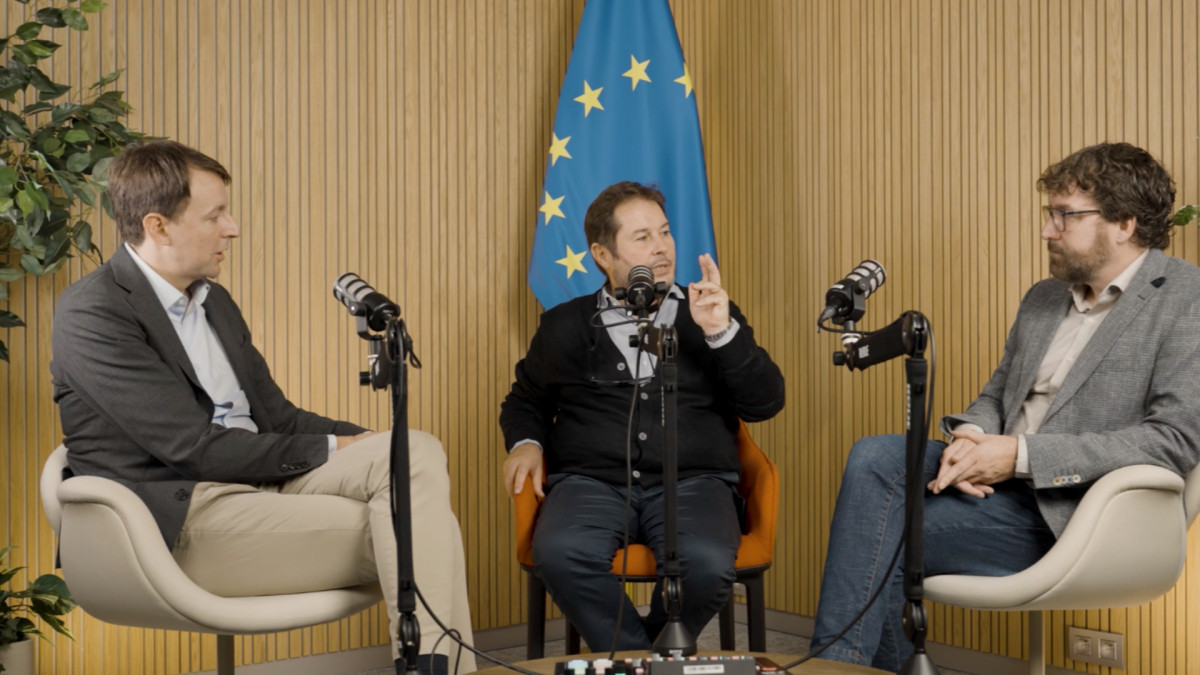
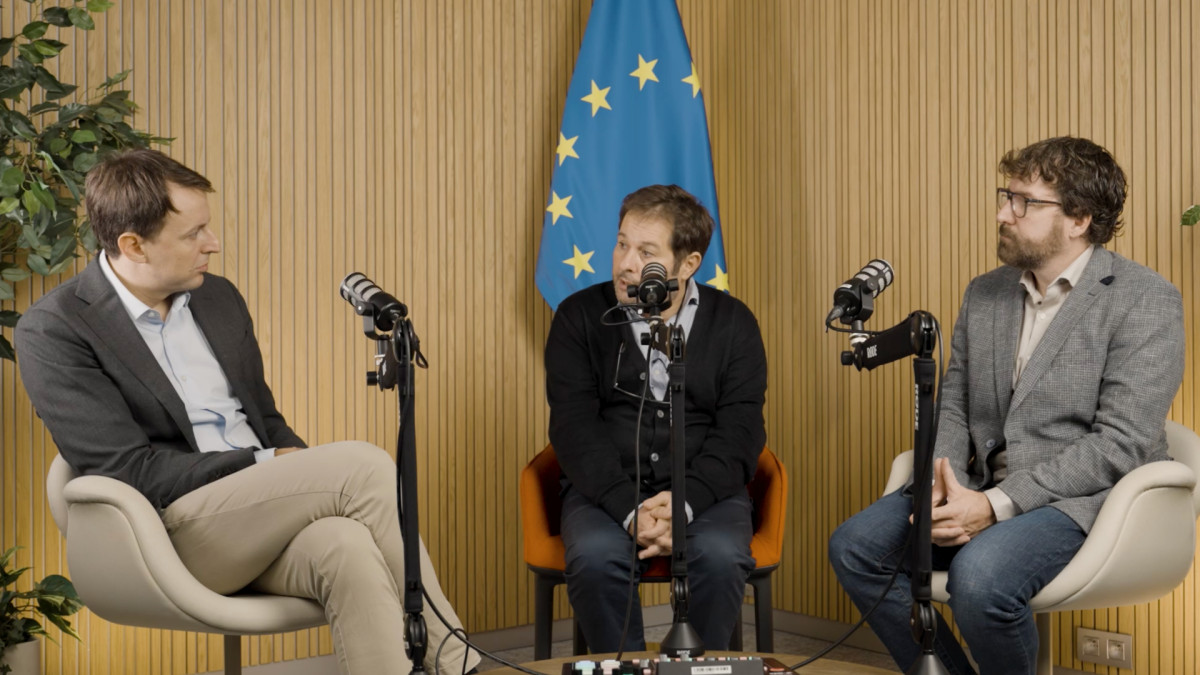
Javi López, Marc López Plana and Dave Keating discuss Germany and European industrial policy, with the EU flag in the background. Photo: Agenda Pública
The midterm elections in the United States are another major unknown for Europe. Many in Brussels expect a Democratic win to limit Donald Trump’s room for maneuver. Would it really change the transatlantic relationship or could it even have the opposite effect?
D. K.: I worry it would have the opposite effect. Even if the Democrats win both chambers and their representatives take their seats, Trump could focus even more on areas where the president has wide latitude: foreign policy and tariffs.
“Trump could concentrate even more on areas where the president has wide latitude: foreign policy and tariffs”
In Brussels there are many people hoping that the “good Americans” will rescue Europe. But the power of the U.S. Presidency has been increasing for decades, especially in foreign policy. Congress has mechanisms to limit tariff policy, but its ability to hold back the White House on some issues that most affect Europe is limited.
That’s why I don’t see how a Democratic victory would fundamentally transform the transatlantic relationship. Europeans are looking for solutions where they shouldn’t have to.
J. L.: That’s exactly the mistake we made during Trump’s first term. We waited for things to change in Washington, hoping to return to the international order we knew. It was a disastrous strategy. We wasted a decade waiting for another political outcome in the United States.
Javi, Dave has just warned against the idea of waiting for U.S. policy to solve Europe’s problems. However, at times it seems that Ursula von der Leyen’s Commission has been pursuing precisely that strategy. How do you rate her response?
J. L.: I would call it appeasement, and I am very critical of it. I recognize the Commission’s good intentions. But in Brussels we applaud Mark Carney’s speeches and almost never do what he does. We should reflect on that contradiction.
Let me move to Ceuta as the European border. When Poland faced pressure at its eastern border, other EU governments spoke of solidarity and defending Europe’s borders. Why was the initial European reaction to the Ceuta crisis so different?
J. L.: I think the explanation is political. Some governments of the European People’s Party used the Ceuta crisis to attack Europe’s main progressive government, instead of defending Europe’s general interest.
Javi López addresses the European response to the Ceuta crisis and the initial lack of solidarity among governments. Photo: Agenda Pública
Are you saying that the Spanish People’s Party used its influence within the European People’s Party to turn the Ceuta crisis into a political attack on Sánchez’s government?
J. L.: Of course. The PP is an important force within the PPE and the crisis was instrumentalized in an extremely partisan way. What we were witnessing was an attack on Spanish and European sovereignty, with implications for strategic autonomy and the security of the Strait of Gibraltar.
“Some governments of the European People’s Party used the Ceuta crisis to attack Europe’s main progressive government”
After several days, the matter reached the European Council and a more institutional response began to emerge. But that delay mattered. Episodes like this test European unity and I think we failed that test.
There is another factor: migration has become a toxic political issue. Fear and electoral anxiety condition the response in a very different way than a decade ago, when many Syrian refugees arrived in Greece and Italy. Both partisan confrontation and the toxicity of the migration debate acted at the same time.
D. K.: I also see two factors. The EPP was upset with Spain’s immigrant regularization program and tried to cast the crisis as a consequence of that policy, although the evidence does not allow establishing that relation.
But Spain also complicated its position by not publicly acknowledging the possibility of a hybrid attack. Poland directly accused Belarus of deliberately pressing at its border. Spain did not publicly attribute what happened in Ceuta to Morocco.
There are legitimate questions. Why were so many people able to cross? Why were many of them Moroccan citizens? But I understand the government’s reluctance to accuse Rabat: Spain depends heavily on Moroccan cooperation to manage migration, and a diplomatic confrontation would carry a high cost.
“Spain depends heavily on Moroccan cooperation to manage migration”
This caution left a political vacuum. Leaders like Meloni offered their own explanation, linking the crossings to Spain’s migration policy. In broader terms, the EU’s dependence on Morocco makes even talking about deliberate pressure diplomatically difficult.
In Poland, the EU could openly discuss Belarus’s role. With Ceuta, Europe’s dependence on Morocco seems to hinder any such accusation. Is it possible the Commission itself preferred Sánchez avoid publicly attributing what happened to Rabat?
D. K.: Yes. That matches what I’ve heard.
J. L.: I understand the argument. But a state can only formally attribute an operation when it has sufficiently reliable evidence. Spanish authorities have not publicly identified who could be behind those unusual crossings or the activity seen on social media. It may simply be that there is not enough evidence to make an accusation.
Spanish and European authorities also acknowledged good cooperation with Morocco in the days after the incident. The situation may be more complex than the Belarus and Poland case.
The thing that worries me most is the initial lack of solidarity and the instrumentalization of politics. It was a sad moment for Europe. It tested our unity and we were not up to the task.
Dave Keating outlines the consequences for European integration of a Marine Le Pen presidency in France. Photo: Agenda Pública
Spain is heading toward the polls and France, Poland, and Italy also face important elections. Taken together, these processes could alter the political balance of Europe. What European Union do they image could emerge from this electoral cycle?
J. L.: In the end, citizens will decide. That is the positive part of democracy: the future isn’t written. Europe’s future is also decided on November 29.
I see two possible paths. One is an Europe in which conservatives and the radical right collaborate not only in parliamentary votes but also in national governments. That could freeze European integration and weaken our ability to protect prosperity, democracy, and the social model in a much more hostile world.
The alternative is to build a new pro-European consensus, as Sánchez is trying to do in Spain: strengthen European sovereignty, defend our social model, and develop the collective capacity to act effectively. Individual states cannot achieve all of this. Europe needs strength and a common voice.
D. K.: I don’t want to end on too pessimistic a note, but I don’t see any scenario in which the European Union, as we know it, survives a French presidency of Marine Le Pen. She may have abandoned Frexit, but her project would roll back integration to something like the Maastricht-era: little more than a free-trade zone.
“I don’t see any scenario in which the European Union, as we know it, survives a French presidency of Marine Le Pen”
The institutions could survive on paper, but competencies would return to the national capitals. That would mean giving up the goal of European sovereignty. Le Pen tells the French that France can be independent on its own, but even France cannot achieve a real degree of strategic autonomy in isolation.
Some expect she will govern pragmatically, like Meloni. But Meloni has moderated her stance within the current balance of power in Europe. A Le Pen presidency would change that balance and give Meloni fewer incentives to move toward the European center. If Le Pen wins, I think it will probably be the end of the European Union as we know it.
Thank you very much.
Natalie Foster
I’m a political writer focused on making complex issues clear, accessible, and worth engaging with. From local dynamics to national debates, I aim to connect facts with context so readers can form their own informed views. I believe strong journalism should challenge, question, and open space for thoughtful discussion rather than amplify noise.