
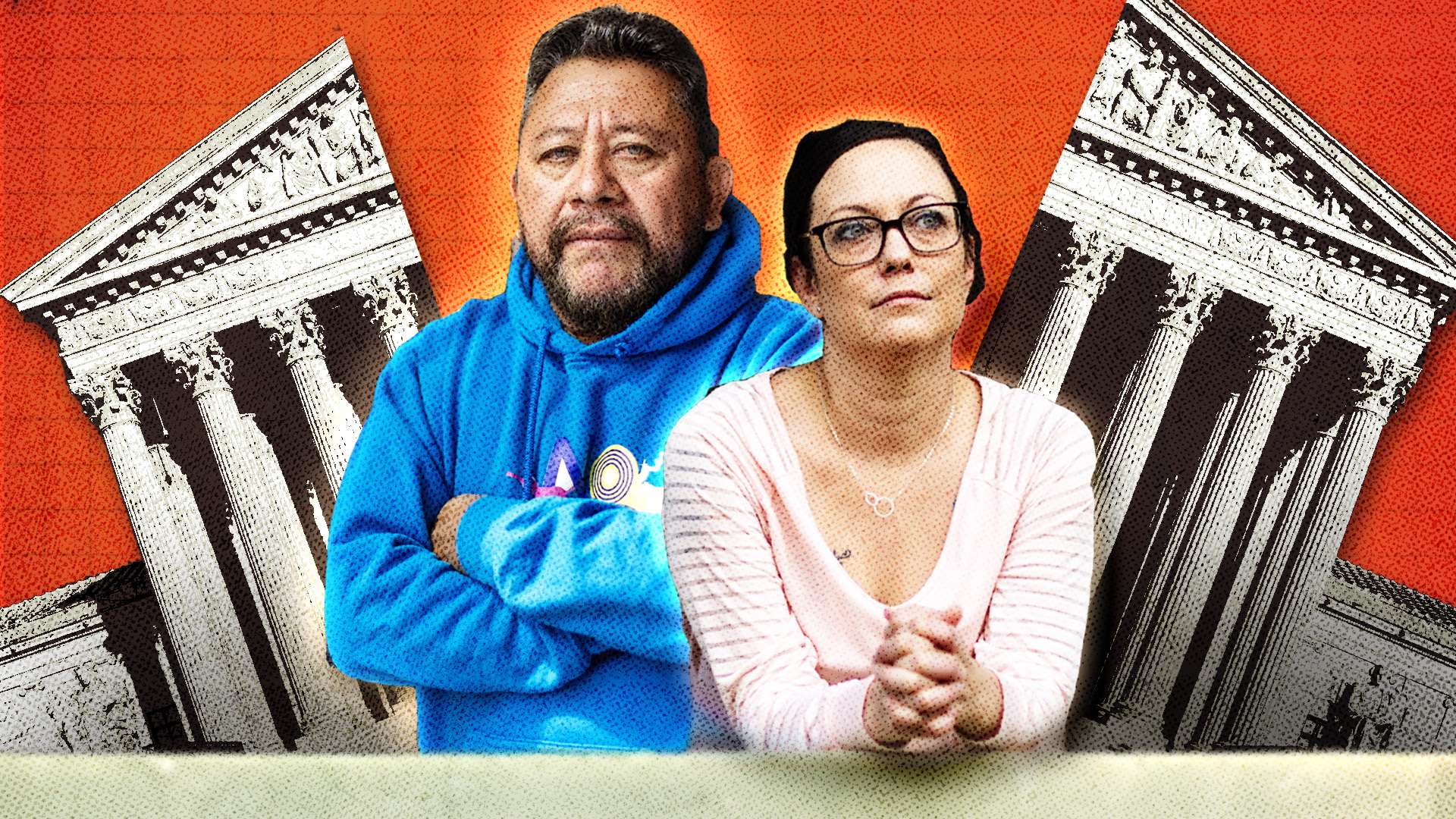
Are innocent people entitled to compensation when police damage their property? That question remains unsettled.
Is there a carve-out in the Fifth Amendment’s guarantee that private property can only be taken for just compensation if the government acts within its legitimate powers? The Supreme Court chose not to settle that issue this week, turning away a trio of petitions that pressed the justices to decide whether people should be paid when law enforcement seizes or wrecks their property as part of criminal investigations.
Two of the petitions involved individuals who had no criminal charges against them, yet whose property ended up collateral damage during police efforts to capture a suspect. In June 2022, a police operation in South Bend, Indiana, involved firing 30 tear gas canisters into Amy Hadley’s residence. Officers shattered windows, removed security cameras, rummaged through furniture, tore down a panel and a fan, and punched holes in walls in search of a fugitive named John Parnell Thomas, who had never been inside Hadley’s home. Investigators had incorrectly concluded that Thomas accessed the internet using the IP address registered at Hadley’s address. Hadley estimated that the raid caused at least $16,000 in damages, a sum only partially covered by insurance.
Roughly two months later, a Los Angeles SWAT team descended on Carlos Pena’s North Hollywood printing business, destroying the shop and the equipment inside it. The incident crippled Pena’s livelihood after a fugitive forced his way in and barricaded himself inside the facility (the suspect ultimately escaped). Pena asserted damages totaling about $60,000 in his lawsuit against the city, which refused to provide compensation. His insurer also declined to intervene—as is often the case when government-caused damage falls outside coverage, many policies exclude such losses.
The third petition involved motorists in Chicago whose vehicles had been seized by municipal authorities over modest unpaid parking fines. Ryan O’Donnell saw his car impounded and later sold for scrap because of roughly $524 in debt. Michael Goree’s vehicle was seized and turned over to a lienholder for a debt that did not belong to him; the $560 in unpaid tickets belonged to a different car owned by his co-signer.
In every instance, the appellate courts reached for a familiar rationale. Hadley, O’Donnell, and Goree pressed their claims before the Seventh Circuit, which has embraced a categorical doctrine: property destroyed in the name of a police power falls outside the protections of the Takings Clause, the constitutional provision that bars the government from taking private property without fair compensation. Pena’s case, by contrast, traveled to the Ninth Circuit, where judges have resisted a broad exemption while instead holding that governments do not owe compensation when police actions are deemed “necessary.”
In a joint statement, Supreme Court Justice Sonia Sotomayor—joined by Justice Neil Gorsuch—highlighted the numerous inconsistencies among the circuit courts on this topic. It remains an unsettled matter whether the various approaches align with this Court’s precedents. Few of the decisions identify a clear source for any police-power exception to the Takings Clause—whether drawn from common law, the Constitution, or elsewhere—and, as a result, such questions continue to benefit from further development in the lower courts before the Court weighs in.
Sotomayor’s remarks echoed ideas she expressed previously. In 2024, she offered a similar stance in response to a petition from Vicki Baker, a Texas resident whose McKinney home was ransacked by a SWAT team seeking a fugitive. The Court opted not to hear Baker’s case, though she ultimately obtained relief under the Texas state constitution this year.
“Perhaps the Court believes the lower courts have not yet given this complex but important issue enough contemplation,” commented Patrick Jaicomo, a senior attorney at the Institute for Justice who represented Hadley. “We have brought five cases from five different circuits. How much more contemplation is needed? The Court will eventually need to address this issue, and it isn’t clear what another circuit decision—or six—might contribute to that effort.”
Jaicomo’s remark reflected a sentiment intertwined with Sotomayor’s broader caution. Even as the justice’s remarks aligned with earlier warnings, they carried a sharper edge: a suggestion that the era of indefinite delay could be nearing its end.
“Courts considering this matter should proceed with care,” Sotomayor urged, reiterating that deference to state police powers must not eclipse constitutional rights. The underlying tension remains whether the constitutional framework protects private property from government action that, though taken in the pursuit of public safety or order, leaves the owner with little redress.
As the Court stood back from ruling this time, the fabric of lower-court rulings continues to shape the path forward. With each case, advocates press for a coherent standard that acknowledges the harms suffered by individuals who were not alleged to have erred but whose property nonetheless bore the weight of enforcement efforts. The question endures: under what circumstances, if any, should those harmed by government action receive compensation, and who should determine the boundaries of police power versus private property rights? The legal landscape remains unsettled, awaiting a guiding decision from the nation’s highest court that would reconcile the divergent paths taken by several appellate courts and offer a clear answer to those affected when property is damaged in the line of law enforcement duty.
