
Almost the entire pre-election debate centers on Congress, where the poll average gives the PP and Vox a comfortable absolute majority. However, there is another figure that could weigh just as much in the next legislature and is talked about far less: 160 senators, the three-fifths of a 266-seat Senate. With them, without needing to reach a pact with the other major party, the four magistrates of the Constitutional Court that correspond to the chamber are chosen. The four current members have expired terms and remain in office.
To measure how close that figure is, I built a model that averages published polls, correcting for the bias of each firm, converts the vote into the 59 Senate constituencies, and simulates the election thousands of times with the errors that polls have shown between 2015 and 2023. Before using it, I tested it on the past: applied to the actual 2023 vote, it correctly assigns 199 of the 208 elected senators. With polls published up to October 17, if Vox runs candidates in all provinces, PP and Vox reach the three-fifths in 17% of the simulations.
Why the Senate is so sensitive
In each province four senators are elected, but each voter can cast only three names. In practice, the most-voted list takes three seats and the second one takes one. That makes the Senate amplify small differences: one percentage point swing that changes who finishes first in a province moves two senators at once.
This year there is also an asymmetry in the field. PSOE and Frente Amplio run together in 46 provinces under the coalition Senate of Progress, while PP and Vox run separately. In equally contested provinces, the right’s vote is split between two lists and can lose a first-place that, if combined, would win.
What changes if Vox does not run in some provinces
The press has reported that PP and Vox are studying the possibility that Vox does not field a list in some provinces. To measure the effect, I assumed that, where Vox does not run, 80% of its vote goes to the PP. There is no exact precedent; the closest measured in Spain is Unidos Podemos in 2016, which kept 83% of the votes that Podemos and IU had obtained separately. Then I simulated each province separately and added them one by one, starting with the one that moved the result the most.
The sixteen provinces with the greatest effect are Las Palmas, Tarragona, Seville, Valencia, Asturias, Zaragoza, Huesca, Illes Balears, Badajoz, Castellón, Cáceres, Barcelona, Cádiz, Huelva, Álava and Alicante. With those withdrawals, the probability of reaching three-fifths jumps from 17% to 51%.
Figure 1. Probability that PP and Vox reach the three-fifths of the Senate depending on in how many provinces Vox does not run (ordered by impact, from highest to lowest), with the 65% turnout assumed by the polls. Own elaboration.
Not all provinces behave the same. In the equally contested provinces (València, Seville, Asturias, Zaragoza or Badajoz), the withdrawal changes who finishes first and, with it, the distribution of three seats. In Catalunya and Álava, what is at stake is the fourth senator, the one for the minority.
“In the equally contested provinces (València, Seville, Asturias, Zaragoza or Badajoz) the withdrawal changes who finishes first and, with it, the distribution of three senators”
The list of fifteen provinces that has circulated in the press does not match this one. It includes provinces such as Jaén, Córdoba, Granada, Guadalajara or Cuenca, where the effect is small, and leaves out Las Palmas, Illes Balears, Tarragona or Barcelona, which are among the ones with the greatest weight. With that list, the three-fifths appear in 33% of simulations; with the fifteen with the greatest effect, in 49%.
The limit: turnout
There is a ceiling. Even if Vox withdrew in all provinces, the three-fifths would stay at 88% of the simulations. And that ceiling depends heavily on turnout. Polls on average assume that 65% of the electorate will vote. If turnout is 72%, as in April 2019, and new voters behave as in the general elections of 2015 to 2023, the starting point falls to 4%: 36 withdrawals would be needed to reach half the simulations and the maximum possible would be 60%.
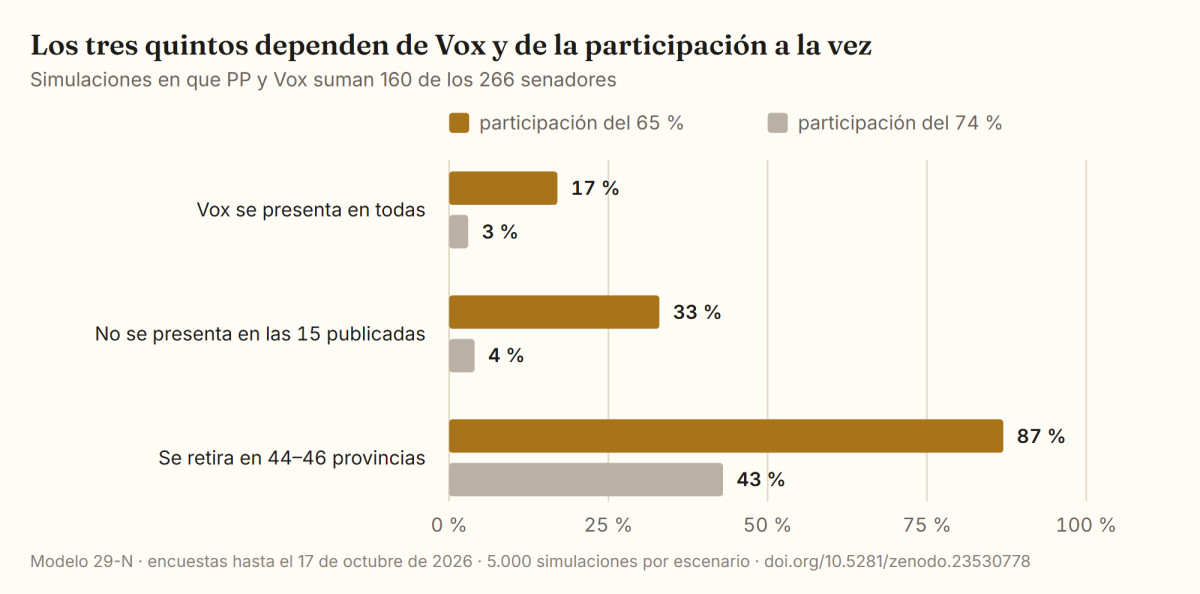
Figure 2. Probability of the three-fifths under each Vox scenario, with the turnout assumed by the polls (65%) and with one at 74%. Own elaboration.
What is at stake
According to the usual press categorization, today the Constitutional Court comprises seven justices leaning progressive and five conservative. If no one reaches the three-fifths and there is no agreement between the two major parties, the four magistrates chosen by the Senate will remain in office and the court will maintain its current composition. If PP and Vox gather the 160 senators and appoint all four, the balance would shift to five progressives and seven conservatives, with the presidency included. Today, PP, Vox and UPN total 149 senators, eleven short of that figure.
The four magistrates chosen by the Senate decide the Court’s majority
The 12 magistrates, who appoints them and their profile · October 2026
Congress (3/5)Term until Nov 2028
Inmaculada Montalbánvice-president
Ramón Sáez
Enrique Arnaldo
Concepción Espejel
Senate (3/5)Expired: in office
C. Conde-Pumpidopresident
M.ª Luisa Balaguer
Ricardo Enríquez
José María Macías
GovernmentTerm until Jan. 2032
Juan Carlos Campo
Laura Díez
Judiciary (CGPJ)Term until Jan. 2032
M.ª Luisa Segoviano
César Tolosa
Progressive (fill) Conservative (outline)
Today: 7 progressives and 5 conservatives.
If PP and Vox elect the four from the Senate: 5 progressives and 7 conservatives, and the presidency changes.
Sources: Constitutional Court, elDiario.es and Moncloa.com. Profiles according to the usual press classification.
Three cautions
The first: the 80% transfer is the weakest assumption and the one that moves the result the most. The second: the model assumes voters vote for their party’s candidates, so it does not capture personal votes or ticket-splitting, which in 2023 explained part of the few misses when reproducing the outcome. The third: the figures are frequencies in simulated elections, not certainties: in 2023, with the polls at the time, this same method gave between 69% and 78% to a right-wing majority in Congress that did not arrive.
“In 2023, with the polls at the time, this same method gave between 69% and 78% to a right-wing majority in Congress that did not arrive”
Senate candidacies must be filed before midnight on Monday, October 26. On Wednesday, it will be known where Vox has decided to compete and where it has chosen to withdraw. From that point, the question ceases to be hypothetical and the answer will depend, above all, on who goes to vote.
