
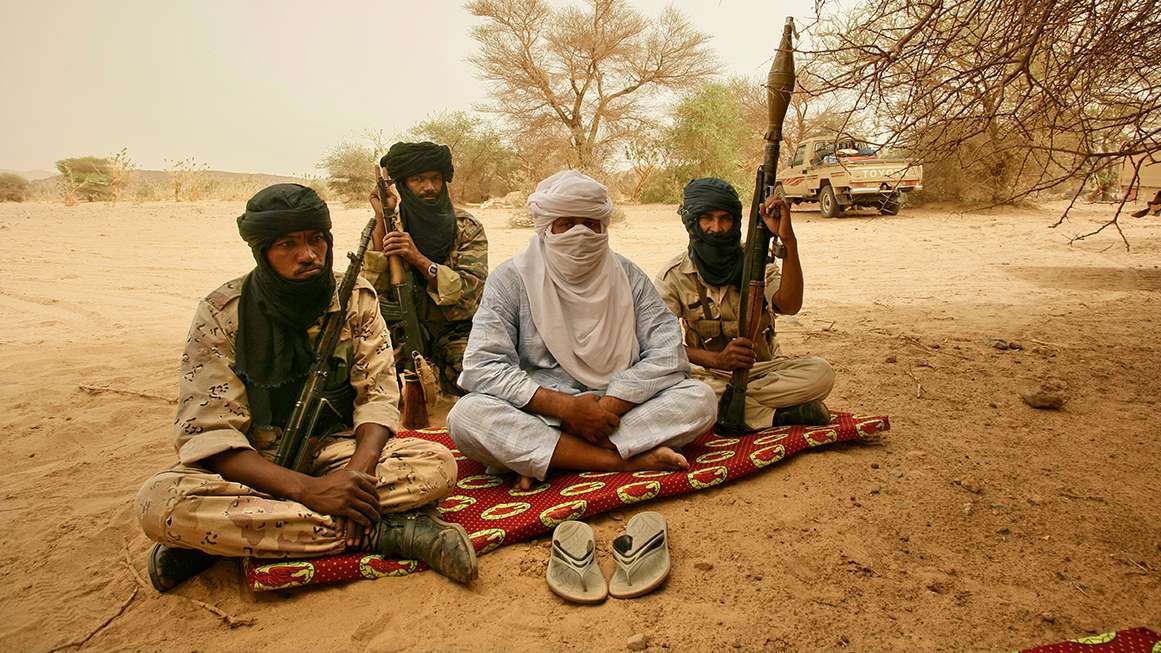
According to the federal government, Africa’s terrorist fatalities surged by more than 100,000 percent between 2002 and 2022.
Al Qaeda’s ascension to rule may occur in Africa rather than in Afghanistan or the Arab world, and its figurehead could be a former whiskey-fueled rock star. In April, the Group for the Support of Islam and Muslims (known as “JNIM” in Arabic) spearheaded a rebellion in Mali, eliminating Defense Minister Sadio Camara, rupturing a prison that housed thousands, and laying siege to Bamako, the nation’s capital. Fighting continued into August.
Mali is not the sole target of a JNIM advance. The West African branch of Al Qaeda operates across a swath of countries in the Sahel. Its leader, Iyad Ag Ghali, once served as the drummer for the rock group Tinariwen. Today he heads a campaign to eradicate what he deems the “music of Satan.” A potential saving grace for Sahelian metal fans is that puritan factions cannot cooperate: JNIM is at war with the rival Islamic State Sahel Province.
The Sahelian civil wars reflect the shortcomings of the global war on terror. Despite roughly $355 billion spent on counterterrorism efforts in Africa from 2001 to 2021, the U.S. government has struggled to prevent Al Qaeda and allied Islamist groups from gaining a foothold across the continent. A study conducted by the Pentagon’s Africa Center for Strategic Studies documents a staggering 101,300 percent rise in terrorism fatalities from 2002 to 2022, with the majority concentrated in the Sahel and Somalia.
These conflicts demonstrate that escalating violence is not the answer to terrorism. In his first 18 months of a second term, President Donald Trump conducted airstrikes against Somalia at a rate four times higher than the United States had in the previous four years combined. U.S. military assistance has flowed to authoritarian regimes throughout Africa with scant regard for their citizens’ rights. Since 2020, the Sahel has witnessed coups by military leaders promising the hard-line actions civilian authorities hesitate to undertake. Many of these leaders received training from the U.S. government. The new regimes have brought in Russian mercenaries renowned for brutality and few constraints on their operations.
“People need to forget about the question of democracy,” Ibrahim Traoré, the head of Burkina Faso, proclaimed in April.
Rather than restoring order, these coercive approaches have amplified chaos. The Sahel’s military juntas appear to be yielding ground to the JNIM. While the Russian fighters have little trouble massacring civilians or torturing prisoners, they have found it far tougher to confront armed opponents who can strike back, suffering repeated battlefield humiliations. Meanwhile, the U.S.-led campaign against al-Shabab, the Somali branch of Al Qaeda, has stalled despite a heavier application of airpower.
The African war on terror began not long after U.S. actions in Afghanistan and Iraq. In some ways, the United States helped cultivate the very dangers it later sought to counter in Africa. Somalia had been embroiled in civil war since the collapse of socialism, and in the early 2000s the CIA financed Somali warlords to curb the rise of Islamist revolutionaries. The relatively moderate Islamic Courts Union nonetheless gained control in 2006—uniting Somalia for the first time in over a decade—and the United States encouraged neighboring Ethiopia to invade. When al-Shabab emerged to challenge the Ethiopian invaders, the United States tapped a former leader of the Islamic Courts Union to head a new Somali government.
Shortly after the Ethiopian–Somali conflict, President George W. Bush established the Pentagon’s Africa Command, and Congress allocated $500 million in aid to militaries across the Sahara and Sahel. At that time, the main Islamist threat in the region was a mostly defeated insurgency in Algeria.
Yet the Libyan civil war in 2011 unleashed new, deadly forces. Soon after President Barack Obama intervened to support the Libyan revolution, weapons and hardened fighters flowed into the Tuareg region of Mali, which declared independence a few months later. Soon after, Al Qaeda and its affiliates took control of the Tuareg rebellion. With the Malian government on the brink of collapse, France intervened in January 2013 and repeated many of the same missteps the United States had made in its own war on terror.
Ag Ghali, the current head of the JNIM, began as a Tuareg nationalist. A 2008 leaked U.S. embassy cable described him as a “proverbial bad penny” who enjoyed “playing both sides” and maintained ties to Islamist and secular nationalist rebels. By the time of the French intervention, he had fully embraced an Islamic theocracy. In 2017 he unified Islamist rebels across the Sahel under the Al Qaeda banner. That year, four U.S. Special Forces troops were killed in Niger by members of the Islamic State group, which was actively consolidating Ag Ghali’s rivals.
Despite the Sahelian governments’ failures to stop Ag Ghali—and their willingness to align with Russia—the Trump administration pressed to intensify support. The U.S. government expanded intelligence sharing with Mali in 2025, and by July it was weighing a direct military intervention against the JNIM, according to The Washington Post. Yet every U.S. escalation on the continent has produced the very enemy that the next conflict had to confront.
