
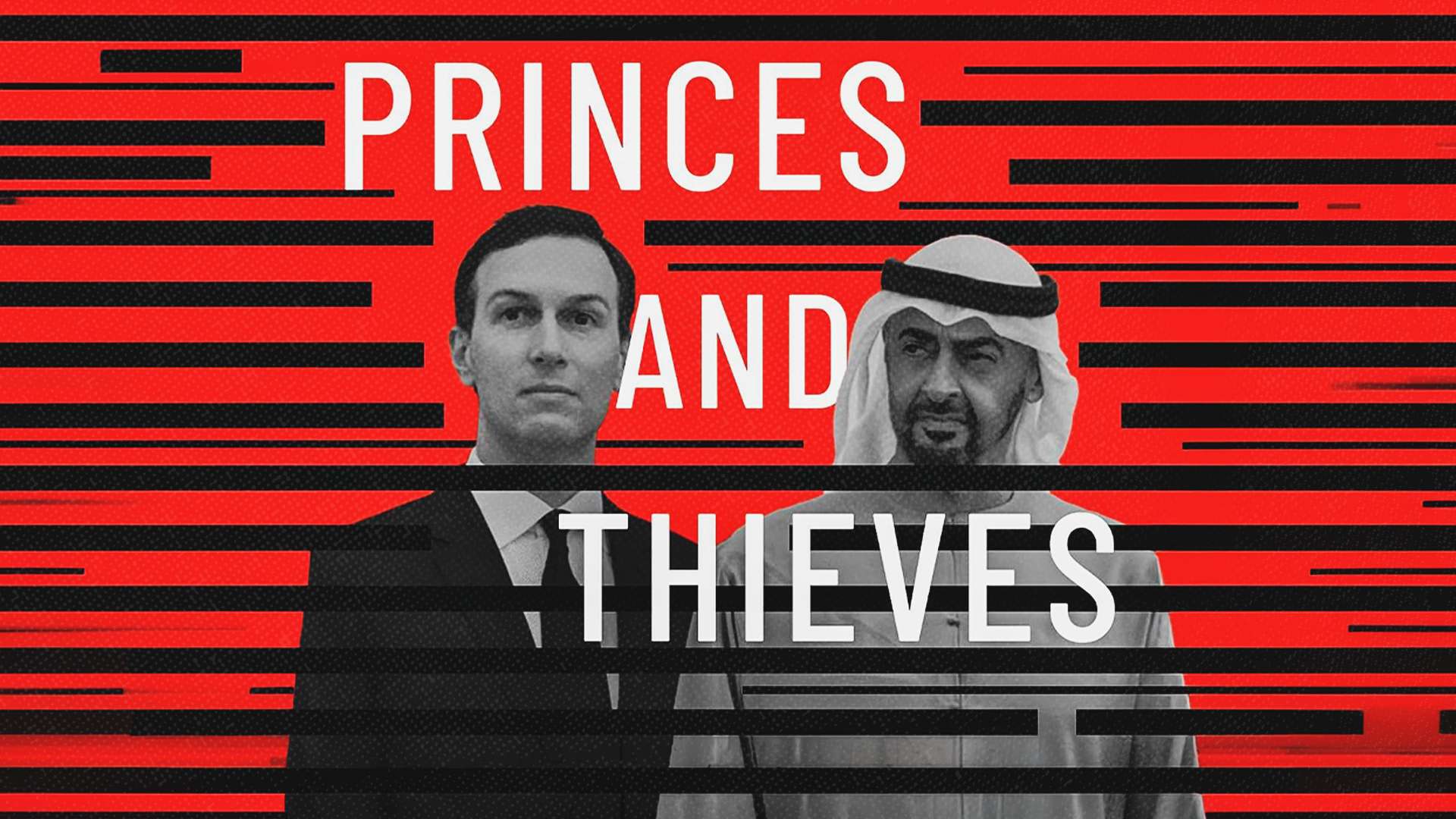
Princes and Thieves poses startling assertions about the Trump kin’s involvement in covert Middle Eastern maneuvering.
Princes and Thieves, a forthcoming investigation by journalist Matthew Cole, could unlock a labyrinth of financial ties linking Middle Eastern autocrats to members of President Donald Trump’s family. Cole accuses Emirati ruler Mohamed bin Zayed (MBZ) of funneling billions to a range of mercenaries and political operatives, including Jared Kushner, Trump’s son-in-law. The reporting blends thoroughly documented connections with secondhand details from anonymous sources.
On Thursday, Vanity Fair published an excerpt from the volume, alleging that Dutch intelligence operatives breached Kushner’s phone in 2018 and uncovered hundreds of millions of dollars in transfers tied to MBZ. Also on Thursday, Kushner issued a letter from his lawyers to Cole denying the “incredible and false” allegations in the book. “Mr. Kushner never accessed foreign accounts and always complied with all laws and regulations, pursuing only aims aligned with the United States as directed by the President,” the lawyers wrote.
Cole had previously stated on his blog that the book was slated for release on October 27, but the publication date was moved up over the weekend.
The book purports to connect Kushner to an expansive network of Emirati influence operations across the globe. In Cole’s narrative, which dovetails with reporting from other journalists, MBZ seeks to redefine the Middle East and eastern Africa into an alliance of U.S.-backed dictatorships, where “tolerance” is enforced via advanced surveillance technology and “democracy” becomes a euphemism for terrorism. MBZ’s use of mercenaries to realize these aims is well documented, as is Kushner’s personal affinity for the Emirati monarch and his economic ties to the Gulf monarchies.
Soon after Trump’s victory in 2016, MBZ is said to have met Kushner in a widely reported encounter. According to the book—and corroborated by earlier reporting—the emir criticized the Obama administration for not backing Arab regimes against popular uprisings, for the decision to end the Iraq War, and for engaging diplomatically with Iran.
Extending beyond prior coverage, Cole now asserts that Kushner personally took part in MBZ’s mercenary campaigns. Cole’s sources allege that MBZ and Saudi Crown Prince Mohammed bin Salman transferred a combined $2 billion into Emirati and Israeli bank accounts overseen (though not owned) by Kushner. The same sources claim portions of this clandestine fund flowed to Libyan warlord Khalifa Haftar, American contractor Erik Prince, and Cuban operative Felipe Vidal.
Haftar, a former CIA asset, emerged as a general during Libya’s 2011 uprising and later attempted to topple the new government with Emirati backing in 2014. Despite a 2020 ceasefire, his forces still hold sway in large parts of Libya. Prince, the founder of the defense contractor once known as Blackwater, relocated to the UAE and aided in assembling a secret army of Colombian mercenaries. He sued Cole for defamation following Cole’s reporting on Prince’s involvement with Haftar, but the suit was dismissed by a judge. Cole’s sources contend that Vidal, who describes himself as a “hit man,” aided the United Arab Emirates in staging a fake Iranian attack on tanker ships in May 2019, intended to push the United States toward war.
Kushner’s lawyers have rejected any ties to those three men beyond a single meeting with Prince after the 2016 election. (Cole suggests that Vidal and Prince declined to comment for the book.) The U.S. government’s position remains that the May 2019 incident represented a legitimate Iranian attack, not a UAE-directed false flag operation.
After the Vanity Fair piece appeared last week, Gershon Baskin noted in The Jerusalem Post that the Bank of Israel does not provide private banking services to individuals, a fact that would make it impossible for Kushner’s funds to be deposited in the Israeli central bank, as Cole suggested. The book counters that the money was placed “in what would appear to be a government account,” with Kushner and Israeli Prime Minister Benjamin Netanyahu jointly sanctioning the transactions.
The Abraham Accords, which bind Israel and the UAE, have often been presented as a way for Washington to “spend less time and fewer resources” in the region, in the words of Vice President J.D. Vance. Yet Cole contends that the UAE leveraged this partnership to pull American interests into an impending conflict. The book claims that Kushner established “a rainy-day defense fund” for a potential confrontation with Iran, funded by Emirati money parked in a separate account at the Central Bank of Israel.
Cole further contends that he possesses evidence of Kushner’s ties to Qatar’s regime. In 2017, as the UAE and Saudi Arabia pressed Qatar, a blockade was imposed on the small emirate. The Intercept later reported that Kushner’s father had sought a Qatari bailout for the family real-estate enterprise just before the crisis, and the Qatari-linked Brookfield ultimately injected the necessary investment in August 2018, triggering a congressional inquiry into the deal.
Kushner’s lawyers state that there is “no evidence that Qatar affected the investment decision. Any suggestion of his involvement in the transaction or any claim of quid pro quo with the Qatari government is false and defamatory.”
Other portions of the book are more substantiated. Cole obtained a draft of Prince’s autobiography, text messages from one of Prince’s associates, and emails from Emirati adviser George Nader, who was convicted of funneling money into Hillary Clinton’s 2016 campaign. If nothing else, the work offers a thorough portrait of the UAE’s covert empire and its American connections. However, the most explosive assertions about Kushner’s involvement rest on anonymous sources, turning the matter into a contest between Cole’s claims and Kushner’s denials.
“I weighed the responses from Kushner’s attorneys carefully and consulted multiple sources regarding them. Over the five years I spent researching this book, I strived to keep an open mind, and I am confident that my reporting is accurate. The lawyers’ replies did not alter that conclusion,” Cole writes in the book’s epilogue.
