
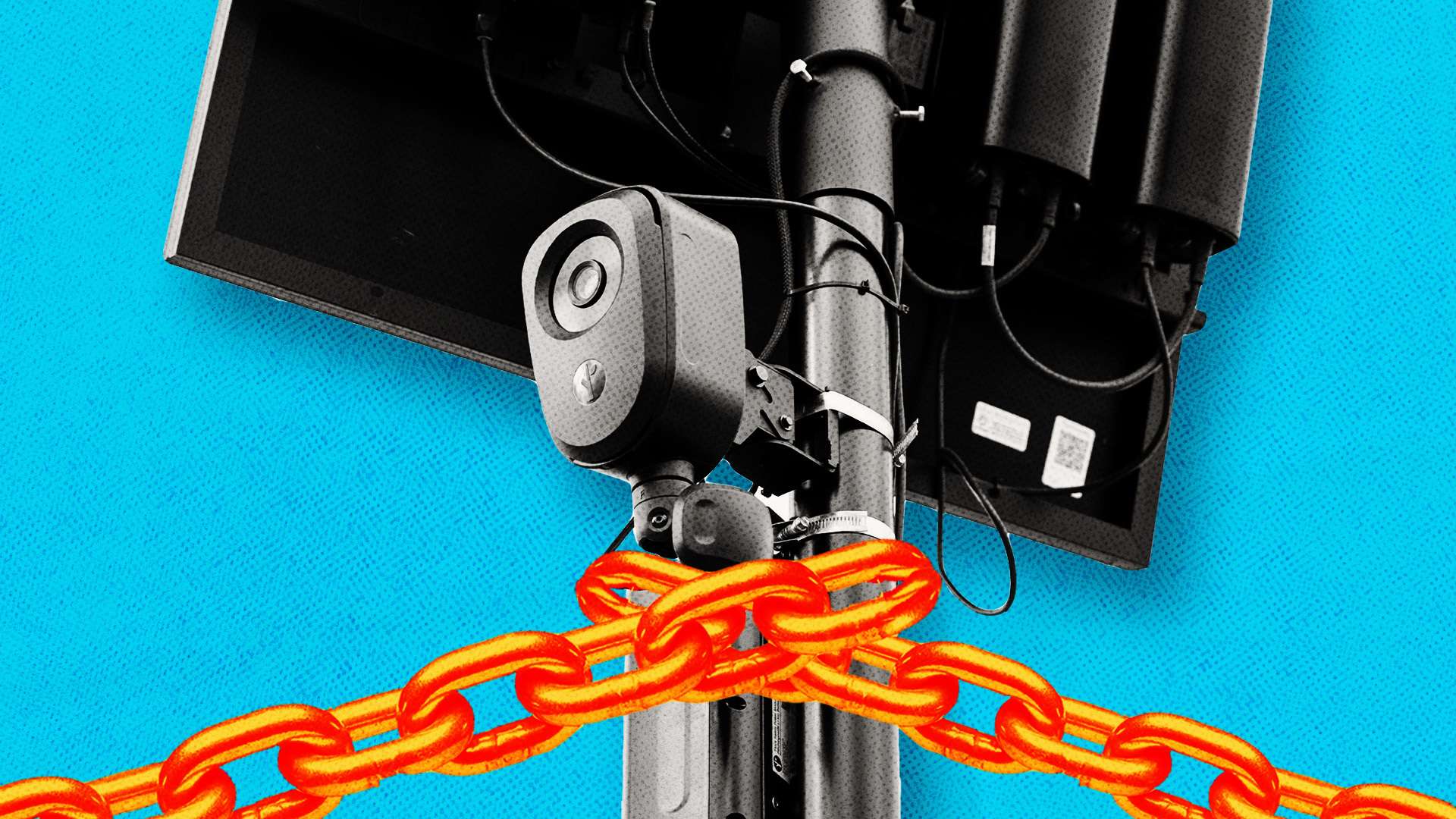
Until recently, Connecticut had no statutory limits on automated license plate readers, devices that trace the journeys of ordinary drivers across the nation.
A Connecticut statute that took effect at the start of October imposes new constraints on police use of automated license plate readers (ALPRs), which enable what a federal judge recently described as “a type of indiscriminate mass surveillance.” The law mirrors a bipartisan backlash against AI-assisted cameras that capture images of passing cars billions of times weekly, creating databases that law enforcement can use to monitor motorists, identify nearby vehicles, forecast itineraries, and conduct searches based on a broad range of vehicle characteristics.
Connecticut previously imposed no statutory limits on ALPRs, a reality that underscores how easily police can access license plate data, which they can search without any judicial review and often without meaningful internal oversight. Yet the law’s provisions, while promising in some respects, fall short of the reforms urged by critics who warn that unconstrained ALPR use endangers the privacy of innocent drivers across the country.
As of today, DeFlock’s mapping project has identified nearly 145,000 ALPR cameras in the United States, most of which were installed by Flock Safety, the leading vendor. That network includes more than 1,500 cameras deployed by Connecticut law enforcement agencies, three-quarters of which use the technology.
The concerns underlying the new law, which Gov. Ned Lamont signed last May, echo objections raised in other states. Last February, for example, CT Insider reported that out-of-state agencies had searched ALPR data from Connecticut thousands of times for immigration enforcement purposes. When police in Johnson City, Texas, searched Connecticut data for a missing woman, the log noted that she “had an abortion,” which reinforced concerns that ALPR information might be used to enforce abortion bans.
As elsewhere, ALPR critics in Connecticut have also complained about a lack of transparency. In April 2025, for instance, South Windsor began using Flock cameras without any public notice. The resulting uproar prompted the city council to cancel the program early this month. CT Mirror reports that South Windsor is “at least the sixth Connecticut community to end or suspend the use of ALPRs this year, following Windsor, Killingworth, Ledyard, Milford and Newtown.”
Compared with those moves, the new state restrictions are fairly modest. Yet they incorporate some potentially meaningful changes, and they illuminate how lax the oversight of ALPRs has been.
The new law limits the sharing of ALPR data, which can now be shared only with Connecticut, Massachusetts, New York, and Rhode Island unless an out-of-state agency secures a judicial warrant. The statute states that the data cannot be used for immigration enforcement, to target conduct protected by the First Amendment, or for investigations related to “reproductive” or “gender-affirming” health care services. It also bars placing ALPRs near facilities that provide such services or organizations that primarily serve immigrants.
The original bill allowed ALPR data to be retained for no more than seven days unless connected to an ongoing criminal investigation, subject to a warrant, or used for toll enforcement. The final version extended that limit to 21 days. Flock’s initial default was 30 days. But last August, in response to widespread criticism of ALPR surveillance, the company began recommending a seven-day limit. Connecticut’s Police Officer Standards and Training Council, which last month sent Lamont a report with suggested reforms, believes the state should adopt the seven-day standard.
Under the new law, police may search ALPR data to “assist in the recovery of a stolen motor vehicle,” “assist in locating a missing or endangered individual,” or “assist in the apprehension of an individual with an outstanding warrant.” They may also query the database for information “relevant and material to a specific active investigation of a criminal offense in which there is reasonable suspicion that the offense has been or is being committed.” When they do that, their agency must record “the reason for the access and any associated case number for the complaint or incident that is being investigated and is the basis for the access.”
It is remarkable that Connecticut lacked such basic safeguards until now, and it remains unclear how effective the new rules will be. Since July 1, 2025, Virginia has required that officers specify a “specific purpose” for ALPR searches, including the “offense type.” Yet last April, WHRO reported that Norfolk police often provide “incomplete and imprecise reasons” for ALPR queries, including terms like “suspect,” “suspicious,” and “investigation” or “inv.”
Connecticut’s “reasonable suspicion” threshold is milder than the standard favored by the Institute for Justice. The organization’s model statute would typically mandate a warrant based on probable cause for ALPR queries. The proposed law does allow exceptions for “exigent circumstances,” stolen vehicles, and toll, parking, or traffic enforcement.
Connecticut’s law also addresses flagrant abuses that have fueled opposition to license plate cameras, including cases where officers were caught using ALPR data to stalk personal adversaries, ex-partners, potentially unfaithful spouses, or objects of romantic interest. The statute states that an officer “who is found to have knowingly accessed, used or disseminated automated license plate reader data with malicious intent for purposes outside of the provisions of this section shall be subject to disciplinary action including, but not limited to, suspension, cancellation or revocation of certification” for police work.
The law establishes two additional remedies that could deter ALPR abuses. It authorizes the attorney general to sue ALPR contractors for damages and injunctive relief when they violate the new restrictions. It also allows “any aggrieved individual” to sue “a public agency” that flouts the rules.
“The law, for a first bite at the apple, is not bad,” Ken Barone, manager of the University of Connecticut’s Racial Profiling Prohibition Project, told CT Insider. Given that “there was a benchmark of nothing,” he said, the attempt to constrain and monitor ALPR use is “a big step forward.”
