
Israel has relied on its military superiority to try to shift the balance of power in the Middle East, but it still has not found a political exit from the conflicts that threaten its security. The operations against its adversaries have altered the regional balance of power without solving the causes of the instability. The result is a country that maintains a military-dominant position, but whose political and diplomatic integration into its surroundings remains deeply uncertain.
This was one of the most provocative ideas of Professor Emma Sky’s intervention at the Workshop on Global Order: Leadership for Times of Change at the Yale University’s Jackson School of Global Affairs, organized by IE University, in which I participated last week. The academic is a British specialist in the Middle East, with extensive on-the-ground experience in Iraq and Afghanistan and currently affiliated with Yale. She spent years working with the American forces in Iraq, an experience that enables her to analyze the contradictions of U.S. policy from an unusual vantage point: the perspective of someone who has known both decision centers and the consequences of those decisions.
“The operations of Israel against its adversaries have altered the balance of power in the region without resolving the causes of the instability”
“Israel is increasingly like Sparta. Its military predominance contrasts with its difficulties in building diplomatic relationships capable of offering durable security,” Sky stated. With this analogy, the October 27 elections can be read in a broader frame. Israelis vote to decide who will govern their country, but they are also doing so amid a transformation of the regional order that has guaranteed its security for decades. And the most interesting part is that these two debates barely intersect.
An election dominated by Netanyahu
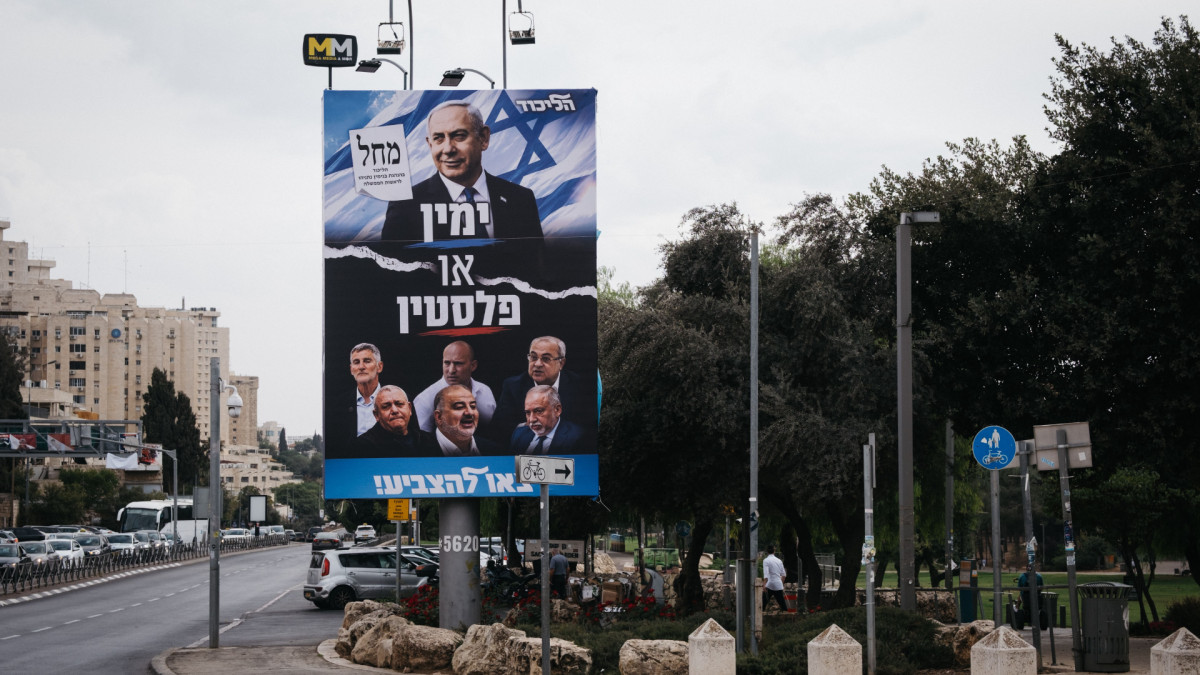
As the professor explained, the Israeli campaign revolves around a much simpler slogan than any discussion about the future of the Middle East: “Anyone but Bibi”. The opposition to Benjamin Netanyahu brings together leaders who would have scarcely shared a political identity a few years ago. Naftali Bennett and Avigdor Lieberman, both from the Israeli right, now appear within what is described as the liberal or democratic bloc. Their common denominator is not necessarily a shared view on the Palestinian issue, but the objective of ending Netanyahu’s era.
Two issues stand at the center of the electoral debate. The first is the military conscription of the ultra-Orthodox, whose exemption from mandatory service is a source of tension in Israeli society. The second is the demand for an investigation into the failures that allowed the attacks of October 7, 2023. Both issues affect the distribution of duties among citizens and the accountability of institutions. But it is striking that the discussion about the future of the Palestinians receives much less attention. Israel debates intensely about who should lead it, while the big questions about its territorial, political and diplomatic future remain unanswered.
Two distinct conceptions for the same country
Reducing these elections to a referendum on Netanyahu would be to stay on the surface. Israel carries a historical split between two conceptions of its identity. One sees itself, above all, as a democratic state of all its citizens. The other centers on its character as a Jewish state. These identities are not necessarily incompatible, but their tensions have intensified as demographics shift, religion weighs more, and the priorities of different social groups diverge.
“Reducing these elections to a referendum on Netanyahu would be staying on the surface. Israel carries a historical split between two conceptions of its identity”
The expert turned to a particularly meaningful reference in Jewish history: the destruction of the Second Temple in Jerusalem in the year 70, during the Roman conquest. Jewish tradition has attributed part of that catastrophe to hatred and internal divisions among Jews themselves. The comparison does not intend to equate two historical moments, but to remind how a society’s fracture can jeopardize its future. In today’s Israel, the growing distance between religious and secular sectors, between those who prioritize the Jewish character of the state and those who defend a shared civic identity, has turned that old concern into a contemporary political question. The divide between Tel Aviv and Jerusalem, between secular and religious sectors, expresses a dispute that transcends changes in government.
To this is added the shifting boundaries of the Israeli political debate. Figures such as Itamar Ben-Gvir and Bezalel Smotrich, whose positions used to lie outside acceptable government coalitions, now participate in the power discussion. The professor invoked the classic Overton window to explain this shift: the boundaries of what is politically permissible are not fixed and can move in both directions. Following this logic, more than asking whether Netanyahu will continue to govern, one should focus on the political positions the prime minister has managed to consolidate and that will endure after this hypothetical step.
Arab citizens and the formation of majorities
One of the session’s most interesting observations concerned the role of Israeli Arab parties. Sky argued that forming an alternative majority to Netanyahu depends on a political decision that the opposition has not fully faced: embracing the participation of Arab representatives in a government coalition.
“We must focus on the political positions that the prime minister has managed to consolidate and that will endure after this hypothetical step”
In this scenario, two Arab leaders embody different strategies. Mansour Abbas, leader of Ra’am, participated in 2021 in the coalition that temporarily ousted Netanyahu from power and has defended direct participation of Arab parties in the government. Yousef Jabareen, a lawyer and the new leader of the Joint List, which brings together Hadash, Ta’al and Balad, advocates a more conditional relationship: he is willing to consider parliamentary support, but demands political commitments that go beyond merely replacing the prime minister.
Arab citizens of Israel do not form a homogeneous political bloc, and their representatives disagree about how to exercise influence. Yet both strategies force the Jewish opposition to answer a question that goes beyond electoral arithmetic: are they willing to recognize Arab parties as legitimate interlocutors in forming the government?
The issue is particularly meaningful in Israel because it links parliamentary arithmetic with the debate over national identity. A coalition that can incorporate Jewish and Arab parties would not, by itself, resolve the Palestinian conflict. It would not eliminate the ideological differences that already exist among opposition forces either. But it would introduce a different conception of political participation.
Another relevant leader is Gadi Eisenkot, former chief of staff of the Israeli army and leader of the centrist party Yashar, which embodies one of the main alternatives to Netanyahu. His military background and his participation in the post-October 7 war cabinet give him a profile very different from a traditional left-wing opposition. Eisenkot calls for changes in how institutions operate and for an investigation into the mistakes that allowed Hamas’s attacks, but he maintains security positions close to those of the current government. His main challenge could arise after the elections: rallying a parliamentary majority without fully embracing Arab party participation.
Turning military power into security can be problematic
Yet the session’s most important aspect may have been its attempt to link the Israeli elections to the unraveling of the old American order in the Middle East. For decades, regional security rested on three Washington priorities: ensuring energy supply, protecting Israel, and preventing a hostile power from dominating the region. That system has eroded as a result of American decisions, regional conflicts and technological transformations.
The 2003 invasion of Iraq weakened the regional balance and indirectly strengthened Iran. The Arab Spring questioned the stability of traditional alliances. The U.S. withdrawal from the Iranian nuclear deal eroded trust in the durability of its diplomatic commitments.
Added to this is a decisive military transformation: cheap drones and missiles enable threats to infrastructure whose defense would require extraordinarily costly systems. The expert summed up the problem with one idea: The United States can preserve its reliance on its allies without preserving their trust.
For Israel, the consequences are profound. Its military superiority remains substantial, but the country needs something that its armed forces cannot provide on their own: a regional environment in which its security does not depend solely on its ability to defeat its adversaries. The Abraham Accords represented an attempt to move in that direction. The normalization with the United Arab Emirates, Bahrain and Morocco opened diplomatic and economic possibilities. The potential inclusion of Saudi Arabia would have significantly broadened that process. But the Gaza war has complicated the regional legitimacy of normalization that does not offer progress on the Palestinian question.
And the Palestinian issue? It hasn’t disappeared
The prospects for a political solution are, from this perspective, particularly pessimistic. It is hard to imagine a one-state formula accepted by Israeli society, because it would challenge the conception of the country as a Jewish state. Yet there is no credible path to a two-state solution either.
The situation in Gaza, the continuation of Hamas and the weakness of Palestinian leadership still further complicate any transition. Her analysis introduced an important distinction: a change in Israeli government could modify certain policies, particularly the response to settler violence in the West Bank, without necessarily implying an immediate transformation of the situation in Gaza.
It is a useful warning against the temptation to view elections as an automatic solution to regional problems. The Palestinian issue may take little space in an electoral campaign and yet remain one of the main obstacles to Israel’s integration into the Middle East.
After Netanyahu
Sky compared some dynamics of Israeli politics with those of other Western democracies: the increasing emphasis on identity, polarization between political camps, and the difficulty of forging agreements that survive electoral confrontation.
The comparison does not imply that those societies are equivalent. But it does allow us to see how a single election can become a contest over the very definition of the country. Israel faces that debate under especially demanding circumstances. Its regional environment is changing, American guarantees are less predictable, and opportunities for diplomatic integration remain constrained by unresolved conflicts.
The elections tomorrow will decide the makeup of its next political power. They will not, by themselves, resolve the tensions between military security, national identity and democratic coexistence.
Leaving the Yale session, I carried away precisely that idea: the great challenge for Israel is not merely to decide who will govern after Netanyahu, but to find a way to turn its military power into a sustainable political future.
