
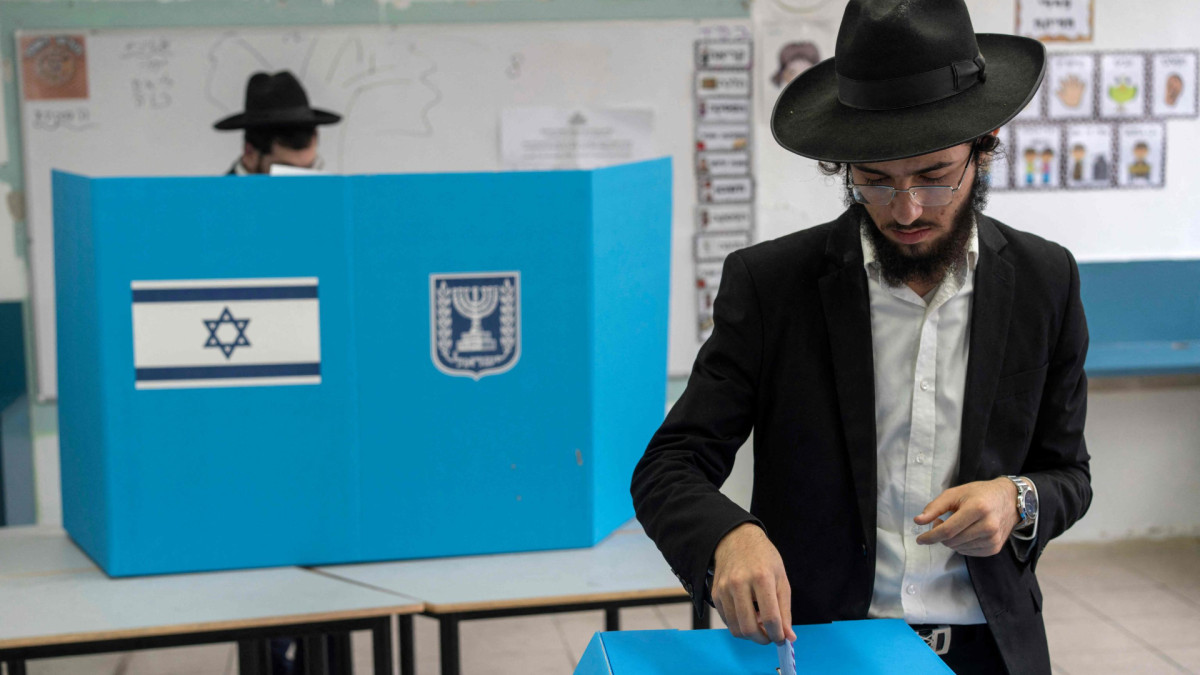
Israel has voted, but, at this hour, it still does not know who will be able to govern it. The first elections held since October 7, 2023 and the genocide in Gaza have returned the country to a political scenario familiar to them: political deadlock. Between 2019 and 2022, Israelis went to the polls five times without resolving a political crisis anchored around Benjamin Netanyahu.
Four years later, the story threatens to repeat itself. That is, with one essential difference: the historic mobilization of Palestinian citizens of Israel has turned their representatives into the true referees of governance. Precisely those whom the political system has tried to exclude now hold the key to unlocking it.
The provisional count, with 84.5% of polling stations reported, places Netanyahu’s bloc at 54 seats, compared with 49 for the Jewish opposition and 17 for the Arab parties. However, neither of the two major blocs reaches the 61 seats required to control the Israeli Parliament, the Knesset. Although numbers can still shift, the political conclusion is clear. Prime Minister Benjamin Netanyahu does not have a guaranteed majority to continue governing, but his opponents cannot build an alternative without the Arab parties, unless there is a realignment of the blocs.
“Precisely those whom the political system has tried to exclude now hold the key to unlocking it”
The main novelty of these elections is therefore not Netanyahu’s decline, which still enjoys broad public support, but the transformation of Arab political representation into an indispensable actor. The mobilization of Palestinian citizens of Israel has turned parties historically marginal in government negotiations into the true kingmakers of the Israeli political system. With their electoral results, their parliamentary weight allows them to decide whether there is an alternative majority, and this is no small matter in a country where Arab political participation has been systematically questioned and where the legitimacy of their representatives remains a matter of dispute.
This new context in parliamentary representation substantially alters the terms of the Israeli political debate. For years, Netanyahu, a large part of the Israeli right and its media ecosystem have built a strategy of delegitimizing Arab parties: it was not only about excluding them from governments, but about presenting any majority that depended on their votes as politically illegitimate. The message has ended up permeating even much of the opposition, which has adopted as its own a line drawn by Netanyahu.
In that sense, Gadi Eisenkot, Naftali Bennett and Avigdor Lieberman have built their electoral strategies around three commitments hardly compatible with parliamentary arithmetic: not to govern with Netanyahu, not to depend on Arab parties and to exclude the ultra-Orthodox from their coalitions. Now they will have to break one of those promises if they want to avoid the bloqueo. The paradox they face is not trivial, as they could win a potentially Netanyahu-hostile majority in Parliament and yet be unable to turn it into a governing majority because they refuse to recognize as legitimate interlocutors those who could supply it.
“Not merely about excluding them from governments, but about presenting any majority that depended on their votes as politically illegitimate”
Netanyahu knows this contradiction perfectly, intends to exploit it and has a clear strategy that consists of keeping his alliance with the ultra-Orthodox parties intact and pressuring the leaders of the opposition right to abandon their electoral commitments. It would not be the first time. Benny Gantz agreed in 2020 to participate in a unity government with Netanyahu, a decision that ended up eroding his political credibility. Because it should not be forgotten that Netanyahu’s main strength does not reside necessarily in having a social majority, but in making the alternatives unviable.
In this context and with these numbers and constraints, three potential political scenarios in Israel can be outlined.
The first would be a recomposition of the conservative majority by bringing in some of the parties that have promised to exclude him. In this way, the current mandate could be extended. On the one hand, there would be a high political cost for those who decide to break their commitments, but, on the other, it would also confirm that Netanyahu continues to be able to shape Israeli policy even when the ballots weaken his position.
“The main strength of Netanyahu does not lie necessarily in having a social majority, but in making the alternatives unviable”
The second scenario involves an alternative coalition led by Eisenkot or Bennett, with the support of the Arab parties. For this, their inclusion in the Executive would not be essential. Coalition agreements could be negotiated and external parliamentary backing for certain initiatives could be arranged. The 2021 experience, when Ra’am participated in a governing coalition, demonstrates that this possibility is not institutionally impossible. Currently, The Democrats, led by Yair Golan, are the main force of the Jewish opposition that openly advocates political cooperation between Jews and Arabs.
Of course, a majority with these characteristics would be fragile. The ideological differences among its members, especially regarding Gaza, the West Bank and Palestinian national rights, would hinder the government’s stability. But it could also drive institutional reforms, restore democratic checks and balances, and establish an independent national commission to investigate the political, military, and intelligence failures that made October 7 possible.
Finally, the third scenario is deadlock. If no one manages to form a government, Netanyahu would remain as acting Prime Minister while a new election could be called. The 2019-2022 experience shows that this situation can be prolonged and benefit the one in power. However, a parliamentary majority opposed to Netanyahu could use that period to push legislative initiatives and demand accountability for October 7, provided that it can articulate concrete agreements.
In these circumstances, one cannot ignore Netanyahu’s incentives to try to maintain his position. It is important to remember that the current Prime Minister continues to face a corruption trial and, although the office does not grant automatic criminal immunity, staying in power allows him to retain considerable political influence. His exit from the government could weaken his position to seek a favorable resolution to his legal problems. Political and personal survival thus become intertwined again.
In any case, and in the event of a possible departure from power by Netanyahu, we would not be witnessing a profound transformation of Israel. Eisenkot and Bennett represent leadership alternatives, though they do not have to constitute a break with the dominant security consensus. Neither of them offers guarantees of substantially changing policy toward Gaza, the occupation of the West Bank, or the denial of Palestinian national rights. In that sense, replacing the prime minister could facilitate a certain institutional and diplomatic realignment without altering the fundamental structures of the conflict and could even allow their successor to gain higher levels of international legitimacy than their predecessor.
“Eisenkot and Bennett represent leadership alternatives, although they do not have to imply a break with the dominant security consensus”
In this sense, the election results in Israel leave at least two paradoxes. The first is that Palestinian citizens can play an essential role in governing a system that deems their influence on government formation unacceptable. Now it depends on the rest to accept the political consequences of the existing reality. The second paradox is that of Netanyahu’s own political survival and the ideological conditioning of exclusion: if his opponents fail to assemble a sufficient majority, the contagion effect will have materialized. And Israel’s democratic crisis will continue to deepen.
