

The agency’s rising unpopularity could open the door to its abolition.

A Pew Research Center survey released recently shows that Immigration and Customs Enforcement (ICE) holds the lowest level of public regard among federal agencies, far surpassing even the IRS, which many people loathe. Pew data indicate 56% of Americans view ICE unfavorably, while only 35% express approval. This stands in stark contrast to the IRS, where disapproval sits at 46% and approval at 37%.
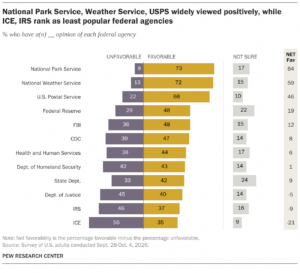
Other recent surveys show growing public support for abolishing ICE. For instance, a YouGov poll conducted in July found 48% backing abolition, while 40% opposed it, and a March survey recorded a comparable 50-39 margin in favor.
The fact that ICE is unpopular does not by itself prove that the agency should be scrapped. Having authored a book and numerous other writings about widespread public ignorance of government policy, I would be the last to claim that popularity is a reliable metric for judging a policy’s—or an agency’s—merit. Yet, in this instance, public sentiment is aligned with the argument that ICE’s numerous abuses justify abolition. I laid out this case in an August 2025 piece in The Hill, and in a follow-up article for the Boston Globe (non-paywalled version here), where I argued that ICE’s abuses certainly warrant dismantling. Moreover, subsequent events, such as the fatal shooting of two American citizens in Minnesota, have reinforced this line of reasoning.
While ICE abuses were intensified by the policies of the second Trump administration, many of them predate that era and stem from the very framework of mass deportation itself.
As I described in my The Hill article, dismantling ICE would not wipe out interior deportations entirely. Rather, it would render them heavily contingent upon cooperation from state and local authorities, thereby reinforcing constitutional federalism and reducing incentives for abuse to a meaningful degree.
In that piece, I also show how support for abolition could be strengthened by pairing the move with reallocating ICE funding to state and local law enforcement. This would address the central political objection to abolition—the fear that removing ICE would spur more crime—and channels funds to local police, which could help secure police cooperation and foster genuine declines in violent and property crimes; social science evidence indicates that increasing on-street policing can produce such effects, whereas deportations do not.
