
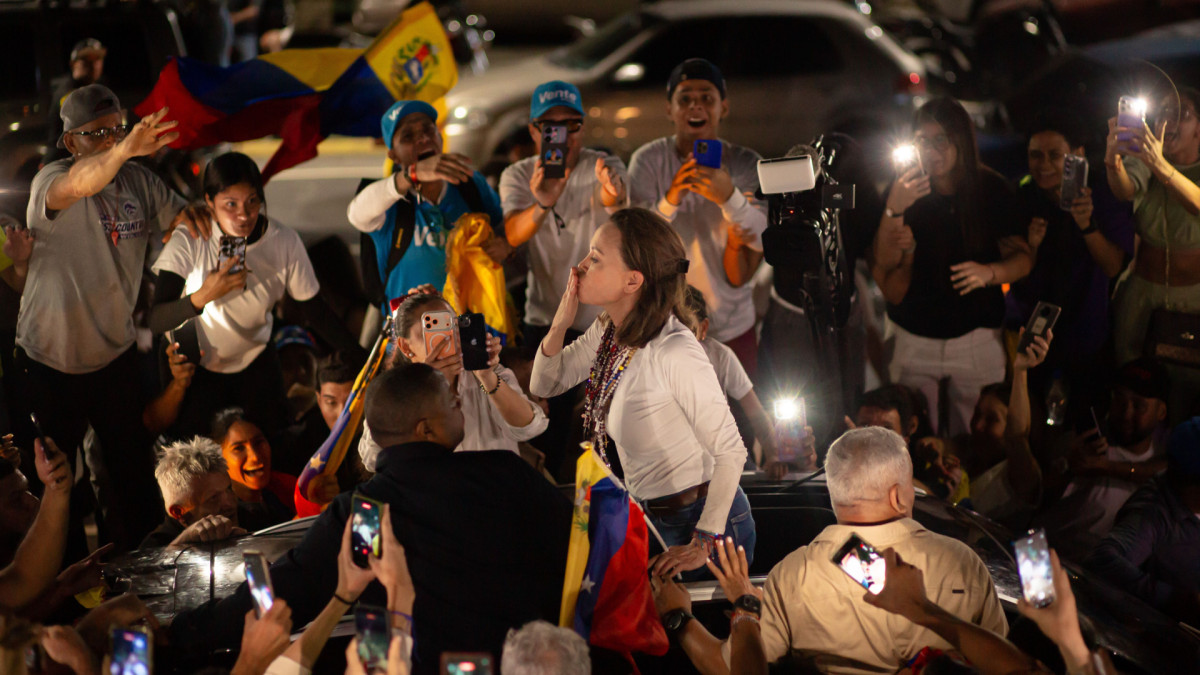
The return of María Corina Machado to Venezuela, last Sunday, October 25, has introduced a variable that Donald Trump would probably have preferred to keep under control. Ten months after leaving the country to receive the Nobel Peace Prize, the opposition leader has returned with a clear political objective: to transform her ability to mobilize popular support into effective pressure to call elections. Already with her feet on Venezuelan soil, the opposition leader brings back to the table a question that the U.S. Administration had managed to postpone for much of this year: how long can a political transition be sustained without Venezuelans having the opportunity to decide who should govern them?
Venezuela has changed deeply since Nicolás Maduro was captured by U.S. forces on January 3. The old regime has lost its principal leader, but much of the structures that sustained it — both political and security — continue to operate under the interim presidency of Delcy Rodríguez. In this case, Washington has chosen to negotiate with those who retain control of the State, while keeping democratization as a declared horizon, albeit without publicly committing to a definitive electoral calendar. The result leaves a politically ambiguous situation: while Venezuela is no longer governed by Maduro, it cannot be considered a democracy in an irreversible transition.
“The opposition leader has returned with a clear political objective: to transform her ability to mobilize popular support into effective pressure to call elections”
Now, with the return of Machado, the balance is likely to have to be different. The leader has announced that she will undertake a national tour and that she is preparing a series of meetings with social organizations and political actors to build a grand national accord that would enable advancing the transition. The strategy seems deliberately gradual. It is not only about filling plazas, but about demonstrating that there exists an organized alternative, capable of articulating majorities and offering guarantees for a new political era. Machado knows that popular support constitutes her main asset, but she is also aware that a mobilization without an institutional impact could end up strengthening those who defend the need to prolong the current stabilization period.
From a one-in-three chance to nearly one-in-two
In September, Agenda Pública published an analysis based on The Forecasting Machine forecasts that placed the probability of Venezuela holding democratic elections before December 31, 2027 at 32.8%. It was a prudent estimate, coherent with the difficulties of transforming an authoritarian system through externally led negotiations. At that moment, Maduro’s departure had altered the balance of power, but there were still not enough indications that those who controlled the State after his departure were willing to submit this continuity to the verdict of the ballots.
The new forecast, dated October 28, raises that probability to 46.5%. It is an increase of 13.7 percentage points in just over a month. The possibility of holding democratic elections remains slightly lower than not holding them, but the gap between the two scenarios has narrowed considerably.
How should one correctly interpret this change? Such a forecast is not a promise nor does it prove that elections will be held. What it indicates is that, based on the information available after Machado’s return, the democratic scenario has gained chances. The emergence of a more concrete institutional path, accompanied by pressures to establish a calendar, helps shift expectations. However, the forecast itself also recalls that essential institutions still need reform. Likewise, it is important to remember that holding a vote does not by itself guarantee its democratic character, a variable also contemplated by the forecast.
“The possibility of holding democratic elections remains slightly lower than not holding them, but the gap between the two scenarios has narrowed considerably”
Electoral processes organized by institutions that still respond to the old power structure, lacking sufficient guarantees for candidates, media, or voters, could serve to legitimate a political continuity under a renewed appearance. That is why the Venezuelan debate cannot be reduced to merely setting a date. The focus should be on the conditions that must be met for that date to have real meaning.
The transition Washington wants
With María Corina’s arrival, Washington has made public the plan it has for Venezuela. The White House’s bet is to renew the Supreme Court (Tribunal Supremo de Justicia), then reform the National Electoral Council (CNE), and pave the way to elections in the second half of 2027. There have already been discussions about renewing the judicial and electoral bodies, though none of these advances yet amounts to a call for elections. Republican Senator Bernie Moreno has proposed July 24, 2027 as the election date, a possibility supported by Machado but lacking official approval.
At bottom, the American logic responds to a mix of interests. Trump needs Venezuela to have stability so that his energy industry can resume production and that the economic deals reached with Caracas can be carried out. The Administration has found in Delcy Rodríguez an interlocutor capable of guaranteeing a degree of administrative continuity and negotiating with Washington. A good example of this is the oil agreement signed in August, which grants the United States access to one-fifth of Venezuela’s reserves. Economic normalization has advanced faster than politics.
“Trump needs Venezuela to have stability for his energy industry to resume production and for the economic deals reached with Caracas to be carried out”
Nevertheless, this strategy contains a contradiction. The more effective Rodríguez is at safeguarding American interests, the less incentive she may have to accelerate elections that could remove her from power. Washington needs the interim government to retain decision-making capacity to implement reforms, but it should also avoid letting that same capacity become a tool to perpetuate itself. Stabilization is a necessary condition for democracy, even though it can end up becoming its main competitor.
The pragmatism of Stalin González
In an interview published by Agenda Pública last March, the opposition deputy Stalin González offered his interpretation of this dilemma. González advocated a negotiated transition, capable of incorporating sectors of chavismo and rebuilding the institutions without provoking a new rupture of the State. His argument was not to renounce democracy, but to recognize that those who control the institutions must participate in the process that will allow transforming them.
“His argument was not to renounce democracy, but to recognize that those who control the institutions must participate in the process that will allow transforming them”
The leader warned that the more extreme sectors of chavismo and the opposition were not understanding the possibilities opened after Maduro’s fall. And he also established a difference between Trump and his Secretary of State, Marco Rubio: while the American president would approach Venezuela mainly from its economic interests, Rubio would have a more political understanding of the need for democratization. In this sense, González considered that the renewal of the CNE, accompanied by a new electoral legislation, would be the decisive signal that the country was approaching competitive elections.
Institutional reforms play a central role, but they are not exempt from limitations. Negotiation can facilitate former leaders accepting losing power, provided there are sufficient guarantees for their future participation. However, a negotiated transition among elites runs the risk of excluding those who represent a substantial portion of the popular will. The challenge is not to choose between González’s pragmatism and Machado’s mobilization, but to find a formula that combines both elements: institutions capable of organizing credible elections and an opposition with sufficient legitimacy for those elections to make sense.
In María Corina’s mind
The opposition leader returns precisely when that contradiction begins to become more visible. It should be remembered that Machado does not participate in the Washington-backed negotiation table, where opposition representation is led by Dinorah Figuera. “Things are going really well for us in Venezuela,” Trump told reporters who asked him about Machado’s return. However, the social leadership of Venezuelan politics and its link to the demand for the July 2024 election result make it hard to imagine a democratic transition that can do without her. Her challenge will be to transform that legitimacy into influence over institutional decisions. And to do so without getting trapped between confrontation and acceptance of a process whose calendar she does not control.
The experience of other transitions shows that elections do not necessarily arrive when an opposition manages to mobilize enough citizens. They arrive when the calculation of those who hold power changes and when there exists an institutional framework that makes the uncertainty of the outcome acceptable. In Venezuela, that calculation depends as much on internal pressure as on Washington’s decisions. Machado can raise the political cost of delaying elections, but Trump retains considerable capacity to determine Delcy Rodríguez’s incentives.
“Elections arrive when the calculation of those who hold power changes and when there exists an institutional framework that makes the uncertainty of the outcome acceptable”
Europe and, particularly, Spain should pay attention to this evolution. Diplomatic normalization with Caracas can contribute to improving economic conditions and opening spaces for negotiation, but it should not be mistaken for democratization that has already been achieved. Spain has ties of various kinds (political, economic and even human) that can be useful to accompany the reforms, promote electoral guarantees and facilitate agreements between opposing sectors. Its contribution would be more valuable if it helped ensure the process depended progressively less on American decisions and more on legitimate Venezuelan institutions.
The increase in the probability of democratic elections to 46.5% expresses a real, but premature and fragile opportunity. In the coming months one should pay less attention to statements about the transition and more to concrete decisions: who designates the new magistrates, how the electoral body is reformed, what guarantees opposition leaders receive, and when a verifiable calendar is established. Those decisions will allow us to distinguish between an opening aimed at transforming the system and one designed to manage it for longer.
Maduro’s exit opened a new phase in Venezuela. And now Machado’s return could contribute to ensuring that phase ends with a democratic outcome. Nevertheless, the result still depends on a question that no military intervention, oil deal, or diplomatic negotiation can resolve on its own: whether those who today hold power are willing to accept that someday they might lose it.
