
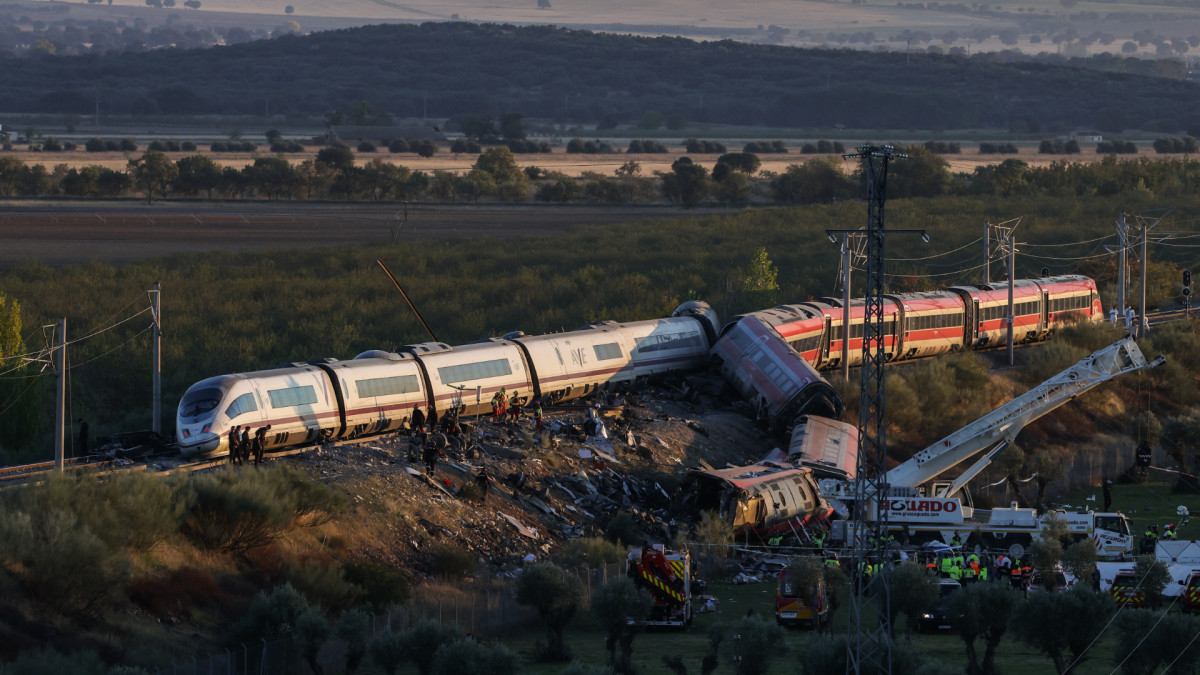
On the night of the accident, a multitude of international media outlets opened their evening editions with news of the tragedy. On CNN they reached out to Simon Calder, the travel correspondent for The Telegraph. From New Delhi, he tried in vain to find explanations for the improbable chain of extremely serious accidents in Spain, with more than a hundred fatalities — adding the incidents in Adamuz and Urda in 2026. The decision was to highlight Spain’s global leadership in the high-speed rail network, while discussing the necessary safeguards to passenger safety when transporting people at such high speeds. Almost at the same time, in TVE’s special pre-news program, the United Kingdom correspondent for the public broadcaster made the curious remark about a supposed British envy in rail matters, in a country where high-speed rail remains virtually non-existent.
I remembered the visit of the then Foreign Minister, José Manuel García-Margallo, to the Austrian National Bank in 2015. During his appearance he showed attendees a fabulous video of Spanish achievements, from football to architecture and great monuments, with particular emphasis on infrastructure — Madrid’s T4 and the AVE network, with an abundance of tunnels and viaducts. When it ended, a journalist asked: “Austria is a mountainous country, and as you will understand, we know something about bridges and tunnels. We are also a country of resources and one of the few net contributors to the EU. Yet we could not afford such a high-speed network. How can they finance this in Spain, being a country dependent on European aid?”
AVE: Are the high costs offset by the social benefit obtained?
In 2025, the BBC devoted a feature to how Spain, with a 4,000 km network, had become the “world leader in high-speed rail” and to the “doubts” generated by this bet. “Spain has the greatest ratio of kilometres per inhabitant in the world and has far surpassed pioneering countries in the development of this mode of transport, and with higher per capita income, such as France or Germany.” For Spanish president Pedro Sánchez, the network is a bet on “sustainable mobility”. Yet the British cited experts questioning the model, highlighting “high costs that are not offset by the social benefits obtained”, and development that comes at the expense of other, more economical and far-reaching transport services for the population, such as conventional medium-distance rail or commuter networks.
“Spain has the greatest ratio of kilometres per inhabitant in the world and has far surpassed pioneering countries in the development of this mode of transport”
While, according to data from the Ministry of Transport, investment in rail has risen considerably in recent years, partly thanks to European Next Generation funds, there is also the impression that journeys along large stretches of the national conventional network across our geography evoke a sense of desolation. Whether one wants to travel between capitals along the Cantabrian coast or try it from Almería to Murcia, from Cáceres to Salamanca, or from Benidorm to Valencia. For family reasons, my preferred stretch is the one from Vic to the French border. It has the honor of being slower today than when it was inaugurated, between 1875 and 1929.
It would be reckless to be a person with reduced mobility on Bilbao’s Cercanías and come across those impossible gaps between platform and train, or to rely on the Rodalies of Barcelona as a daily transport method to reach work from a home that many in society could potentially afford—hence located at a certain distance from the center of Spain’s second-largest city.
The Central European method for modernizing the network
In 1998, a first-generation ICE on the route between Hannover and Hamburg suffered a terrible accident near Eschede, with more than one hundred dead and around a hundred injured, due to a mechanical failure in the train wheels. After the accident, a commission was created to inspect and review the safety of the entire railway network, and a year later Deutsche Bahn presented a new concept of global safety, including new technical measures, greater controls, and the principle of redundancy in major reviews and decision-making, under the motto “more four eyes than two.”
The next serious accident in Germany would occur in 2016, when two regional trains collided head-on on a single-track section at Bad Aibling in Bavaria, leaving twelve dead and more than eighty injured, due to human errors, communication failures, and signaling. Subsequently, the train drivers’ union GDL would demand the continued use of simulators to prepare engineers for crisis situations, as well as the inspection of the communication elements between trains and the control center.
In recent years, Deutsche Bahn has accumulated numerous problems, mostly related to maintenance of the network and its necessary modernization. As in Spain, the gradual increase in rail traffic requires updating signaling systems to allow, safely, greater density of trains. However, the solution is not simply to patch things up. In 2024, a plan for a “general sanitization” of forty sections in the country’s central rail corridors was presented, which would entail their total and successive closure, by stretches and phases, until 2030. They did not hesitate to close for months the Frankfurt–Mannheim route, 74 km long, crucial for southwest-bound journeys; the entire Hamburg–Berlin route, 278 km; or a stretch between Hagen, Wuppertal and Cologne, one of the axes around the Rhine-Ruhr conurbation — home to more than 11 million people, one of Europe’s most populous metropolitan areas.
“In 2024, Germany presented a plan of “general sanitization” of forty sections in the country’s central rail corridors, which would entail total and successive closures, by stretches and phases, until 2030”
In Vienna, ÖBB has not hesitated to close a “Y”-shaped section of its suburban and regional network in the city center for more than a year, with major inconvenience for users, in order to modernize it completely, change tracks and catenary, and install new digital signaling systems and automated ETCS Level 2 safety, which will considerably increase train frequency and will replace obsolete systems such as the PZB or LZB — the latter still in operation on the Madrid-Seville AVE line.
ERTMS and ETCS: European interoperability requires system modernization
Despite having the highest density of “steel tracks” in the world, crossing Europe by train remains an odyssey. There are few direct cross-border routes, and it is practically impossible to book a ticket that includes segments with different companies in different countries. In case of delays, passenger rights tied to an itinerary with another operator are in question. Not to mention other issues such as the lack of accessible trains on many routes.
“Despite having the highest density of ‘steel tracks’ in the world, crossing Europe by train remains an odyssey”
Historically, one of the major problems to resolve has been the disparity of infrastructures, from tunnel clearances to axle load limits on bridges and viaducts, and the varied characteristics of trains. Hence approval processes remain necessary across different countries.
Europe is attempting to offer solutions, and one of the battlegrounds lies in signaling. The ERTMS system offers a qualitative leap in safety, efficiency, and interoperability for railway networks. By unifying national systems under a single European standard, it eliminates technical borders, allowing the same train to cross different countries without needing to change locomotives or drivers due to signaling. Furthermore, by integrating continuous train supervision with advanced digital communications, it significantly increases line capacity (allowing trains to run closer together, with greater safety) and drastically reduces maintenance costs by requiring less physical track infrastructure (no longer necessary to rely on signals and other elements).
“By unifying the national systems under a single European standard, it eliminates technical borders, allowing the same train to cross different countries without needing to change locomotives or drivers due to signaling”
Different infrastructure managers are gradually migrating. A first step is the transition to ETCS Level 2, equipping vehicles with onboard ETCS units and specific antennas. On the track, fixed beacons are installed so the train can geolocate its exact position. The fundamental difference of this level is the elimination of lateral signal lights; instead, a secure digital communications network is deployed, and Radio Block Centre (RBC) centers are installed to compute and send movement authorizations directly to the driver’s cab in real time.
The next step is ETCS Level 3 or ETCS-only, which implies the total elimination of track circuits and traditional axle counters that physically detect the train’s presence. In Level 3, it is the train itself that continuously calculates its position and, crucially, actively confirms its “integrity” (ensuring with internal sensors that no car is detached). This information is constantly sent to the RBC, allowing the safety space between trains to adapt dynamically to their real speed, fully maximizing line capacity and eliminating risk factors from earlier systems.
However, ETCS-only systems require new-generation convoys compatible with the system, removing older trains from circulation, which entails additional investments that explain the delay in their installation.
Risk management on Spain’s railway network
In 2024, a report from the Railway Accident Investigation Commission (CIAF) following an incident in Cuenca — where safety conditions in the circulation deteriorated, with some parallels to Urda — called for technical mitigation measures dependent on the human factor. According to SER reports (as of October 29) based on Adif data, on the Madrid–Seville AVE line there have been fifteen signaling bypasses with collision risk since 2023. In the Urda stretch, there have been nine faults since that date — four in 2026, some caused by cable theft.
Added to this is the fact that our country has been a leading student in passenger-train liberalization since the approval of the so-called Fourth Railway Package in 2016. Spain did not hesitate to allow entry to operators such as Ouigo, a subsidiary of the French SNCF, or Iryo, majority-owned by Trenitalia, while Renfe faced serious difficulties competing in neighboring countries. In markets like Germany, the penetration of operators unrelated to Deutsche Bahn in medium- and long-distance routes barely reaches 10%, although major changes are planned for the near future.
“Our country has been an outstanding student in the liberalization of passenger trains, following the approval of the Fourth Railway Package in 2016”
In Spain, thanks to the arrival of new operators, between 2019 and 2024 the number of passengers rose from 22.79 million to 39.68 million — a 74% increase— concentrated on the Madrid–Levante and Madrid–Barcelona axes. Daily frequencies rose from 56.2 to 84.9 on Madrid–Barcelona, and from 30.5 to 48.8 on Madrid–Valencia. And this had a direct impact on infrastructure, which reached a tipping point, as described by El Debate. The bottlenecks in the network are especially noticeable at stations.
In addition,
It is evident that maintaining the 4,000 km of high-speed network —with one of the highest kilometers-per-capita ratios in the world according to the International Union of Railways (UIC)— costs a true fortune. In 2024, the cost had reached €111,700 per km according to RTVE, almost double the estimated cost per km on the conventional network.
Just as Spain has several airports effectively closed, it is questionable whether the less profitable sections of the network can remain operational forever, in a country that remains one of the rare in Europe that stubbornly refuses to apply generalized tolls to its extensive network of highways and motorways, visited annually by millions of tourists who today do not pay any toll to use them.
Were the decisions on the Madrid–Seville line correct?
On paper, the actions seemed correct for the Madrid–Seville AVE line, the oldest in Spain with 34 years of service. In 2021 the contract for upgrading signaling installations, including the implementation of the European safety system ERTMS, had been awarded. Initially, the work was scheduled to finish in early 2026. According to El Periòdico, Adif had begun verifying the operation of the new Level 2 ERTMS devices “precisely in the environment where the collision occurred,” with the system already installed and in testing.
Yet the question remains whether a drastic surge in rail traffic, produced by the entry of additional operators, could be supported by an infrastructure that, while waiting for ERTMS rollout, still relies on an obsolete signaling system, which occasionally causes “signal overruns with collision risk,” coupled with the parallel execution of improvement works without halting the line, as would have been done in other countries. The Madrid–Seville line is undergoing a process of “comprehensive renewal” that will overhaul the entire infrastructure (tracks, ballast, electrification systems, telecommunications and, as noted, signaling).
“Adif had begun verifying the operation of the new Level 2 ERTMS devices precisely in the environment where the collision occurred”
We should also ask about redundancy systems, or the lack thereof, in each “signal overrun with collision risk” scenario. In Urda there was a “cascade failure” of three safety systems on the line (LZB, ERTMS —being tested— and ASFA) for unknown reasons. Several voices contend that the number of companies involved in the line’s modernization could have, by accident, touched a cable and affected the entire technological system.
Similarly, it is legitimate to question the level and intensity of investment in training, preparation, and the use of simulators for drivers and control-center staff, so they can react optimally in crisis situations — data from Adif show these events are not rare — with the goal of avoiding loss of lives. Are we talking about training levels and ongoing evaluation comparable to those implemented for commercial aviation pilots and air traffic controllers?
“In theory, in Urda there was a ‘cascade failure’ of three line safety systems (LZB, ERTMS —being tested— and ASFA) due to unknown causes”
Finally, given the extremely high commercial speeds in Spain, we might question the absence of basic preventative measures in trains, such as strengthening wagon structures to resist overturning, and even seat belts in carriages, aimed at reducing fatalities and serious injuries in the event of a collision.
In this context, it does not help that the minister responsible for the rail network —speaking after the Adamuz tragedy, a tragedy that claimed 46 lives— chose to appear on a satirical program on LaSexta to mock Renfe’s “breakdowns” rather than focusing on managing and resolving the network’s numerous problems, including grave safety risks.
Safety, the key to the railway’s success
We all know someone who fears flying. The reasons are many. One obvious reason is that when we board a plane, we put our lives in the hands of pilots, air-traffic controllers, maintenance personnel, security staff and many more people involved in the incredibly complex task of getting a large metal bird safely into the air and to its destination. In reality, the same is true for trains, subways, buses, even elevators, or when someone else is at the wheel of a car. Statistically, the majority of accidents occur in private homes, or at least that is what travel agencies have told us all our lives.
Since the tragic date of October 28, 2026, Spain is not only a leader in high-speed rail but also in the ranking of fatal accidents on high-speed lines. The morning after the tragedy, some experts hurried to call for “calm” on the Madrid–Barcelona AVE, with a “more advanced” safety system. On SER, Aimar Bretos questioned the absence of cross-checks that would prevent a “human error” from costing lives.
“Spain is not only a leader in high-speed rail but also in the ‘ranking’ of fatal accidents on high-speed lines”
Undoubtedly, one of the challenges for the government elected in the next general elections will be to convince citizens, and the millions of visitors Spain receives each year, of the viability of placing one’s life in the hands of Adif and the rail companies, traveling by a safe and reliable mode of transport.
It is crucial to achieve this not only for the pride that it represents for our country —and for the enormous efforts required— but also because rail is one of the most viable forms of transport that exist.
Beyond its overwhelmingly positive environmental balance and climate crisis impact, the electricity that powers it can be sourced independently of the volatility and tensions of geopolitics that drive the soaring prices of fossil fuels, consumed greedily by other transport modes.
Railway transport is also, the only form of mass transport capable of averting city and metropolitan collapse in terms of automotive and logistical pressures.
We need, therefore, to be able to move by train again normally, especially on the route affected by two gravely serious accidents in such a short span, without feeling as if we are risking our lives. And for that to happen, safety on the tracks must become an absolute priority for rail managers and policymakers, and for it to be perceived thus by the public.
Only a comprehensive, in-depth overhaul of the Spanish rail model, with particular emphasis on the inherent safety measures, can help restore the confidence that has been lost.
It was already dawn in India and Calder seemed tired. His verdict for CNN was unequivocal: “The only acceptable number of victims in high-speed is zero”.
