
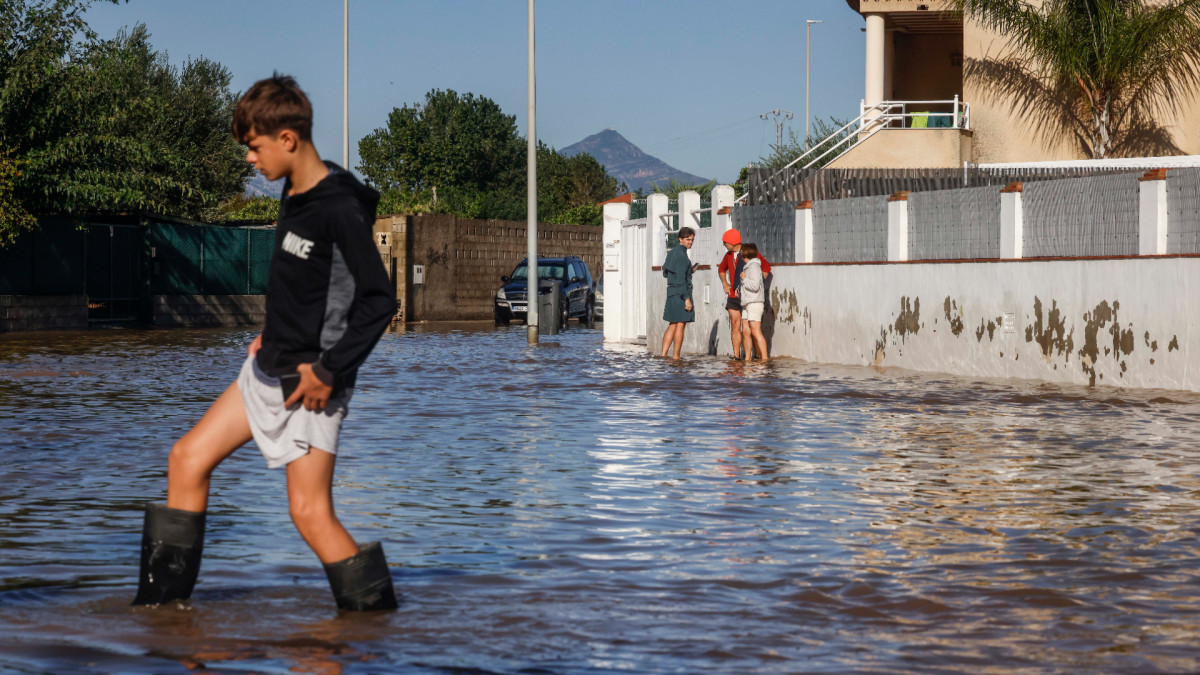
These days, in a tragic coincidence with the Toledo rail accident, two years have passed since the DANA that struck the metropolitan district of Horta Sud in Valencia and parts of the Valencian regions of Requena-Utiel and La Ribera. This coincidence challenges us and should compel us to ask what kind of society, what model of land use and mobility we have built that puts the lives of dozens or hundreds at risk. 233 people died from the DANA in Valencia and its neighboring cities and nearly 70 due to the Toledo accident—more than enough —one victim, in fact, would have sufficed—to reflect on whether the current territorial and mobility model we live in should be revisited. Honestly I think so.
The Valencia DANA was not merely a tragic manifestation of climate change. In fact, the DANA at the end of October 2024 brought with it three chained crises that remain unresolved. First, a human crisis, affecting and affecting tens of thousands of people who mourn their dead or have not yet been able to return to their previous way of life. Second, a territorial crisis that has called into question the urban planning, hydraulic, and territorial management model in a metropolitan-type comarca, but without metropolitan governance. And third, a political crisis, embodied in the resignation of former president Carlos Mazón in the face of dozens of street demonstrations, a crisis that lingers due to ongoing judicial proceedings and the political consequences that derive from them.
“The DANA of late October 2024 brought with it three chained crises that remain to be resolved”
These three crises should be addressed with resolve. I will focus on one of them, the territorial crisis, and what we have learned after dozens of debates, dialogues and reflections on what happened. First of all, this territorial crisis must promote a cure of humility that perhaps is equally necessary in the case of the Toledo accident: “Between the flood and the human response there perhaps lies the most dramatic battle, when man, short-sighted and lacking ingenuity, faces the majesty of nature or divine providence in a relentless and lost struggle for control; if he wins in the short term, in the long term man is usually defeated.” This powerful idea from Professor Vicenç Maria Rosselló, formulated in relation to the Xúquer flood of 1983, remains current. To what extent is arrogance not spreading through our way of understanding our relationship with the natural environment or with other aspects such as technology? The first lesson, therefore: we must strive to develop a geography, not merely modest but viable, as a safe, sustainable and fair living environment.
In this viable living environment, another essential lesson that becomes apparent is the need to change the scale of analysis in response to situations like the DANA. The tragic events of two years ago demand an adjustment of the scale at which territory is planned and mobility is managed. The Government of Spain has just released, with some delay, the draft of a Metropolitan Agenda for the country. It is a necessary step that arrives late. Today in Spain, there exists only one metropolitan government with the capacity to manage territory, mobility or housing policy—the Barcelona government, while problems have grown in scale.
Episodios such as the DANA of 2024 show that reconstruction will not be complete and correct if it is not carried out from a scale different from the municipal, just as climate change cannot be tackled through solitary actions at the national level. The more than 120,000 vehicles destroyed by the episode were an evident indicator that metropolitan mobility was in the hands of private transport, of the car.
“The more than 120,000 vehicles destroyed by the episode were an obvious indicator that metropolitan mobility was in the hands of private transport, of the car”
Those three crises caused by the DANA are still not fully resolved. It cannot be that returning to “normal” would really mean returning to the “abnormal” of a territorial and mobility model out of control to which, honestly, we had become accustomed. The professor and theologian Ximo García Roca wrote a text that, two years on, I believe remains fully current: “If we only aim to recover what existed, we will be preparing the next destruction. We can rebuild towns around people or around the car. If we put people at the center of reconstruction, we will prioritize green spaces, sidewalks, promenades, meeting areas, temples, mosques, schools, public services, and local shops; if we place cars at the center, we will prioritize highways, elevated roadways, parking lots, residential areas and shopping centers outside the towns.” This, like others, is a decision we have not yet made.
