
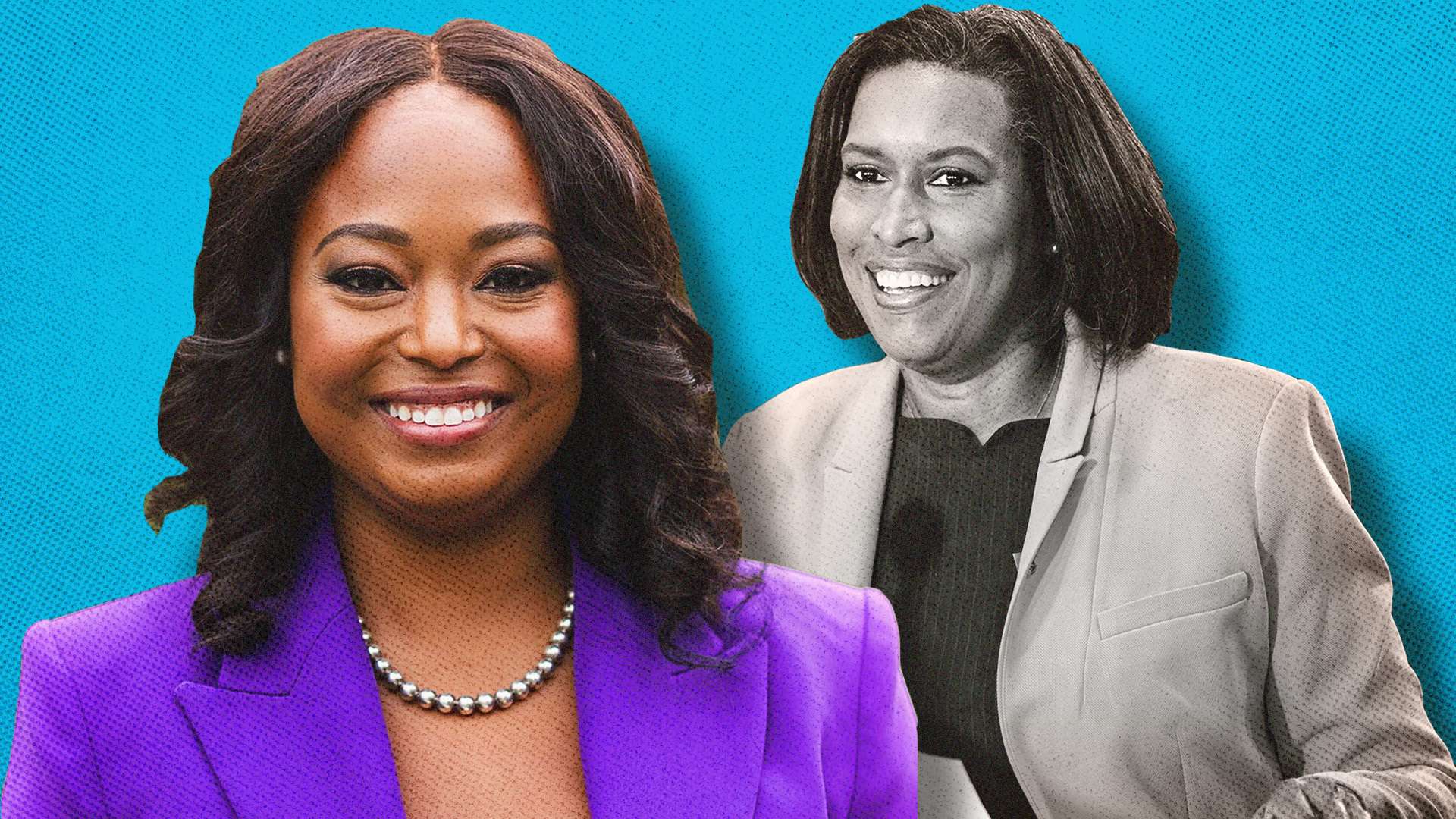
Come Tuesday, D.C. Councilmember Janeese Lewis George stands on the brink of victory in the race to succeed the three-term Mayor Muriel Bowser, who is stepping away.
Early voting is still underway in Washington, D.C.’s elections, but the outcome of the mayoral race already appears decided by many observers.
In June, Councilmember Janeese Lewis George secured a commanding 54 percent in the Democratic primary. In one of the most solidly blue cities in the country, that margin practically guarantees her the mayoralty.
She will take over from Bowser, who is exiting after three terms and has earned a reputation for a cooperative, rather than bold reformist, approach to governance.
Lewis George aims to be a more ambitious steward. She is a dues-paying member of the Democratic Socialists of America, aligning with figures like Zohran Mamdani in New York City (whose endorsement she pursued). Her campaign platform advocated expanded childcare subsidies, greater housing assistance, stronger rent controls, higher taxes, and, perhaps most notably, a sharper confrontation with President Donald Trump.
For months, District political observers have been busy trying to forecast what a Lewis George administration would look like in practice.
Will D.C.’s fragile fiscal situation and a tense relationship with the Trump White House push her toward moderation? Or will she adhere to her ideological stance even in the face of a budget crunch and a potential federal takeover of the city?
Budgetary Strains
When it comes to spending, Lewis George arrives with lofty goals but limited maneuvering room.
As the District’s Democratic mayoral primary was drawing to a close, the city was also embroiled in a fierce discussion over its FY 2027 budget.
Bowser had put forward roughly $450 million in cuts to bring the budget into compliance with legal requirements. The Council, with Lewis George’s enthusiastic backing, rejected those reductions and bridged the gap by drawing on one-time revenues and the city’s reserves.
Bowser allowed the budget bill to become law without her signature in late June, warning in a letter that the Council’s rejection of her cuts would leave an $837 million fiscal cliff for the next budget cycle.
Lewis George, now the presumptive mayor, retorted with a statement labeling Bowser’s proposed cuts as “devastating” and “irresponsible.”
In the lead-up to the general election, she pledged to balance the books and implement her new spending plans without raising taxes on working and middle-class residents.
This, she asserted, would be achieved through “forensic” audits of government departments to root out inefficiencies.
As experience with DOGE has shown, however, uncovering fraud, waste, and abuse does not always yield the funds required to support new permanent programs or tax cuts.
In this respect, Lewis George resembles Mamdani in New York—a fellow DSA member who entered office with grand spending promises, a fiscal shortfall to close, and limited authority to raise taxes.
Mamdani, at least, enjoys a relatively receptive partner in New York Governor Kathy Hochul, who has agreed to some new taxes and state aid to bolster the city’s budget.
Lewis George is likely to benefit from a Democratic shift in Congress that could permit higher local taxes. Yet during her first two years, she will still contend with a Republican president who has shown a willingness to meddle in local D.C. policy.
The Trump Question
One of the most thankless tasks for any D.C. mayor is pleasing a Republican president. In his second term, Trump has made that challenge even tougher.
In August 2025, he dispatched federal law enforcement personnel and National Guard troops to D.C. streets and placed the city’s Metropolitan Police Department under federal control as part of a high-profile crime crackdown.
Under the Home Rule Act, which established D.C.’s elected municipal government, the president could federalize MPD for up to 30 days. Yet Trump remarked that he might seek to extend that control beyond the initial period.
The move sparked protests across the liberal city. Demonstrations surged, symbols and yard signs urging the federal government to step back appeared everywhere, and some people even mocked the federal presence by tossing items into the discourse.
Bowser, whose authority over MPD was being overridden, largely attempted to calm the nerves. At a press conference on the day Trump announced the federalization, she described the move as “unsettling and unprecedented.”
Yet she also pledged cooperation with the administration and suggested that a heightened police presence in certain areas could be beneficial.
“My tone will be measured to fit what is appropriate for the District,” she stated at that August briefing.
If the aim was to prevent a prolonged federal takeover of MPD, the mayor’s measured approach achieved that: after 30 days, control of the department was restored to local authorities.
But such even-handed handling was not what the city’s left wing had hoped to hear.
Lewis George condemned it as an “outrageous action” and pledged to resist the “weaponization” of Home Rule.
In a Democratic primary where voters were eager to voice frustration with the new administration, her stance likely helped her.
In the days before the primary, Trump warned of ending Home Rule if Lewis George won. “Residents told me, ‘If Trump doesn’t like you, I love you,’” she recounted to a reporter in response.
And the question remains whether Lewis George will continue to position herself as Trump’s foil once in office. Constantly opposing the administration could create headaches; it was, in large part, the raison d’être of her election.
Thus far, Lewis George has offered only cryptic remarks about how she would relate to the White House.
“I’m prepared to work with this administration for the benefit of D.C. residents, and I’m ready to stand up to them when that is appropriate,” she told Fox 5 in late October.
From the Mayor’s Seat
Holding the office of mayor in a city like D.C. is rarely a boon for someone who leans left ideologically. You must balance the budget, you cannot print money, and taxpayers can evade redistributive schemes by relocating a few metro stops. We lack even arable land to collectivize.
Bowser, much like her recent predecessors, understood that funding a sprawling city government requires sustaining growth and keeping the federal administration on good terms.
The next mayor will face a difficult path.
The local economy is already weak. Unemployment is rising, housing development has slowed, and Trump has repeatedly threatened to terminate D.C.’s Home Rule and take direct charge of the federal government.
It’s hard to imagine the ideal mayor being a Democratic Socialists of America member with a lengthy wish list of expensive programs and a readiness to “fight” the federal government at every turn.
A potentially telling moment occurred in October when Lewis George urged delaying a bill that would permit autonomous Waymo taxis on city streets, arguing that the jobs of current drivers mattered too much.
That stance gave some observers pause, suggesting she might not bend to practical realities and would instead push for aggressive policies once in office.
For a city already facing stress, that prospect would point toward more strife ahead.
