
A new account opened on X on March 7, 2026, and for seven months it published nothing, followed no one, and was followed by no one, until October 20, at 23:57, it broke its silence with a single message: “On the 24th a blockade will be set up in Madrid to cause trouble, join the WhatsApp group,” accompanied by a QR code that led to a WhatsApp group named “24M” and inviting youths to meet at 17:00 on Gran Vía (Figure 1).
Figure 1. A sleeping account wakes up. Profile of @Blocus_madrid on X, created in March 2026 and with no followers, and its sole message, from Oct 20, with a QR code (pixelated here) pointing to a WhatsApp group. Source: X; capture by Kartex.
It may be the abandoned account of a teenager, renamed for the occasion, or a deliberately aged account to dodge the filters that platforms use to monitor newly created profiles, and with open data it is not possible to know for certain. Yet this is not an isolated case, as at least ten TikTok profiles created or renamed between October 18 and 20 have been documented and eight other accounts created, recycled, or reactivated in under sixteen hours to promote the Barcelona call.
In France, blocus denotes the blocking of a school by its students, and since September 21 it has given name to a movement that has travelled across the country, has echoed with different expressions to Belgium, Italy, Germany and the Netherlands, and on October 24 culminated in the disturbances in Barcelona, which according to the latest balance from the Mossos d’Esquadra resulted in 133 arrests, 85 of them minors.
“‘Blocus’ designates the blocking of a school by its students, and since September 21 has given name to a movement that has traversed the country”
In the first part of this series we analyzed the two fronts opening up on the street this autumn, the right and the radical right around Ceuta and the left around housing. There we warned that a metropolitan violence of a new kind was joining them, the subject of this text, for which at Kartex we analyzed 14,900 posts from 8,711 accounts on X, TikTok, Telegram and Instagram between September 26 and October 27, 2026, cross-referenced with the 472 relevant incidents reported by ACLED that have been recorded in Spain in the last month, together with local and national press.
From a theoretical and methodological standpoint, this actor has no recognizable strategy, so a clear political motivation is ruled out. Nevertheless, suspicions about the orchestration of this group across networks, with pre-formed accounts renamed across platforms, do not clarify its exact origins. Moreover, its geopolitical relevance lies in the fact that other actors treat it as a contested issue. Without clear evidence, pending investigation, the main hypothesis is that Blocus represents a transnational conflict propagated through networks, not traveling as an organization but as a repertoire; its geography sketches a map of metropolitan tension that overlays on the pre-existing conflict tracked by ACLED and on the political calendar, and its emergence opens a third front with spontaneous looting and expressions of rage, turning the phenomenon into a form of non-formal political violence.
Transnationalization of the conflict through social networks
The movement began at a high school in Créteil, in the southeast suburban area of Paris, with concrete demands (more teachers, lighter class loads, dignified buildings), and in one week it had reached Lille, Lyon, Marseille or Bordeaux, with more than 5,000 arrests, 85% of them minors, between September 21 and October 2, according to the Interior Ministry cited by Amnesty International. The national day on October 17, coinciding with the start of All Saints’ holidays, acted as a European detonator, probably because the holidays emptied the high schools, the original territory of the movement, and displaced the protest to the streets and online. In France, social movements often attract looting groups that take advantage of mobilizations, something that can be explained as an expression of resentment toward racism and a confronting identity among family origins and social integration in French society. Milan experienced two looting days that weekend, on the 18th and 19th; on October 31 calls appeared in Germany and the Netherlands; and on the 26th Maldita.es reported calls for Halloween in 46 cities across at least nine countries. By then, the movement had already found its own cry, “Bismillah c’est les ténèbres,” which according to franceinfo originated from messages attributed to police trying to infiltrate the groups.
“The national day of October 17, which coincided with the start of the All Saints holidays, acted as a European detonator”
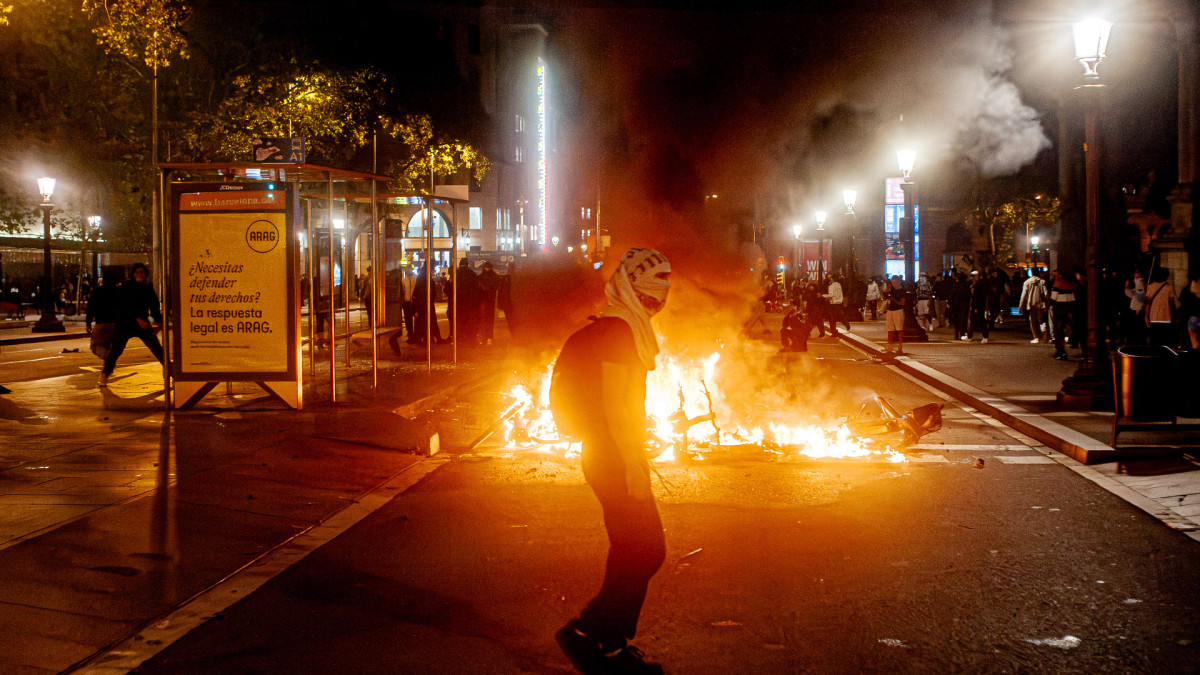
After a failed audition at Puerta del Sol in early October, the label only caught on in Spain after the French event. In our corpus, the first Spanish-language post appeared on TikTok on October 18 at 21:06, and at 00:16 on the 19th, a ten-follower account published the foundational Barcelona call (“We’re fed up with impossible prices, precarious wages, lack of opportunities […] We are not the future, we are the present”), nine hours before the first French “RDV le 24,” so the date did not copy France with a delay, but crystallized simultaneously in France, Italy and Spain in the hours that followed the 17th. That declarative post was only the public face of a mobilization that, according to the Mossos chronology, was organized in WhatsApp groups from October 20 and which on the 23rd Newtral described as a network of about twenty TikTok accounts recruiting youths to replicate the French protests in Madrid, Barcelona, Valencia, Alicante and Bilbao, with instructions on dark clothing, smoke bombs, and attacks on shops. The Catalan police were aware of the call but did not expect “that violent response,” and Spanish social-network conversations, nearly non-existent until the 24th, surpassed the French one on the 26th (Figure 2).
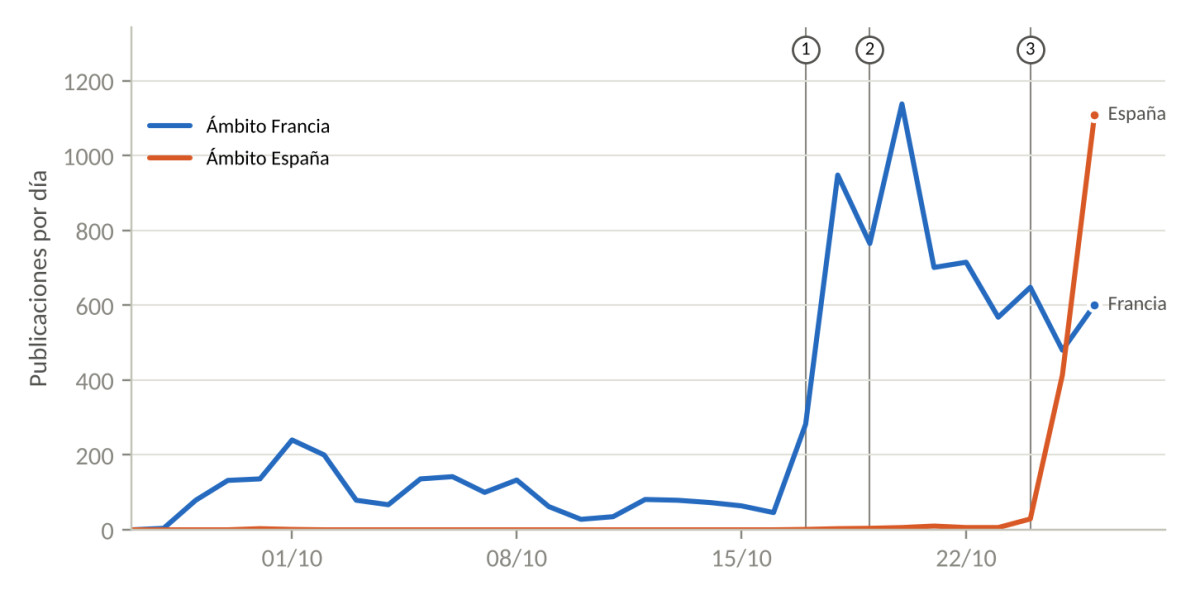
Figure 2. Daily posts about Blocus in French and Spanish contexts (Sept 26–Oct 26, 2026). Markers: (1) Oct 17, French national day; (2) Oct 19, first call in Barcelona; (3) Oct 24, Barcelona riots. Source: Kartex.
Lacking further proof, what crossed the Pyrenees was not an organization but a repertoire of actions to copy, and the information map of the movement makes that clear, since the French and Spanish information spheres barely touch, suggesting more of an information contagion. In the X graph, only 141 of 39,747 interactions (0.35%) connect a French account to a Spanish one, and the main bridge is not an activist but Grok, the platform’s artificial intelligence assistant, which generates 42 of those links by replying in both languages (Figure 3). The border that the repertoire crosses remains intact in the network, and what traveled was a date, a word, an aesthetic, and a format, with 18 of the 91 sounds from the Spanish videos drawn from French videos, a name, “Instituts Indignats” (the Spanish rendering of “Lycées indignés”), and AI-generated posters that repeat formulas like “Inspired by the protests in France.”
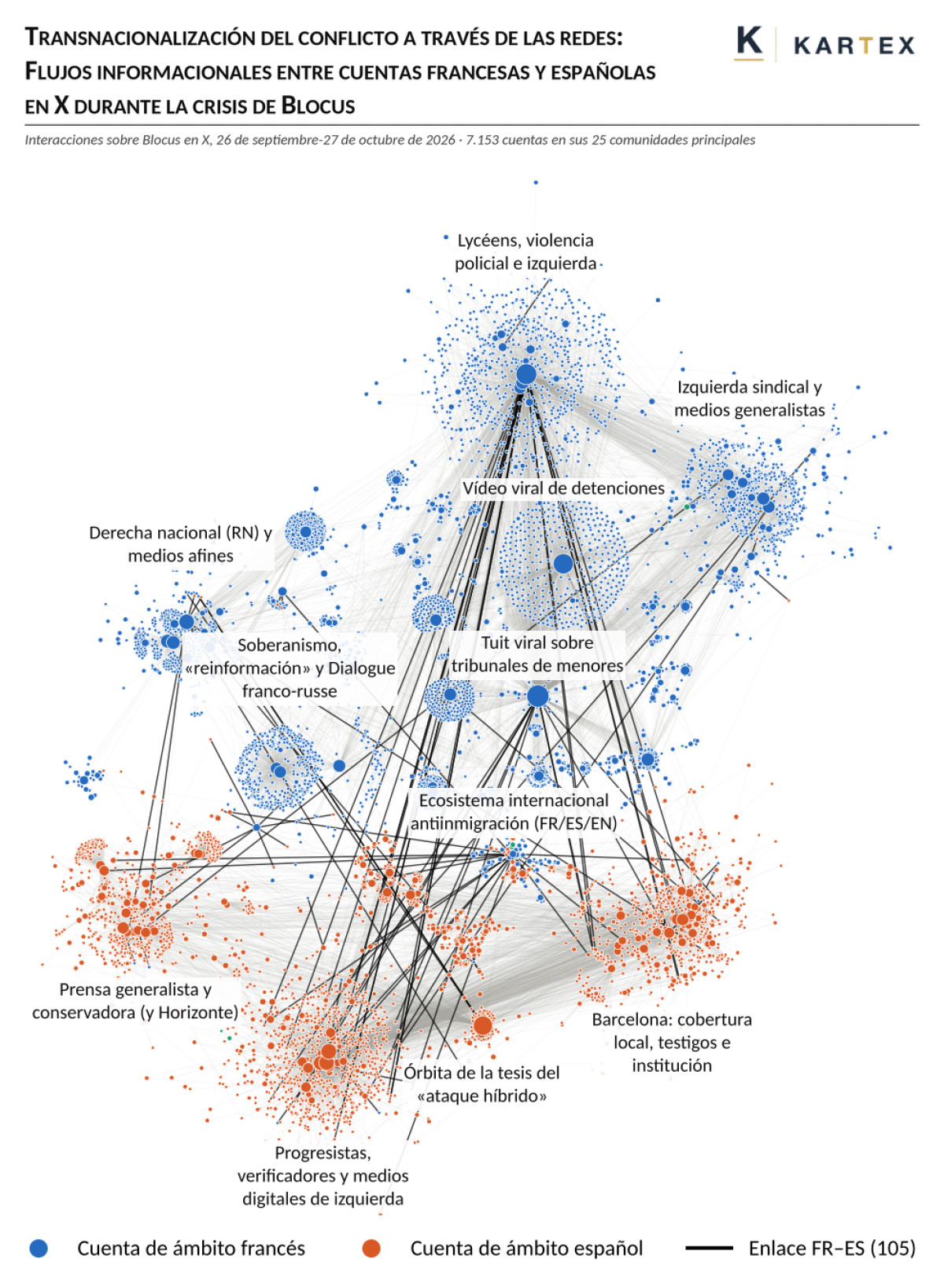
Hover over the graph to zoom. Figure 3. Two national information-spheres. Interaction graph about Blocus on X (core of 7,153 accounts across its 25 main communities, detected with the Louvain algorithm). The color indicates the domain of each account and the size the interactions received; the black lines are the 105 links between French and Spanish accounts. Source: Kartex.
The decisive diffusion also occurred in closed groups, as the initial call, with only 3,303 views on TikTok, was shared 225 times, a 6.81% share rate that places it above 99% of French videos and reveals WhatsApp and Telegram forwarding. Barcelona’s main group on the latter platform grew from about 690 to 1,376 members in twenty hours and exceeded 2,600 when it was closed, before its replacement surpassed 2,000, and when public exposure arrived, its administrators deleted about 11,500 messages and replaced looting instructions with a code (“take a matcha”).
“A falta de mayores pruebas, lo que cruzó los Pirineos no fue una organización, sino un repertorio de acciones a copiar, y la cartografía informacional del movimiento lo muestra con claridad”
Press reports describe a three-tiered machinery: one for recruitment on TikTok and Instagram, with posters and QR codes; a coordination layer in closed groups, where clothing, goals, and schedules are agreed upon and emergency bus hammers for breaking glass are offered; and a amplification carried out by viral profiles. Police have focused their strategy on these “intermediate nodes” and have turned to the Internal Ministry’s CITCO to block new groups.
The transnationalization of the conflict through networks therefore does not require a transnational organization directing the revolt (though such a possibility would not be far-fetched), but rather a replicable format based on a sociology that shares a common symbol, identity, and issues.
Low politicization, not the absence of demands
The similarity on both sides of the Pyrenees is also about the subject, since in France the movement began in the banlieue and its most famous cry is an Arabic invocation turned into a meme, signaling the culture of working-class, multiethnic neighborhoods where Maghrebi-origin expressions are part of teenage slang, and in Spain the available data point in the same direction. The youths involved in the Barcelona disturbances were between 12 and 20 years old, organized in small groups and dressed in black, and the 85 minors detained out of the total 133 exceed the 17 detained during the protests over Pablo Hasél’s imprisonment in 2021. Mossos chief Sílvia Catà dismissed Sílvia Orriols’s blame on foreigners by noting that the detainees “are people who live in Catalonia,” and spoke of a “new phenomenon of youth violence” which, she clarified, does not constitute “a generalized threat to public safety nor a widespread youth phenomenon”, and the chats reconstructed by elDiario.es reveal the jargon of suburban high schools, where Latin American and Maghrebi influences mix (“klk”, “zbi”).
Our reading is that the group most responsive to the call resembles the French one greatly: adolescents and young people, many of them children or grandchildren of immigration, largely Maghrebi, with very low politicization, not a lack of demands, as shown by the founding call that spoke of prices, wages and opportunities, by the Granollers posters calling for “the quality of the institute,” or the November 30 posters with “lower prices, more dignity.” They also come from a significantly identitarianly delicate cohort, subjected to both right-wing suspicion and political invisibility, in a country where 33.9% of minors under 16 are at risk of poverty or social exclusion, according to the Living Conditions Survey, and where the poverty risk rate for non-EU foreigners doubles the average. None of this alone explains looting, but it describes the social terrain, cross-cut by territorial and identity fractures, in which a TikTok call could resonate.
“None of this alone explains looting, but it describes the social terrain, crossed by territorial and identity fractures, in which a TikTok call found resonance”
What remains to be established is whether this constitutes political violence; for that I use the distinction proposed by Eduardo González Calleja between social violence, spontaneous, loosely organized and low-ideology with a minimal project, and political violence defined by its relation of support or challenge to the established power, as well as the three criteria, following Ekkart Zimmermann, that allow distinguishing them: the number of people involved, the actors’ intentionality, and the reaction of the community and the public, since violent acts acquire a political nature depending on the meaning attributed to them by witnesses and affected actors.
Because of its intentionality, Blocus sits on the border with social violence: a Barcelona on-duty judge described the gathering as “empty of content” and an “excuse” to loot, and the Catalan police chief Ferran López stated that participants “did not seem to be pursuing any aim other than wrecking and stealing.” Yet, the number of those involved—about six hundred youths in Catalunya Square—and, more importantly, the reaction of political actors is turning it into political violence, a tumultuous violence, in González Calleja’s taxonomy, whose political meaning is largely constructed outside of itself, in the contest over its representation.
Foreign interference and a hybrid attack, political parties or a social eruption?
The debate about the Blocus collective has been framed around three hypotheses: the possibility of foreign interference in the form of a hybrid attack, the possibility of partisan instrumentalization (Vox), and the possibility of a social eruption, each saying as much about the phenomenon as about the representations of its defenders. The interference hypothesis is fed by indicators that are not few: dormant or renamed accounts in a matter of hours, such as @Blocus_madrid on Twitter, created in March, posters generated with artificial intelligence, and a symbolism that oddly no local organizer would combine, such as the Iberian cross (ikurriña) with the Spanish flag in Bilbao or the Moroccan flag with the Spanish flag in Reus, which leads some to speak of a “hybrid attack” or to note that Catà indicated that the October 31 call is the only one monitored by the Catalan police that was energized by an external actor, without specifying who or whether it is a foreign actor.
Nevertheless, the evidence so far does not support this: the Mossos, who are investigating alongside the National Police, the Civil Guard and intelligence services, currently exclude foreign interference, the strategic intelligence report that posits this hypothesis admits it lacks “independent resources, contacts, and traceable purposes” to substantiate it, and in our corpus the pro-Kremlin Telegram networks devoted 52 messages to the French movement and none to Barcelona.
“The debate about the Blocus collective has been framed around three hypotheses: foreign interference as a hybrid attack, partisan instrumentalization (Vox), and a social eruption”
The partisan hypothesis is the mirror image of the previous one and has grown with the proximity of elections, because a national call for the day after November 29 and posters that mix flags with slogans against the PP and Vox lend themselves to any suspicion of electoral manipulation. Each side attributes the authorship to the opponent, the hard right to the government and immigration, and a portion of the left to a false flag, the most repeated attribution across networks, in a debate that is echoed almost in the same terms in Italy, where Giorgia Meloni warned after Milan’s looting that “to set our cities on fire” is not a right, and Elly Schlein accused the government of using the violent “to drown out the voice of those who protest peacefully against the cost of living.”
The corpus, however, documents those who exploit the brand, from looters and provocateurs to promoters of a memecoin called $BLOCUS, ultra channels and propagandists of all stripes, but not those who run it, and neither police nor judicial investigations have publicly identified a single organized actor behind the calls. The first alleged organizer arrested is a 17-year-old minor, arrested by the National Police on October 28 in Valencia and charged with conspiracy to commit public disturbances and property crimes and with belonging to an organized group, linked to the creation of two messaging groups, “Blocus Vlc,” one of which had more than 400 members, from which looting of stores was called for Halloween night, a profile aimed more at local imitation than external direction, although the investigation remains open to determine possible involvement of others. An initial sowing by a third party, foreign or national, turns out to be indistinguishable, based on open data, from spontaneous imitation, and only data kept by the platforms, such as the IP address or the phone numbers linked to the creation of accounts like Madrid’s, will allow unraveling that thread.
“An initial sowing by a third party, foreign or national, is therefore indistinguishable from spontaneous imitation based on open data”
The hypothesis of a social eruption, in my view, best fits the available data and is the one that allows us to say the phenomenon is here to stay, because, whether or not it is articulated through external interference or internal partisan manipulation, the group that has answered the call resembles that of other European metropolitan areas. In France the movement began in its high schools and amassed over 5,000 arrests, 85% of them minors, in two weeks; in Milan, on Sunday, October 18, police escorted 271 youths to the police station, 220 of them minors, mostly Italian or second-generation, who came in small groups after TikTok invitations and looted sporting goods and fashion stores; in Barcelona, those detained were 133, 85 of them minors. They share the same symbolic references, the Arabic invocation turned into a meme, which circulated in Italy before reaching Spain, along with trap music, tracksuits, branded sneakers, and luxury or sports loot, and a shared identity crisis, that of second-generation migrants and working-class youths who see limited access to social ascent, a problem greatly amplified by the glamorous-luxury imaginary typical of the social networks economy.
The main cities of the State under strain
The map we have built at Kartex (Figure 4) situates the Blocus expansion within its territorial context and is designed as a diatopical diagram: the overlay of spatial sets at different scales, European, national, regional and urban, whose relationships explain the phenomenon.
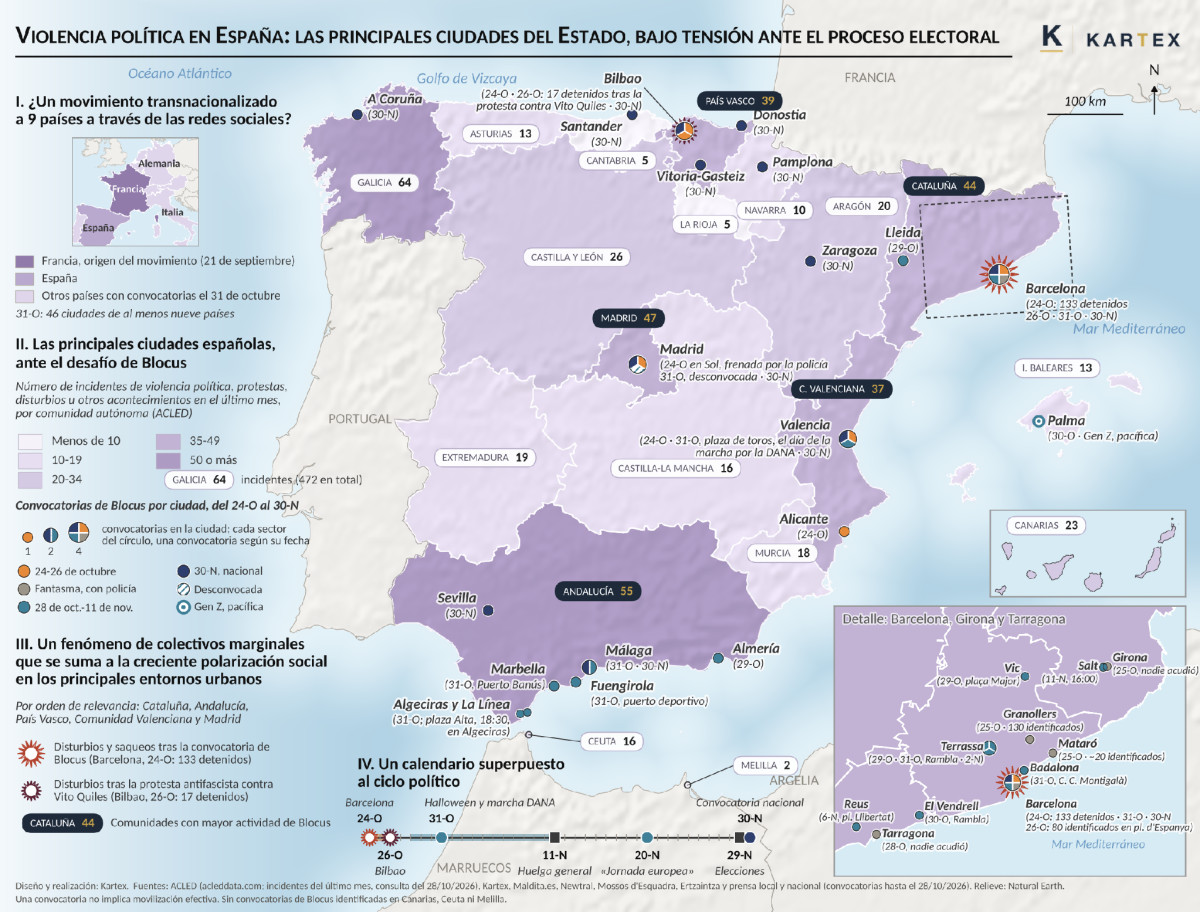
Hover over the map to zoom. Figure 4. Political violence in Spain: the main cities of the State under stress ahead of the electoral process. Incidents recorded by ACLED in the last month by autonomous community, Blocus calls by city between Oct 24 and Nov 30, Barcelona and Bilbao riots, European day on Oct 31 and the political calendar. A call does not imply effective mobilization. Source: Kartex, based on ACLED, Maldita.es, Newtral, Mossos d’Esquadra, Ertzaintza and press (until Oct 28, 2026).
The European frame places the movement’s origin in France and the Oct 31 events in 46 cities across at least nine countries, and it recalls that the scale of the phenomenon is not national. On Spanish soil, ACLED’s violet shades show that six communities—Galicia (64 incidents), Andalusia (55), Madrid (47), Catalunya (44), the Basque Country (39) and the Valencian Community (37)—account for six out of ten events. The events do not measure their real magnitude; for example in Ceuta political tensions were very high with the formation of right-wing brigades.
The circles of the calls, whose sectors indicate the date for each gathering, sketch a coastline and metropolitan geography of 29 localities in nine communities, complemented by a peaceful protest by Generation Z in Palma, aligned along the Mediterranean corridor from Girona to Alicante, the Andalusian arc linking Almería with the Costa del Sol and the Strait, and the northern capitals, while much of the interior of the peninsula, from the two Castiles to Extremadura, and also the Canary Islands, Ceuta and Melilla, remain empty. Catalunya concentrates twelve of these localities, detailed in the lower box, and the nationwide call for November 30 adds six northern capitals (Bilbao, Vitoria-Gasteiz, Donostia/San Sebastián, Pamplona, Santander and A Coruña) to the six largest cities, producing a northern skew that excludes Murcia, Palma or Las Palmas de Gran Canaria.
The outbreak stars only appear in Barcelona and Bilbao, and the five communities where the phenomenon weighs most, in descending order — Catalunya, Andalusia, the Basque Country, the Valencian Community and Madrid — coincide with the country’s main urban environments, painting a phenomenon of marginalized collectives that adds to the growing polarization of large metropolitan areas. Since a call does not guarantee mobilization and new gatherings had limited reach, this is not a map of mobilization but of tension, overlaid with three geographies: the storefront, the peri-urban fringes, and the political calendar.
“It is not a map of mobilization, but of tension, overlaid with three geographies: the storefront, the peri-urban fringes, and the political calendar”
The geography of riots and looting is the geography of targets that are not the centers of political power but the consumer spaces, such as Passeig de Gràcia and the block between Universitat, Urquinaona, Portal del Ángel and La Rambla, where on October 24 barricades rose from 18:30 and 23 businesses were affected, to Madrid’s Gran Vía, Puerto Banús, the Fuengirola marina, the Montigalà shopping center in Badalona or Tarragona’s Rambla Nova.
Every poster created within minutes requires dispatching dozens of agents, warning businesses, and occupying the news, and whether or not deliberate, that cost asymmetry turns the phantom call into a tool for police saturation. Its geography is the metropolitan municipalities and the interior of Catalonia with a notable share of migrant-origin populations, from Badalona to Terrassa, Tarragona, Vic or Salt, and in Andalusia forming a coastal arc from Almería to Marbella and up to Algeciras and La Línea, facing Gibraltar and Ceuta, in the same southern border that characterized the first part of this series.
The most troubling geography is that of the political calendar, which the map’s timeline overlays onto the calls. In Madrid, the October 24 gathering at Puerta del Sol, the housing camp site, was halted by a strong police deployment, and the Halloween call was called off with the argument that there were infiltrated agents in the groups. In Valencia, the Oct 31 gathering at 17:30 in the bullring coincides with the 18:00 protest for the second anniversary of the DANA, with the slogan “Mazón in prison,” and with the 17:00 rally that former National Police inspector Ricardo Ferris has called at the Colón Market to “defend Valencia,” three gatherings separated by barely one kilometer. In Bilbao, the Oct 26 day ended with 17 arrests when about a hundred hooded protesters joined Ikasle Antolakunde Sozialista’s demonstration against ultranationalist agitator Vito Quiles in Deusto, at the end of a university tour that had previously visited Pamplona, the Autonomous University of Barcelona and Zaragoza, and Basque Security Counselor Bingen Zupiria described the detainees as youths who “have not known ETA violence nor kale borroka.” Salt has a call on November 11, the general strike day, groups announce a “European day” on the 20th, and the national call is set for the 30th, the day after the elections, so Blocus has no program, but it has a calendar, and that calendar is the political cycle.
Ceuta, Sol and Blocus: the third front
In the first part of this series we analyzed the two fronts opened this autumn: the right and the radical right, which turned the Ceuta migrant crisis into an established street-mobilization cycle and supported brigadism, the aim of civilian groups to monitor, patrol and “defend” a territory against a designated enemy, and the left reactivating around housing with the vocabulary of the 15-M movement, two fronts that clashed already at the Sol camp on October 3 and 12.
Blocus opens a third front that does not belong to either side, with no recognizable ideology or organization, but it also responds to the rise of the radical right and to the intensification of racism that this right normalizes in society by stigmatizing and pointing even more at the collective. This phenomenon will both fuel radicalization on the part of the radical right, which sees its discourse legitimized, and punish the left, which observes how “gratuitous” violence ends up masking a more concise analysis of the phenomenon.
“Blocus opens a third front that does not belong to either side, without recognizable ideology or organization”
The online debate confirms a contest over the narrative (Figure 5), as one in five Spanish messages about Blocus points to a culprit without any single one dominating, and the radical right or the false flag (30.4%), Israel (29.3%), radical left (23.1%), immigration (22%), and foreign interference in general (19.1%) share the conversation, while Russia barely appears (4.9%). Each community in the graph chooses its preferred enemy, in the same multipolar framework we measured in Ceuta and Sol, and it is in that information war where the third criterion of González Calleja is fulfilled, since Blocus violence becomes political to the extent that actors incorporate it into their representations of the adversary.
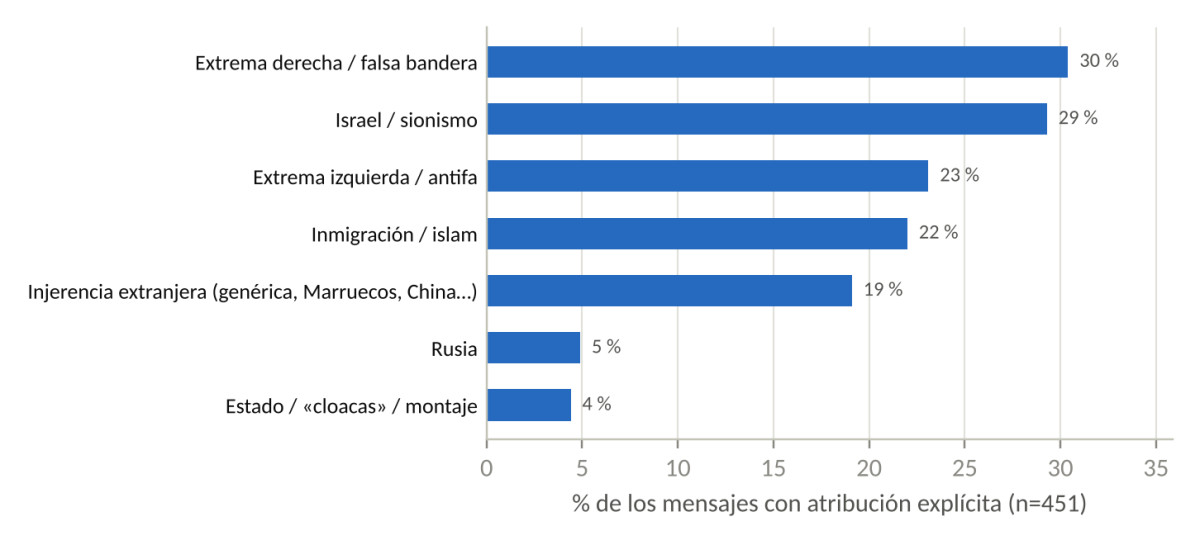
Figure 5. Who the Spanish debate blames. Explicit attributions in the 451 messages pointing to a responsible for the disturbances, out of 2,328 Spanish-context messages. A message can name several responsible parties, and mentioning an attribution does not imply endorsement. Source: Kartex.
A cycle of unprecedented political violence
My hypothesis is that we are facing a cycle of rising political violence that may be unprecedented in our democracy, not so much for its intensity—though still distant from past terrorist violence—as for the convergence of three dynamics that until now had run separately: the long cycle of mobilization by the right and the radical right, which began in Spain with the procés and the COVID-19 era, and found in the DANA, Torre Pacheco and Ceuta its arguments; a left that the pandemic left dazed and that today reactivates around housing, Palestine and the first general strike in fourteen years; and the transnational youth rebellion of Generation Z, which since 2025 has traveled through Nepal, Morocco and Madagascar, took on France the form of “Bloquons tout” and the blocuss, and reaches Spain with less intensity but a worrying potential to settle in certain cities like Barcelona. Its subject, adolescents from working-class neighborhoods, many of them of migrant origin, is also one that neither the radical right nor organized left address, except as a threat on the former side and as victims on the latter.
“We are facing a cycle of rising political violence that may be unprecedented in our democracy”
Democratic Spain has already experienced two stages of political violence: terrorism, from ETA to Terra Lliure or the GRAPO, and the period that opened the 2008 crisis, in which direct violence diminished in intensity and “non-violence” and civil disobedience, from the 15-M to the procés, became a strategy of movements, eventually resulting in a low-intensity civil conflict in Catalonia that security forces managed to curb and that carried risks of escalation (though it did not culminate in a terrorist level despite fleeting signs). Blocus may be pointing to a third stage, a tumultuous violence without a project, summoned by algorithms, territorialized in metropolitan spaces, which responds to deficit-societal dynamics, identity issues, and the labeling by the radical right, and which may be activated together with other mobilizations, as seen in France.
The strategies these actors employ for the November 11 strike and the November 29 campaign are already taking shape against this backdrop. The law-and-order discourse has fully entered the campaign, with a PP presenting Xavier García Albiol, mayor of Badalona with his own Blocus call, and challenging Vox for a security framework that this party fuses with immigration and the border, while the Government, acting as the private prosecutor, and the Mossos advocate containment supported by judicial avenues, which has prohibited several detainees from attending demonstrations, and in pursuing intermediate-nodes. For the left, the risk is that the general strike becomes associated with disturbances, because a Blocus call such as Salt’s on November 11 or an overwhelmed picket could allow the right to confirm its narrative of a left that wants to light the street on fire, as Feijóo put it, a left that has lost the street.
In this high-voltage calendar, weaving together Halloween, the DANA march, the general strike, the “European day,” the elections and the national Blocus call in less than a month, the risks range from police saturation (as phantom calls already test) to a brigadismo that could find a new enemy in working-class youths, possibly involving ultras crowds that serve as a cross-cutting space that lends radicalized crowds their energy, aesthetics, and pretext, and to the campaign’s contamination.
In short, we are witnessing a process of multipolar social polarization, with a strong translation of street strategies and rising mobilization cycles, especially from the radical right, but also from the radical left and from movements like Blocus with heavy disturbances, which will normalize violence as a normal praxis, as seen among the radical (dissident) wings of the left or even radical independence movements, as observed during the anniversary of October 1. A period of mutual activation, increasing antagonism and high street mobilization is on the horizon, with a worrying outlook for stability.
