
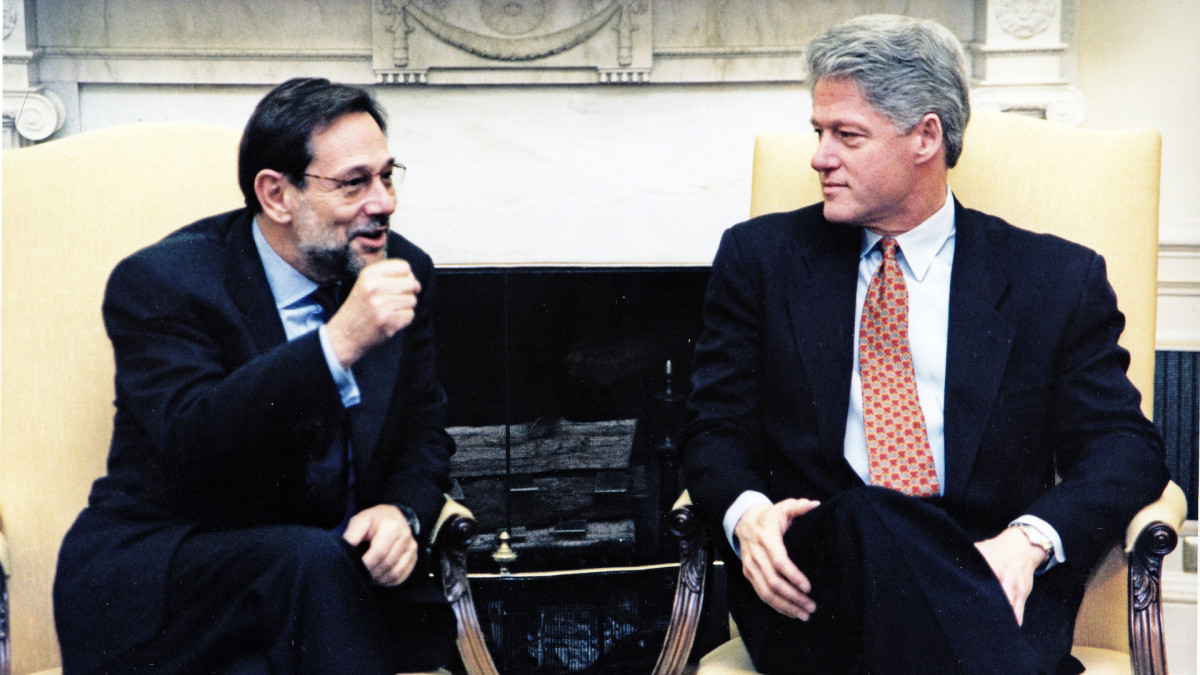
On 22 October 1996, just a couple of weeks ahead of the United States presidential election, Bill Clinton traveled to Detroit to deliver a speech in which he stated that the initial group of Central and Eastern European nations invited to join NATO should attain full membership by 1999, in time for the alliance’s 50th anniversary.
The choice of Detroit was telling. Michigan, much like Wisconsin, Pennsylvania and Illinois, housed sizeable communities of Polish Americans and other Americans with roots in Central and Eastern Europe. Many kept family and cultural ties to nations that had only recently shaken off Soviet domination. For these communities, Poland’s entry into NATO represented not only a security matter but also a question of identity.
“For them, Poland’s accession to NATO was a matter of security, but also of identity”
Clinton grasped the significance of these voters. So did his Republican challenger, Bob Dole, who pushed for quicker NATO enlargement and criticized the president for the slow pace of the process. Both were competing for the backing of groups that could prove pivotal in several states. After delivering his speech, Clinton visited the Polish Village Cafe, a venue serving Detroit’s Polish-American community. In March 1999, Poland, Hungary and the Czech Republic joined NATO.
To what extent was one of the most consequential geopolitical decisions of the late twentieth century shaped by the need to win an American presidential election?
Ian Shapiro has little doubt that electoral calculations mattered. “Clinton wanted to win Michigan, Wisconsin and Pennsylvania,” he tells me over dinner in New Haven, near Yale University, where he teaches political science. He is the author of After the Fall: From the End of History to the Crisis of Democracy, How Politicians Broke Our World, a book examining the decisions that shaped the international order after the Cold War.
In the first portion of our conversation, published in , we discussed Pedro Sánchez’s decision to call an early election, the missteps of social democracy and the political opportunities that leaders do not always know how to seize. NATO enlargement is another episode that Shapiro analyzes through this lens.
Foreign policy can win votes, too
In October 1996, Radio Free Europe/Radio Liberty reported on the electoral significance of Americans with roots in Central and Eastern Europe. These communities were especially concentrated in a corridor spanning the Northeast to the Midwest. In a political system where the presidency is determined state by state, their votes could carry substantial weight, particularly where the contest between Democrats and Republicans was tight.
For Clinton, NATO enlargement offered an opportunity to present himself as a guarantor of the independence and security of states that had formerly been part of the Soviet bloc. It wasn’t a policy improvised for the campaign: his administration had formally raised the enlargement prospect in 1994, after years of debate about NATO’s future. Yet the looming election provided an extra incentive to make firm commitments and to communicate them to specific voter groups.
“The approaching election provided an additional incentive to make firm commitments and communicate them to particular groups of voters”
In Detroit, Clinton argued that NATO could help stabilise Central and Eastern Europe, just as it had helped safeguard Western Europe’s security after 1945. There was a strategic logic to his stance, but the choice of Detroit as the venue for announcing the enlargement timetable also reflected electoral considerations.
A 2024 study by the Carnegie Endowment for International Peace documents the lobbying efforts of organisations representing Americans of Central European descent in favour of enlargement, as well as the importance the Clinton administration attached to their support in closely fought Midwestern states. The study notes that the White House used the re-election campaign to announce progress on a policy that was already under way.
Richard N. Haass, an American diplomat who would later become president of the Council on Foreign Relations, also identified in 1997 pressure from these communities as one of the factors behind the decision. His analysis acknowledged the strategic case for enlargement, while warning of the risks of damaging relations with Russia and undermining European security.
Electoral calculations were not the sole driver of NATO’s expansion. The decision enjoyed the backing of Central European governments seeking membership, a large portion of the American political establishment and several European allies. But domestic political interests also played a role. Even major international-security decisions can be shaped by immediate electoral pressures.
Was NATO enlargement inevitable?
Shapiro pushes his critique of those years’ decisions even further. “I would have shut down NATO in 1991, or replaced it with a pan-European security alliance,” he says, noting that this isn’t a hindsight conclusion: alternative proposals for Europe’s security architecture existed at the time.
“I would have shut down NATO in 1991, or replaced it with a pan-European security alliance”
François Mitterrand and Hans-Dietrich Genscher, among other European leaders, had advocated pan-European security frameworks that could bridge the military divide left by the Cold War. In the United States, figures such as George Kennan, Brent Scowcroft and Senator Sam Nunn also questioned the wisdom of NATO enlargement and warned of its potential consequences for relations with Russia.
Shapiro asks why a military alliance designed to contain a Soviet Union that no longer existed should be preserved and broadened.
In his view, the post–Cold War moment offered a unique chance to reform international institutions and redefine relations with Moscow. Russia was weakened, its leadership sought ways to cooperate with the West, and the ideological divisions of the past appeared to have lost much of their relevance.
Yet Washington interpreted the collapse of the Soviet Union as confirmation of the superiority of its own model. The United States had emerged as the dominant power and chose to extend the institutions that had organized the Western world for decades. “What strategic interest did the United States have in 1999 in bringing Hungary, Poland and the Czech Republic into NATO?” Shapiro asks. In his view, there was no sufficiently compelling strategic necessity to justify the decision.
His position is controversial, especially from the perspective of the countries that had lived under Soviet influence. For Poland and its neighbors, the disappearance of the Soviet Union did not guarantee that Russia had permanently abandoned its territorial ambitions. Central Europe’s history of invasion and occupation meant that American protection was seen as a safeguard against the possibility of renewed Russian expansionism.
Russia’s invasion of Ukraine in 2022 reinforced those fears. From Warsaw, NATO enlargement can be read as a decision that anticipated a real threat. Any critical assessment of that process must therefore take into account the wishes of the governments and societies that sought membership.
Shapiro does not deny that Poland had good reasons to seek such protection. What he questions is whether the American response necessarily required expanding a military alliance. He believes there were alternative ways to provide security for Central Europe while building a cooperative relationship with Russia.
This is one of the central arguments of After the Fall. Major historical transformations are not entirely determined by economic structures, institutions or ideologies. At certain moments, political leaders have exceptional room to choose among different courses of action.
“At certain moments, political leaders have exceptional room to choose between different courses of action”
In the 1990s, the West could have constructed different security institutions and fostered a different relationship with Russia. NATO enlargement arose from decisions shaped by strategic interests, international commitments, diplomatic pressure and the electoral incentives facing American leaders.
From Clinton to Trump: Europe’s dilemma
Three decades after Clinton’s Detroit remarks, Donald Trump has once again placed America’s commitment to European security at the center of political debate. I ask Shapiro how he interprets the differences between the two presidents and their respective visions for America’s role in the world.
Clinton believed that the Cold War left his country with the power to organize the international system around its own institutions and priorities. His foreign policy reflected an internationalist stance in which Washington was expected to lead the Western world. NATO enlargement was part of that project.
Trump, by contrast, approaches international affairs from a more nationalist and transactional viewpoint. His willingness to challenge long-standing commitments to European allies has called into question some of the foundations of the order built after 1989.
In 1996, an American president championed NATO enlargement both as a security guarantee for Europe and as a means of cementing U.S. leadership. Thirty years later, a different president repeatedly questions America’s obligations to defend its allies.
Europeans, meanwhile, depend on choices made by leaders they cannot vote for. I pose this democratic paradox to Shapiro because I believe it is especially relevant to understanding the limits of European sovereignty. The security of Poland, Germany and Spain is shaped by the outcome of American presidential elections in which their citizens have no say.
“The security of Poland, Germany and Spain is affected by the outcome of American presidential elections in which their citizens have no say”
In 1996, Polish-American voters in Michigan could sway the decision to bring Poland into NATO. Those living in Warsaw, who would be directly affected by that decision, could not vote for the American president.
This dependence does not excuse European governments from responsibility, nor does it undermine the legitimacy of decisions taken in Washington. But it shows how far the domestic priorities of a major power can shape the security of other nations. Even when a presidential election is decided by a narrow margin in a handful of states, its consequences can extend far beyond the United States.
The risks of a nationalist Europe
I ask what might happen if Europe’s leading nations were to fall under nationalist administrations. We discuss the potential ascent of the French far right, the rise of Alternative for Germany, Giorgia Meloni’s government in Italy and the prospect of a PP–Vox coalition in Spain.
His answer is unsettling: “I think it would dramatically raise the odds of war in Europe, including conflicts among Europeans”
Shapiro fears that some nationalist governments might turn to external confrontations if their economic programs fail to satisfy voters. The tactic of forging a common enemy to mobilise support against immigration or domestic political opponents could eventually spill over into interstate relations.
“The use of a common enemy to mobilise support against immigration or domestic political opponents could eventually spill over into relations between states”
The hypothesis invites debate. Nationalist administrations do not all share the same foreign policies, and ideology alone does not guarantee that they will provoke armed conflict. Nor does Shapiro present this outcome as inevitable. His warning concerns the risks of a political outlook that treats relations between groups and countries as a zero-sum contest, where one side can gain only by the others’ loss.
The problem would be especially grave in a Europe whose security depends on agreements among governments with divergent interests. Treaties and international institutions offer avenues for cooperation, but their effectiveness also rests on the political coalitions in power and the choices their leaders make.
Europe could find itself with governments increasingly unwilling to cooperate with one another, just as Washington redefines its global priorities. That combination would make it markedly harder for Europe to respond to external threats.
The election that helped reshape European security
Clinton’s stop at the Polish Village Cafe illustrates the links between domestic political dynamics and international relations. The U.S. president engaged with Polish-American voters right after announcing a decision of major importance for European security, all while he was in the middle of his re-election bid.
Clinton did not travel to Detroit merely to win votes. His administration carried a strategic vision for Europe, shared by many Western leaders and supported by the Central European governments seeking NATO membership. Enlargement addressed security concerns that cannot be reduced to the interests of an American presidential campaign.
“Enlargement answered security concerns that cannot be reduced to the interests of an American presidential campaign”
Yet that international strategy also carried electoral appeal. The pledge to admit new members was announced to a notably receptive audience, with barely two weeks remaining before the election.
Shapiro believes that the end of the Cold War offered Western leaders opportunities they failed to seize. It is possible to disagree with his proposal to dissolve NATO or with his assessment of enlargement’s merits, especially in light of Russia’s later invasion of Ukraine. Nevertheless, his analysis calls for weighing both the strategic arguments behind the decisions of that era and the interests of those who made them.
On 22 October 1996, Clinton announced in Detroit a commitment that would transform European security. The Polish Americans listening to his speech could vote in the presidential election on 5 November. The citizens of Poland, who had long sought NATO membership, could not.
Thirty years on, Europe still relies heavily on decisions made in Washington to ensure its security. And those decisions may be shaped by the electoral interests of leaders whom Europeans cannot vote for.
