
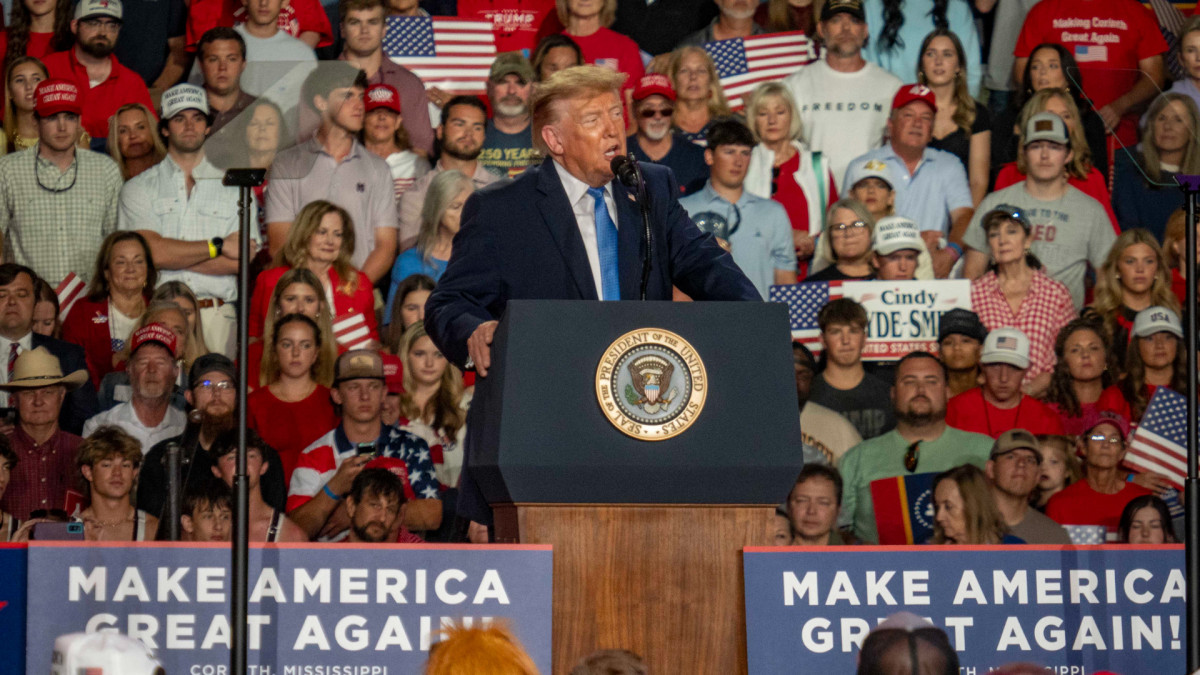
There is in politics an undeniable habit that repeats with almost military discipline: each president faces the midterm elections, as if looking at themselves—both in terms of personal accountability and that of others—in a mirror. It happened to Barack Obama and also to Joe Biden, to Bush and to Clinton, to name just a few, but now it is Donald Trump’s turn again, who, as we have already discussed in Agenda Pública, arrives at the ballot with popularity at historically low levels.
On the eve of the midterms, many polling and data-analysis houses, such as The Cook Political Report, Inside Elections, The New York Times/Siena University, YouGov or VoteHub, among many others, have reached the same conclusion: a substantial portion of the electorate appears ready to use these upcoming elections as a broad-scale correction in politics, the economy, and society. Added to that is the fact that the Democrats are currently favored to regain the House of Representatives and that a slight edge for them looms in the battle for the Senate—a fiercely contested arena where Republicans are very hard to defeat.
“A substantial portion of the electorate appears ready to use these upcoming elections as a broad-scale correction in politics, the economy, and society”
In this instance, as with any important date with the ballots in the United States, swing states are key to defining the legislative reconfiguration ahead of the second half of the presidential term. For example, the most meticulous analysts are not focused on California, Massachusetts, or Illinois, where Democratic support enjoys relative comfort; nor, for example, on Florida, which has long stood out as a strongly Republican territory (although Angie Nixon, one of the most tenacious Democrats, could deliver a surprise). The real pulse concentrates in a narrower, more revealing geography: Michigan, Texas, and Georgia. There, more is at stake than a simple election: it is a test of the Republican Party’s ability to hold onto the electoral coalition that made Trump’s return to the White House possible, while at the same time measuring the Democrats’ ability to reconstruct a competitive alternative beyond their traditional strongholds.
Let us begin with the first: Michigan. If there is a politician in the United States who has gained prominent influence in the closing stretch of these elections, it is Abdul El-Sayed: a physician, the son of Egyptian immigrants, a Muslim, with an impeccable presence and excellent oratory, a figure firmly betting on public health—a topic as thorny as it is essential in the American political debate. Recently he faced a Trump attack; the president accused him of siding with terrorists. He has not been the only arrow launched at him. And it is not hard to imagine the fury his figure provokes in the White House, when someone with such political force, and in a pivotal state like Michigan—which, as we have already explained in this outlet, functions as a national political laboratory—has solidified the left’s discourse against traditional centrism. That said, he responds with remarkable poise and force to his adversaries’ attacks. Yet, the lead he brings into the midterms against Republican Mike Rogers is not enough to be complacent. Forecasts from Reuters, The New York Times, and NBC News, among others, give him a slight edge. A recent poll places him seven percentage points ahead; for now, nothing is written.
If we turn to Texas, we find something unusual: the Lone Star State has ceased to be a predictable terrain. The Senate race between James Talarico (Democrat, 37) and Ken Paxton (Republican, 63) appears virtually tied in several analytical models (and there are even a few that grant the Democrat a slight edge). And that is news, because that fact alone reveals what many people know and say, inside and outside the state, that Texas functions, practically, as an independent country. The ways of life and electoral preferences in places as disparate as the big cities—Austin, Dallas, or Houston—have nothing to do with towns that border Mexico, with New Mexico or with Louisiana. Until two years ago, Texas Republicans could indulge in certain diversions, even look the other way; today, that is impossible, because tomorrow they will have to defend a territory they always believed was theirs. The percentage of people who approve of Trump’s handling stands at 42%, and internal cracks within the red party have set off alarms for these elections.
“The percentage of people who approve of Trump’s handling is now at 42%, and internal cracks within the red party have set off alarms for these elections”
Georgia, a state that clearly defines Southern identity, tells a similar story. Democratic Senator Jon Ossoff finds himself again at the center of a national contest while the different Republican factions attempt to keep a once-homogeneous electorate united. And here lies a key point: the political evolution in the Atlanta suburbs, as well as among independent voters, will be watched with as much attention as campaign speeches. Georgia, for many reasons, is a kind of experiment where the country tests its immediate political future. And, as we have already chronicled in Agenda Pública, Jon Ossoff is a name that is redefining both that future and that identity.
One thing remains certain: the final verdict will be spoken at the ballot box. Forecasts suggest the Democrats will enter the polls with favorable winds, but they are far from a guaranteed victory. The Republicans, on the other hand, who always boasted a solid electoral base, today fear the cracks that the MAGA leader’s controversies have generated: attacks on the press (such as calling an NBC News journalist a “horrible little reporter” or directly insulting a Reuters reporter while he asked about a trip to Kansas), denial of the Epstein issue, and misogynistic remarks (such as Trump’s comment about Nicki Minaj’s body)—factors that have become the major toll the leader exacts on his party. The question here is not whether there will be a punitive vote against the president (and his countless eccentric tariff moves, temper tantrums, and unorthodox geopolitical maneuvers); the American tradition suggests there will be. What matters in this midterm edition is the magnitude of that punishment, to a large extent revealing how Trump 2.0’s administration will shape up. Will there be a more or less compliant Congress? That is the question reverberating through Washington and the streets. For now, in the White House there is a somber air that travels through the corridors. At least, that is how Katie Rogers describes it in The New York Times.
The detailed forecasts
Let us start with the basics, technically speaking. The midterms are midterm elections held on the Tuesday following the first Monday in November, at the midpoint of the presidential term, and in them the 435 seats of the House of Representatives and, in 2026, 35 (out of 100) of the Senate are up for grabs.
The Cook Political Report, one of the most respected electoral-analysis references in Washington, predicts that for the House of Representatives, the Democrats would gain between 12 and 25 seats, a number sufficient to reclaim the majority (that would give the blue party roughly 227 to 240 seats, above the 218 needed to control the House). Regarding the Senate, it shows that Democrats could gain between 2 and 6 seats: they need 4 to reach the majority, so it isn’t a difficult target to achieve.
Another major electoral-analysis firm is Inside Elections. For them, the key lies in the suburbs and exurban areas where Trump won by slim margins. What is their prediction? That the broad context of discontent with Trump could reverse the Republican trend and give Democrats a clear advantage. Gain between 4 and 6 seats for the blue camp (numbers not as optimistic as The Cook Political Report, but far from negligible). And, regarding the House of Representatives, they forecast a loss of Republican control.
“The broadly shared context of discontent with Trump could reverse the Republican trend and give Democrats a clear edge”
Also, at this point, it is necessary to consider the data from The New York Times/Siena University. In their September poll, the Democrats led in the Congress ballot with 51%, versus 43% for the Republicans. For them, the Democratic edge is clear, although the poll does not allow determining whether Senate control will also fall to them.
Pushed by these figures, the Democrats currently have a prime opportunity to curb the aggressive interventionist policies of Trump, one that has become more tangled with scandals—economic-military, tariff, immigration, corruption and impunity, digital financial opacity, etc.—and whose controversial practices have left inflationary periods that have eroded the living standards of many American citizens.
The stage is set for the grand electoral exercise in which Trump will be held accountable not only to his voters, but to the entire American people. For now, the Democrats arrive with several “cards” in their favor. However, these are only forecasts, and, as is well known in politics, until the polls close, numbers (and realities) do not.
