
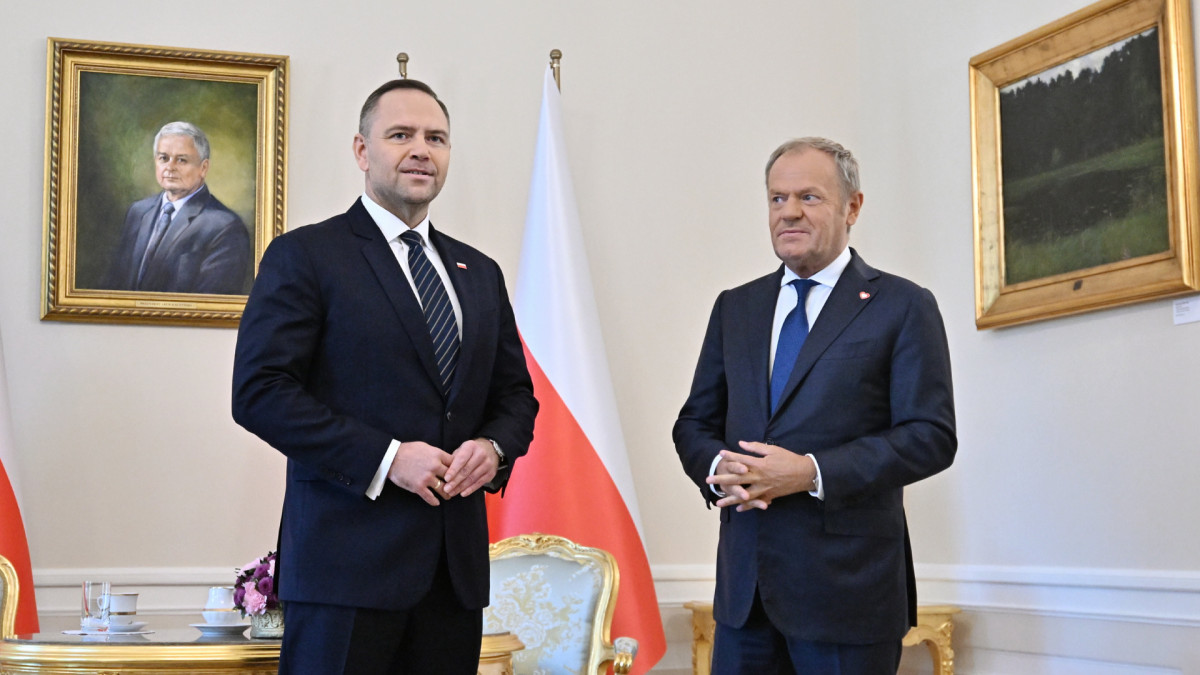
The images of riot police deployed outside Poland’s Constitutional Tribunal, the demonstrations by supporters of the ultraconservative opposition, and the abrupt return of President Karol Nawrocki to Warsaw have once again placed the country at the center of a severe institutional crisis. What is happening is not simply a dispute over the appointment of some judges or control of a court, but the most recent expression of a conflict that has been eroding the foundations of the Polish rule of law for more than a decade. A battle in which two antagonistic interpretations of legality confront each other, two political projects, and, above all, two conceptions of democracy.
The crisis exploded last Friday when Judge Anna Korwin-Piotrowska announced the suspension for one month of the president of the Constitutional Tribunal, Bogdan Święczkowski, and of his vice president, Bartłomiej Sochański, and temporarily assumed the leadership of the institution. The decision, the legal basis of which is being questioned, triggered protests from supporters of Law and Justice (PiS), police intervention to protect the facilities, and an immediate reaction from the President of the Republic, aligned with the national-conservative opposition. Nawrocki, in fact, interrupted an official trip to Senegal and returned to Poland, denouncing what he considers a forcible takeover of a constitutional institution.
However, to understand how we arrived here, it is necessary to go back to 2015. That year, PiS’s electoral victory, led by Jarosław Kaczyński, inaugurated a process of institutional transformation that deeply altered the balances of the Polish democratic system. Under the pretext of fighting the inherited structures of the previous regime, what PiS called “decommunization” was launched and a late lustration was promoted as the main ideological argument to undertake a profound reform of the judiciary whose ultimate aim was to increase political control over the courts.
The first arena of confrontation was precisely the Constitutional Tribunal. The dispute over the appointment of several judges allowed PiS to block designations legally carried out by the previous Parliament and push through its own. Subsequently came changes to the National Council of the Judiciary, disciplinary mechanisms against judges, and reforms of the Supreme Court. These were not isolated measures, but part of a transformation of the system of institutional checks and balances that progressively subordinated judicial independence to the will of the parliamentary majority.
“It was not a matter of isolated measures, but a transformation of the system of institutional checks and balances that progressively subordinated judicial independence to the will of the parliamentary majority.”
The Brussels reaction did not take long. In 2017, the European Commission activated for the first time theArticle 7 procedure of the Treaty on European Union against a Member State for the risk of serious violation of the Union’s fundamental values. In addition, infringement procedures, judgments of the EU Court of Justice, and conflicts related to access to European funds followed. Poland became, together with Hungary, the main European laboratory of what has been called democratic backsliding or democratic backsliding.
But the confrontation had a dimension that went far beyond judicial independence. PiS turned the conflict with Brussels into a dispute over national sovereignty. In the face of the primacy of European law, it advocated an interpretation of the Polish Constitution that allowed challenging the authority of community institutions. The Constitutional Tribunal, whose independence had been compromised by earlier reforms, ended up playing a central role in the legal legitimization of that political project.
The victory of the coalition led by Donald Tusk in 2023 opened, in that sense, a new phase for the country. The return of a pro-European government was welcomed in Brussels as an opportunity to restore institutional normality. Tusk pledged to recover judicial independence, rebuild relations with the European Union, and reverse the reforms pushed by PiS. Yet soon a hard-to-resolve contradiction emerged. How can democratic legality be restored when the institutions charged with guaranteeing it have been transformed by those now in opposition?
The question was no small matter. The judges appointed during the previous phase continued to hold their offices, court rulings continued to have legal effects, and any reform attempts could be blocked by institutions whose legitimacy was precisely in question. The presidency of Andrzej Duda and, since 2025, that of Karol Nawrocki, both politically tied to the conservative camp, added another obstacle through the exercise of presidential veto and the powers related to judicial appointments.
Thus, the current situation is the result of that accumulated stalemate. The Sejm elected eight judges for the Constitutional Tribunal this year, but Nawrocki only swore in three of them. The other five swore in without the president’s presence and, consequently, the leadership of the tribunal refused to allow them to perform their duties. In this way, Poland has ended up developing two incompatible institutional legitimacy frameworks. For the Government, restoring the rule of law requires undoing the consequences of reforms that undermined judicial independence. For PiS and its allies, the executive’s actions constitute a violation of the Constitution and a partisan appropriation of the institutions.
This is precisely the paradox that makes the crisis so dangerous. Restoring the rule of law cannot be achieved through procedures that reproduce the practices they seek to correct. The legitimacy of the objective does not automatically render all the instruments used to achieve it legitimate. And one cannot ignore that the apparent legal neutrality of inherited institutions hides political decisions that contributed to dismantling their guarantees of independence.
“Restoring the rule of law cannot be carried out through procedures that reproduce the practices they seek to correct”
In this context, the institutional dispute unfolds simultaneously in another field, that of constructing the political narrative. Social networks have become a fundamental space to present the same events as a democratic restoration or as an institutional coup. The images of police outside the Constitutional Tribunal, taken out of context and disseminated through emotional messages, provide particularly effective material to fuel polarization. Legal complexity disappears behind slogans about defending democracy, national sovereignty, or political persecution.
Thus, we are not only facing a battle for control of the institutions, but for determining who has the authority to define what is legal and what is democratic. A confrontation in which misinformation, simplification, and digital mobilization can end up replacing the debate about constitutional guarantees.
“We are not just facing a battle for control of the institutions, but for determining who has the authority to define what is legal and what is democratic”
The European dimension is equally decisive. For years, Brussels denounced the deterioration of the rule of law under PiS governments. Now it must apply the same criteria to the actions of a government that is politically closer to the community institutions. The European credibility depends precisely on ensuring that defending judicial independence does not become a matter of partisan affinities.
But it is also important to remember that Poland faces parliamentary elections in 2027, so the proximity of that electoral date increases the incentives to transform the legal conflict into an identity confrontation. For Tusk, proving that he is capable of reversing the authoritarian legacy of PiS is essential before an electorate frustrated by the slow pace of reforms. For the opposition, denouncing alleged institutional persecution allows mobilizing their bases and presenting themselves as defenders of the Constitution.
Thus, the Polish crisis raises a question that transcends its borders. How to rebuild a democracy when those who have eroded its institutions continue to use those same institutions to block its recovery? The answer cannot consist of replacing one partisan capture with another. Democracy needs more than electoral majorities and formally legal procedures. It needs institutions recognized as legitimate even by those who lose elections. Yet the main problem facing many societies is a deep crisis of legitimacy of institutions and intermediate actors, fueled, moreover, by disinformation campaigns that seek greater fragmentation and polarization.
“Democracy needs more than electoral majorities and formally legal procedures. It needs institutions recognized as legitimate even by those who lose elections”
And Poland is by no means an exception. In this country the shared framework of law has broken and has turned into a weapon of political combat. Thus, to get out of the blockade it will need to recover a shared legal framework, and to rebuild it will require the cooperation of political actors who have made the dispute over legitimacy one of their main confrontation instruments. Neither the Government possesses sufficient institutional mechanisms to complete the reforms, nor does the opposition have incentives to facilitate an exit that would involve questioning much of its political legacy. Meanwhile, the proximity of the 2027 elections threatens to deepen polarization even further. Poland’s problem is no longer merely how to restore the rule of law, but how to break an institutional deadlock in which every attempt at a solution could become the origin of a new crisis. And that is, probably, the most lasting legacy of a decade of democratic erosion.
