
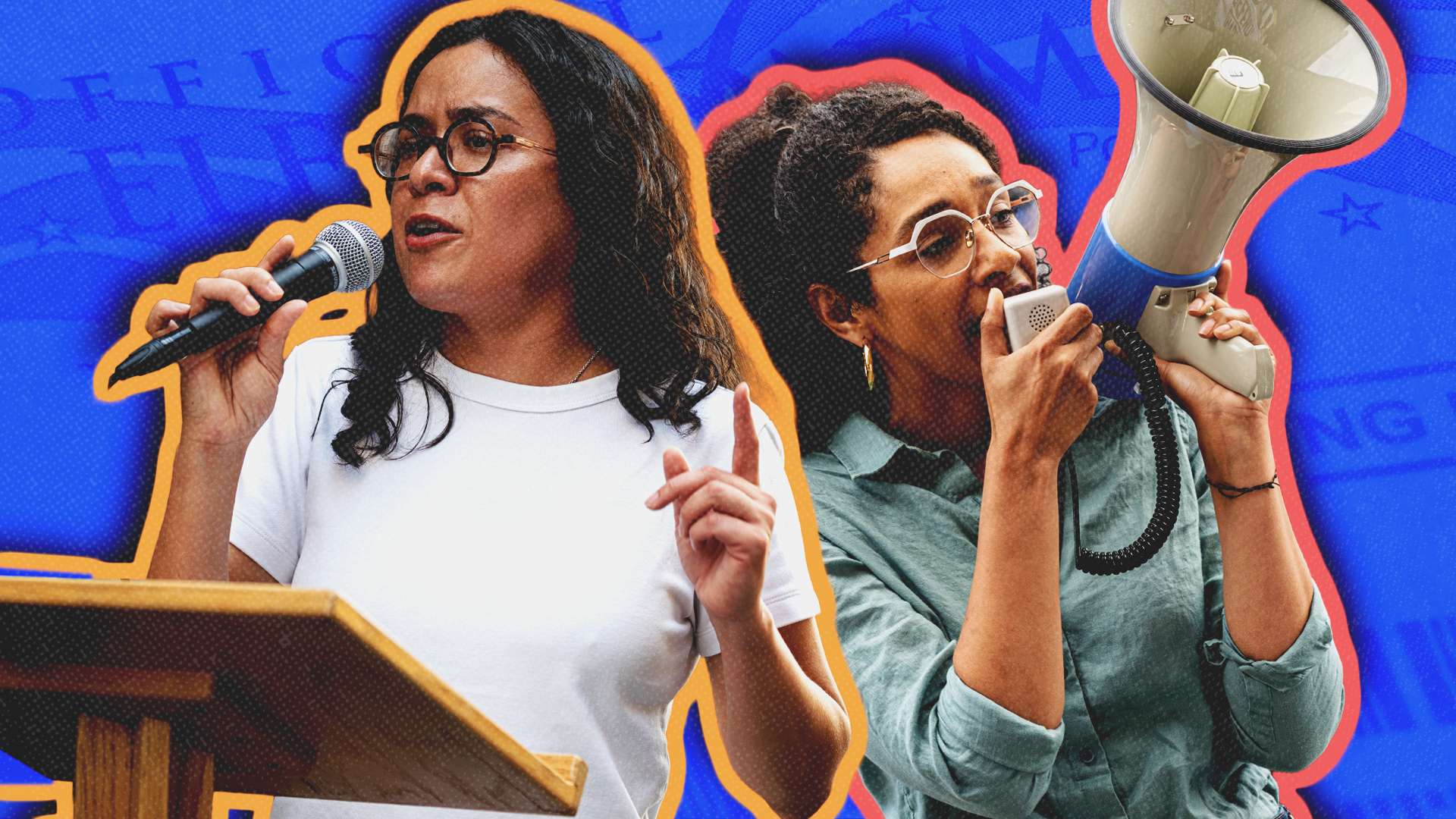
Today marks the onset of a era in which openly progressive socialists will wield tangible influence in Washington, D.C.
Gauging today’s national coming-out moment for the Democratic Socialists of America requires more than a quick glance. Indeed, the DSA caucus in the House is set to multiply its ranks. Yet expanding from a mere two representatives—New York’s Alexandria Ocasio-Cortez and Michigan’s Rashida Tlaib—to roughly eight would only bring them into lineup with the Congressional Ski and Snowboard Caucus in numerical terms.
But viewing this through a strictly DSA-centric lens neglects the broader leftist current. Bernie Sanders, the widely acknowledged patron saint of this movement, is not formally part of the DSA. Neither is Abdul El-Sayed, the Michigan contender who today is stirring significant excitement and affection, described by Reason’s Robby Soave as a “socialist in all but name.” You could endlessly debate who qualifies as a member, a national supporter, a local-only backer, or a former supporter who nevertheless drew the blessing of Zohran Mamdani, New York’s DSA power broker, or of a former backer who was excommunicated for not joining the Boycott, Divestment and Sanctions movement.
The wider milieu surrounding these individuals is a rapidly expanding bloc of elected officials who challenge American military actions, soften the portrayal of human-rights abuses by adversaries, and advocate for Medicare for All. They want to tax the wealthy, curb the expansion of data centers, abolish Immigration and Customs Enforcement (ICE), strip corporate money from politics, and cut U.S. ties with Israel.
“The DSA, along with the energy and eagerness for bold transformation rather than incremental shifts, will be… dominant,” predicted Gavin Newsom, California’s governor and a potential candidate for 2028, last month. “That energy is going to become the mainstream Democratic movement. There’s no doubt about it in my mind.”
As the House gains a new Democratic majority and the Senate edges toward a similar outcome, all eyes will focus on how large this socialist bloc becomes and whether it can challenge the margins that define party control.
“I’d prefer the Republicans to retain the House by five seats rather than Democrats winning by five, because in the former scenario they’d be hostage to the DSA,” groused longtime Democratic strategist James Carville last month. “Take Hakeem Jefferies, for instance—he would have limited maneuvering space.”
That scenario will feel familiar to those who followed the ascent and ensuing derailment of the Tea Party within the GOP. After storming into office via a series of insurgent primary battles against party veterans, the Tea Party faction matured into the House Freedom Caucus and used its arithmetic to torment and eventually topple several speakers—from John Boehner to Paul Ryan to Kevin McCarthy. In particular, the 2011–12 and 2013–14 sessions saw this fractious caucus harass the president of the opposite party and exercise real influence on national policy, culminating in the budget sequestration of 2013.
With the loudest minority example in a majority that resists an unpopular president, the DSA and those aligned with it in Congress are bound to garner substantial screen time over the next two-plus years, aided by their relative youth and striking looks. Here are several of the new, distinctly DSA faces to watch.
Darializa Avila Chevalier
New York’s 13th Congressional District (Harlem/Bronx)
Once a Columbia University activist who challenged U.S. policy toward Israel, a movement supported by Mamdani culminated in a surprising primary victory against a five-term incumbent who led the Congressional Hispanic Caucus. The 32-year-old political upstart advocates for prison abolition and, recently, was shoved down by law enforcement at a protest against ICE; she then called for Jessica Tisch, the police commissioner appointed by Mamdani, to resign. She demonstrated in solidarity with Palestinians on October 8, 2023, has called out Prime Minister Benjamin Netanyahu and President Donald Trump as among the most reviled figures, and has a provocative social-media history that includes opposition to interracial relationships, labeling Joe Biden a “rapist,” and supporting the nationalization of key industries. The Washington Monthly, a publication with a left-leaning tilt, named her one of the “10 worst midterm candidates running for Congress” in 2026. Prediction markets place her odds of victory above 97 percent.
Claire Valdez
New York’s 7th Congressional District (North Brooklyn/Queens)
A further nomination by Mamdani, 37-year-old Valdez is an artist turned union activist turned state legislator who, last year, was arrested outside the offices of Senators Chuck Schumer and Kirsten Gillibrand during a protest against their stance on arms sales to Israel. She advocates for single-payer healthcare, universal rent control, the nationalization of airlines, and a federal jobs guarantee. One of her campaign spots shows her striking a Starbucks cup from a bystander’s hand in protest of the company’s union-related policies. Prediction markets peg her odds at around 97 percent.
Melat Kiros
Colorado’s 1st Congressional District (Denver)
The 29-year-old Ethiopian immigrant and aspiring attorney defeated a long-standing incumbent in a surprise primary, campaigning on Medicare for All, ICE abolition, federal rent-control measures, opposition to data-center expansion, and an arms embargo on Israel—which she characterizes as ethnonationalist and genocidal. Kiros has “made Zionism a defining issue in Denver’s congressional race,” per Denverite, including appearing on Hasan Piker’s podcast to describe the October 7, 2023 Hamas attacks as an “inevitable consequence” of apartheid and occupation, and declining to label a deadly Boulder protest as antisemitic. Her odds hover near 99 percent.
Donavan McKinney
Michigan’s 13th Congressional District (Detroit)
The 34-year-old political organizer and state representative narrowly defeated a one-term, pro-Israel incumbent backed by House Leader Jefferies in the Democratic primary. McKinney’s platform centers on affordability—covering insurance costs and childcare—alongside Medicare for All and ICE abolition. His odds remain around 98 percent.
Angela Gonzalez-Torres
California’s 34th Congressional District (Los Angeles)
In California’s top-two primary system, this 31-year-old DSA advocate seeks to unseat a 51-year-old Democratic incumbent in a contest that could spill into November. Her platform mirrors the usual DSA positions with added emphasis on affordability and a stance against AIPAC. Gonzalez-Torres has pushed a Gaza-friendly resolution during her time as president of the Historic Highland Park Neighborhood Council, later criticizing her successor as a “very Zionist gentrifier man, a white man” who poses a “threat to my community.” Her prediction-market odds are around 80 percent.
Chris Rabb
Pennsylvania’s 3rd Congressional District (Philadelphia)
At 56, Rabb is the elder statesman among the DSA cohort, a political strategist, scholar, and amateur humorist who anchored his campaign around criminal-justice reform, climate action, and the idea of conscious capitalism before contending for this open seat against several establishment-backed rivals. In addition to the usual Medicare for All, ICE abolition, data-center moratorium, and pointed critique of Israel, Rabb has floated the concept of government-operated grocery stores, echoing Mamdani’s broader agenda. He sits firmly in the 99th percentile of supporters.
There are numerous other DSA-aligned politicians—some I’m less fond of, like my own potential future representative Brad Lander—who are poised to join the core DSA contingent in the 120th Congress. Whether their alliances will stay cohesive amid possible internal strife, or whether they will manage to outnumber Democrats relative to Republicans, remains speculative. The Senate’s narrower margin suggests that even a modestly DSA-friendly bloc—two or three members (Sanders, El-Sayed, and perhaps Angie Nixon in Florida if she secures one)—could influence the calculations of Majority Leader Chuck Schumer.
And even if the current numerical heft does not yet resemble Tea Party–style clout, the DSA’s resonance among younger members of the Democratic Party will exert influence on the centrists and the establishment figures. Nearly a dozen years after Donald Trump and Bernie Sanders reshaped American politics, the populist wave remains far from spent.
