
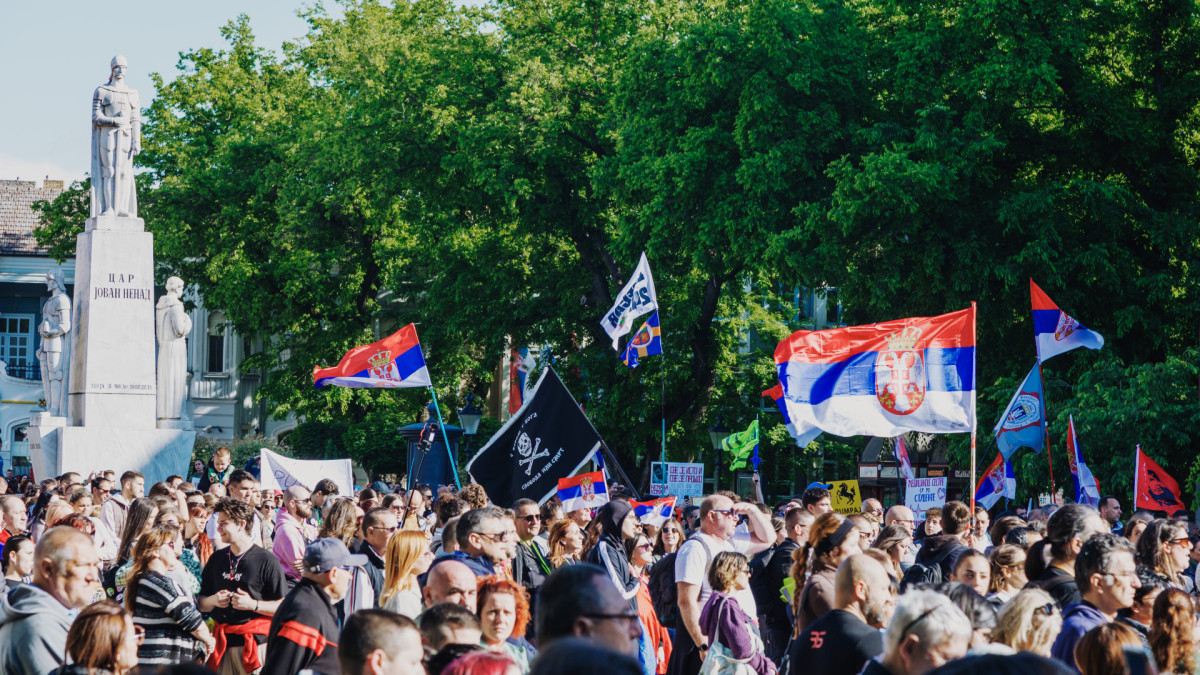
On November 1, Serbia marked the first anniversary of the Novi Sad train station disaster, where the collapse of a concrete canopy killed sixteen people. A year later, Serbian university students continue to demand justice and accountability, leading one of the broadest and most cross-cutting social movements in the country’s recent history, comparable only to the protests that toppled Slobodan Milosevic in 2000.
With the backing of thousands of citizens, the youth are facing their second winter of mobilization in the streets, in town squares and on campuses. Their objective is none other than holding political actors to account and challenging a system rotted by clientelism and authoritarianism. Meanwhile, the European Union remains absent. Brussels, absorbed in its internal crises and geopolitical dilemmas, offers no political or moral support to the protesters, underscoring its inability to align with democratizing forces in a country that has spent years sliding toward autocracy.
The Flag That Does Not Wave
In recent years, Europe has witnessed a surge of citizen protests —from Serbia to Georgia— that demand democracy and the rule of law. Yet, while in Tbilisi the European flags symbolize hope, on the streets of Serbia the blue insignia of the EU is absent. This omission is more than symbolic: it signals a deep rupture between Serbia and the European ideal.
For the Serbian youth, Brussels has lost all credibility. The ongoing displays of indulgence toward President Aleksandar Vučić —flattered by high-ranking European officials while peaceful demonstrations are crushed— have eroded the image of the EU as a guardian of democratic values. At the same time, several member states sign lucrative economic and mining deals with Belgrade, even as the police deploy illegal sonic weapons and resort to violence against protesters, journalists and activists.
“Neither the European Commission nor the European People’s Party, where Vučić’s movement sits as an associate, have shown the willingness to sanction these abuses”
Neither the European Commission nor the European People’s Party (EPP), where Vučić’s party is allied as an associate, have shown the willingness to sanction these abuses. Consequently, for a large portion of Serbian youth, the EU is not an ally, but part of the problem.
A Fading European Horizon
Twelve months after Novi Sad, the paradox is evident: while civil society leads an unprecedented movement for dignity and justice, the European Union has faded from the collective imagination. Its silence —presented as diplomatic prudence— has undermined its symbolic power as a democratic horizon in the Western Balkans.
The promise of EU accession, stalled for years, means nothing to a generation raised in skepticism. “Europe,” once synonymous with stability, is now seen as a contradictory entity, consumed by its own crises: migration management, energy insecurity, and the rise of the far right.
Vučić’s government, aware of the disillusionment, has turned anti-European rhetoric into a political instrument. It portrays the EU as a hypocritical and impotent neighbor, unable to defend its values in the face of the conflicts in Ukraine and Gaza or its own illiberal drift. Serbia maintains a formal pro-European discourse while deepening ties with Russia and China and consolidating a regime intolerant of dissent.
“Their chants appeal to justice, truth and freedom in the face of fear, not to European Union membership, because they see the EU as a accomplice of illiberalism”
In this context, the students’ refusal to identify themselves as pro-European does not mean apathy, but a conscious generational rupture. Their slogans appeal to justice, truth and freedom in the face of fear, not to EU membership. For many of them, the EU is complicit in Serbian illiberalism, having prioritized regional stability over democracy. The absence of European flags at demonstrations is evidence that Brussels does not stand as a moral beacon here.
Serbia and the Global Autocratic Drift
Serbian disillusionment is not an isolated phenomenon, but part of a global trend toward consolidation of autocracy and democratic fatigue. In many regions, governments redefine repression through surveillance technologies, information control, and emotional manipulation.
Vučić’s Serbia fits the same pattern as Erdoğan’s Turkey, Orbán’s Hungary, or Netanyahu’s Israel: regimes that maintain electoral façades while hollowing out institutions and turning fear into political capital. What is troubling about the Serbian case is its geopolitical position, at the edge of an increasingly unstable Europe, and the lack of a coherent response from the EU.
Brussels, by prioritizing “stability” over democracy, has ended up reinforcing the very authoritarian pact it intended to prevent. Each time it tolerates media censorship, police brutality, or electoral irregularities in Serbia, it weakens its moral authority and confirms that its democratic principles are negotiable.
Youth, Autonomy and New Forms of Political Action
In this landscape, student mobilizations stand out for their autonomy and resilience. They have created self-managed spaces for deliberation and solidarity, beyond traditional political parties and NGOs. What began as a response to the Novi Sad victims has evolved into a mature civic movement that rejects instrumentalization.
“These young people operate in a post-partisan context, convinced that the political class as a whole has betrayed the democratic promise”
Horizontal assemblies, encrypted technology usage, and collective decision-making reflect a generation that distrusts both power and opposition. Unlike the 1996–97 marches or the 2020 environmental protests, these youths operate in a post-partisan context, convinced that the political class as a whole has betrayed the democratic promise.
Far from being naïve, their disengagement from traditional parties is a strategy to preserve the movement’s independence and credibility. Their ability to sustain mobilization for months, connect with students in other countries, and navigate digital censorship reveals the emergence of a new democratic culture, not dependent on external guardians or institutional validation. Although they lack a formal political program, they embody an ethical renewal that neither Brussels nor Belgrade can ignore.
A Fragile Hope
The autocratic drift of Serbia gives Brussels a perfect excuse to justify the paralysis of European enlargement. But that strategy, which prioritizes geopolitical calculus over values, has contributed to the same stagnation it denounces. The time has come to acknowledge—as many Serbs already do—that only civil society can save itself.
The day when Serbian autocrats are history, the EU will have to look in the mirror with shame, aware that it betrayed the principles it claims to defend. If it wants to regain relevance in the Balkans, Brussels must rebuild its moral coherence: symbolic gestures and technical aid are not enough. A firm stance against authoritarianism, both inside and outside its borders, and the recognition that democracy cannot be outsourced to repressive regimes are required.
Supporting the Serbian youth movements, even with intangible resources —visibility, exchange programs, protection for activists—, would be a first step toward rebuilding trust. For now, however, European silence persists.
On the streets of Serbia, the students keep shouting for justice without looking toward Brussels. Their struggle, born of pain and sustained by courage, reminds Europe of what it once stood for. The tragedy is not merely the death of sixteen people under the collapsed canopy; it is also that an entire generation has stopped believing that Europe can offer them refuge.
