
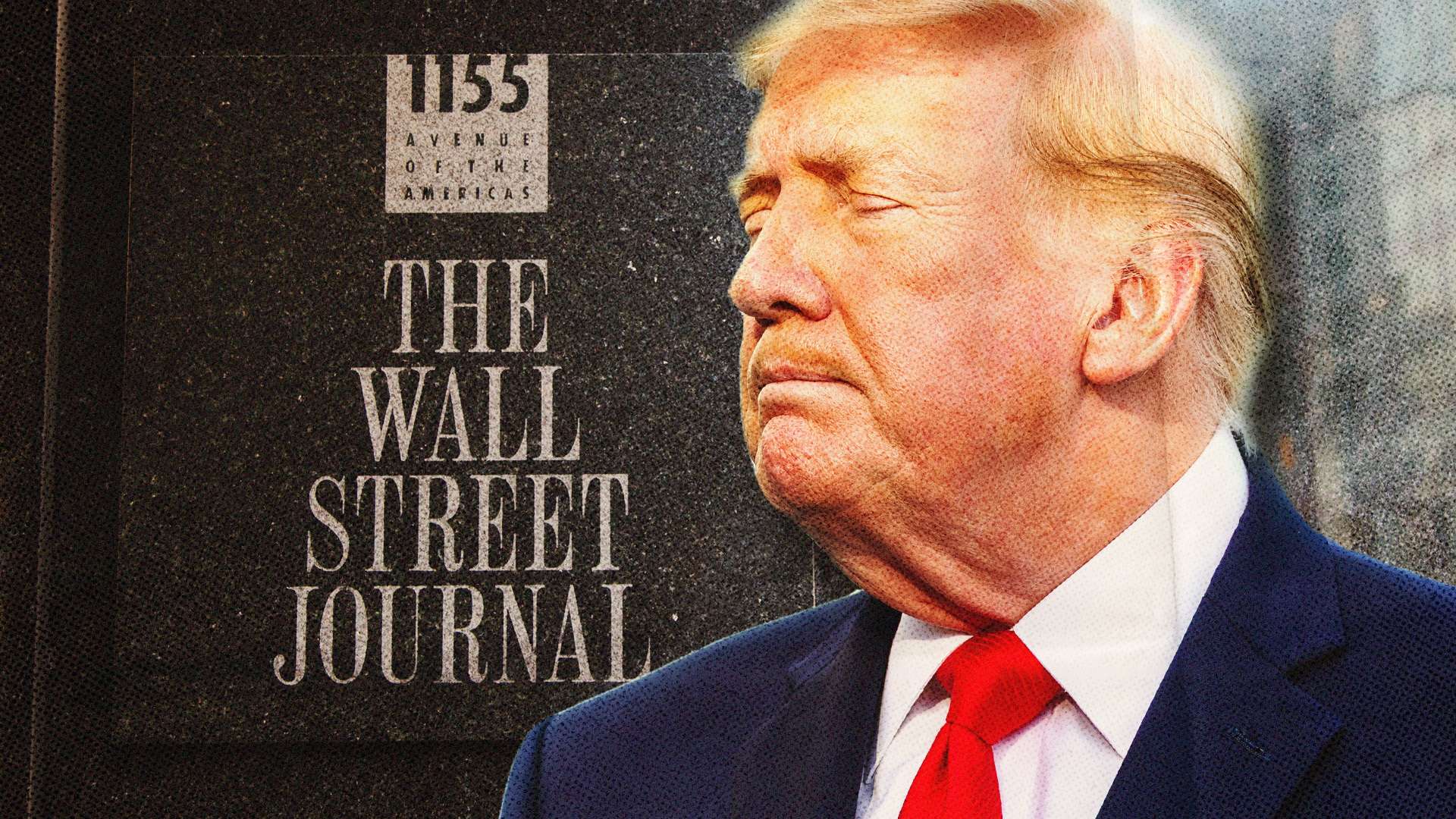
The president’s defamation action against The Wall Street Journal illustrates a recurring tactic of baseless lawsuits designed to punish voices that irk him.
On July 17, 2025, The Wall Street Journal reported that a 2003 album commemorating the 50th birthday of financier Jeffrey Epstein, who would later become entangled in state and federal sex offenses involving underage girls, contained a letter from Donald Trump, a longtime associate. The very next day, Trump filed suit against the Journal in the U.S. District Court for the Southern District of Florida, contending that “the supposed letter is a fake and the Defendants knew it when they chose to deliberately defame President Trump.” The complaint sought compensatory and punitive damages “not less than $10 billion.”
In April, U.S. District Judge Darrin Gayles dismissed that suit but allowed Trump to amend his complaint. On Saturday, Gayles dismissed the suit again, this time with prejudice. In both rulings, Gayles found that Trump’s lawyers had failed to plead “actual malice,” a central requirement in defamation cases involving public figures. The persistent failure underscores a broader pattern in Trump’s long history of frivolous litigation: for him, the aim is to punish speakers who say things he dislikes rather than to obtain legally cognizable redress for a real injury.
What does “actual malice” entail? Trump appears to believe it means that someone published a false statement “out of hatred and ill will”—a phrasing that appears in both his original complaint against the Journal and in his amended complaint, filed May 27, 2026. But as Gayles explains in his order, that is not the meaning of the standard.
“To plead actual malice,” Gayles notes, quoting a 2018 ruling by the U.S. Court of Appeals for the 11th Circuit (which includes Florida), Trump “must allege facts sufficient to give rise to a reasonable inference that the false statement was made with knowledge that it was false or with reckless disregard of whether it was false or not. This is a subjective test, focusing on whether the defendant ‘actually entertained serious doubts as to the veracity of the published account, or was highly aware that the account was probably false.'”
The Supreme Court set forth this standard in the 1964 case New York Times v. Sullivan, holding that it is required by the First Amendment. “In these cases,” the 11th Circuit observed in 2016, “there is a strong interest in ensuring that free speech is not unduly burdened by the necessity of defending against costly yet baseless litigation.”
The actual malice standard “was designed to give publishers the ‘breathing space’ needed to guarantee robust reporting on public figures and events,” the 11th Circuit explained. “Forcing publishers to defend an inappropriate suit through expensive discovery in every situation would constrict that breathing space in precisely the way the actual malice standard was meant to prevent. The costs and efforts involved in defending a case to that discovery stage could chill free speech nearly as effectively as if the actual malice standard did not exist at all.”
That is why Gayles, after tossing out Trump’s initial complaint, rejected his request for discovery “on issues related to actual malice.” In particular, Trump hoped to uncover evidence illuminating the defendants’ “state of mind,” a factor notably missing from his original filing. “President Trump’s request to conduct discovery on issues related to actual malice before filing a well-pleaded complaint contravenes the purpose behind the actual malice standard,” Gayles wrote.
Facing a setback for that fishing expedition, Trump’s lawyers attempted again to file “a well-pleaded complaint,” meaning their allegations, if true, would suffice to imply actual malice. Yet Gayles found no improvement. “President Trump’s conclusory allegations that Defendants acted with malice because they ‘knew or should have known’ the statements in the Article were false are insufficient to state a claim,” he wrote.
The amended complaint “appears to allege that by choosing to publish the Article despite President Trump’s and his team’s denials, Defendants acted with actual malice,” Gayles notes. “In essence, President Trump contends that once he labeled the Letter a ‘fake,’ the Defendants should have disregarded everything else they learned in their investigation and not published the story. But that is not what the actual malice standard requires and runs afoul of the First Amendment. Indeed, under that interpretation, any time a public figure or his team denies an accusation, journalists would be instantly barred from publishing negative or contradictory press.”
Trump argued that the Journal failed to investigate adequately. “A mere failure to investigate, without more, does not establish actual malice,” Gayles notes. “Rather, ‘a plaintiff must show the defendant deliberately avoided investigating the veracity of the statement in order to evade learning the truth.’ The Amended Complaint falls far short of this standard.”
In fact, the Journal‘s article describes a deliberate and thorough inquiry, Gayles writes. “Before publishing the piece, the Defendants reached out to President Trump and his team, to Justice Department officials, and to the FBI for comment. President Trump and his team replied with his denial [which was quoted in the article], the Justice Department did not respond, and the FBI declined to comment.”
Journal reporters Khadeeja Safdar and Joseph Palazzolo attempted to speak with Ghislaine Maxwell, Epstein’s associate who arranged the messages for the birthday album, but she did not respond, and “her attorney stated that she was focused on her case before the Supreme Court” concerning her federal sex-trafficking conviction. In a July 2025 interview with the Justice Department, according to Trump’s attorneys, Maxwell stated “she did not remember President Trump submitting a letter for Epstein’s 50th Birthday.” Interpreting that statement, Gayles says, “Maxwell had little to offer to Defendants’ inquiry.”
Safdar and Palazzolo also “reached out to other individuals named in the Birthday Book, including Leslie Wexner and Alan Dershowitz, and to individuals involved in binding the Birthday Book,” Gayles notes. “In short, President Trump’s assertion that Defendants failed to conduct a proper inquiry is contradicted by the Article and is insufficient to establish actual malice.”
The amended complaint “appears to try to manufacture flaws” in the Journal’s investigation, Gayles states, characterizing those efforts as “grasping at straws.” For instance, the complaint faults Safdar and Palazzolo for “reviewing the Letter before publication” rather than “obtaining a copy of the Letter.” Yet there is no legal requirement that the reporters must obtain, retain, or publish a copy of the Letter.
Discussing “grasping at straws,” the complaint accuses Safdar and Palazzolo of “the intentional omission of the denial from President Trump regarding whether he signed the alleged letter or whether the signature on the alleged letter is authentic.” Yet the article “repeatedly states that President Trump denies writing the Letter and that ‘[i]t isn’t clear how the letter with Trump’s signature was prepared,’” Gayles notes. “That is more than enough to cover any denial that he ‘signed’ the Letter or that the signature on the Letter is authentic.”
Beyond Safdar, Palazzolo, and Dow Jones, which owns the Journal, Trump sued News Corporation, which owns Dow Jones; News Corp CEO Robert Thomson; and Rupert Murdoch, the company’s majority owner and former chairman. But “aside from claiming that Dow Jones and News Corp published the Article ‘at the direction of Defendants Murdoch and Thomson,’” Gayles observes, “the Amended Complaint contains no allegations about how Thomson acted with actual malice.”
Trump’s contempt for meeting basic legal thresholds is part of a long-standing pattern. He has never shown much concern for actually prevailing in court, preferring to inflict pain on his adversaries—whether seeking $500 million from a critic of his Manhattan tower, pursuing $5 billion from a financial journalist who questioned his wealth, suing a comedian over a joke that compared him to an orangutan, contending that CNN defamed him by labeling his post-2020 election claims “the Big Lie,” alleging that The Des Moines Register committed consumer fraud by publishing unfavorable polls, or asserting that CBS caused him $20 billion in damages by editing a 60 Minutes interview with Kamala Harris to render her slightly more coherent.
Although Trump intends to appeal Gayles’ ruling, the Journal’s editorial board stated on Sunday that the appeal “is unlikely to succeed.” It noted that a letter matching the Journal’s description had already been released by Congressional investigators. Trump claimed he never wrote or signed the letter, but the Journal never asserted he did. It said only that a letter bearing the signature existed, and the Journal’s reporting has consistently included Trump’s denials.
“Trump has long used lawsuits to intimidate the press, and most of the time he ends up losing.” The editorial added, “Mr. Trump, like many politicians, uses litigation to coerce settlements he can tout as wins. He failed in this case because the Journal didn’t capitulate. A free press demands editors backed by owners, and we couldn’t do our work without that support.”
