
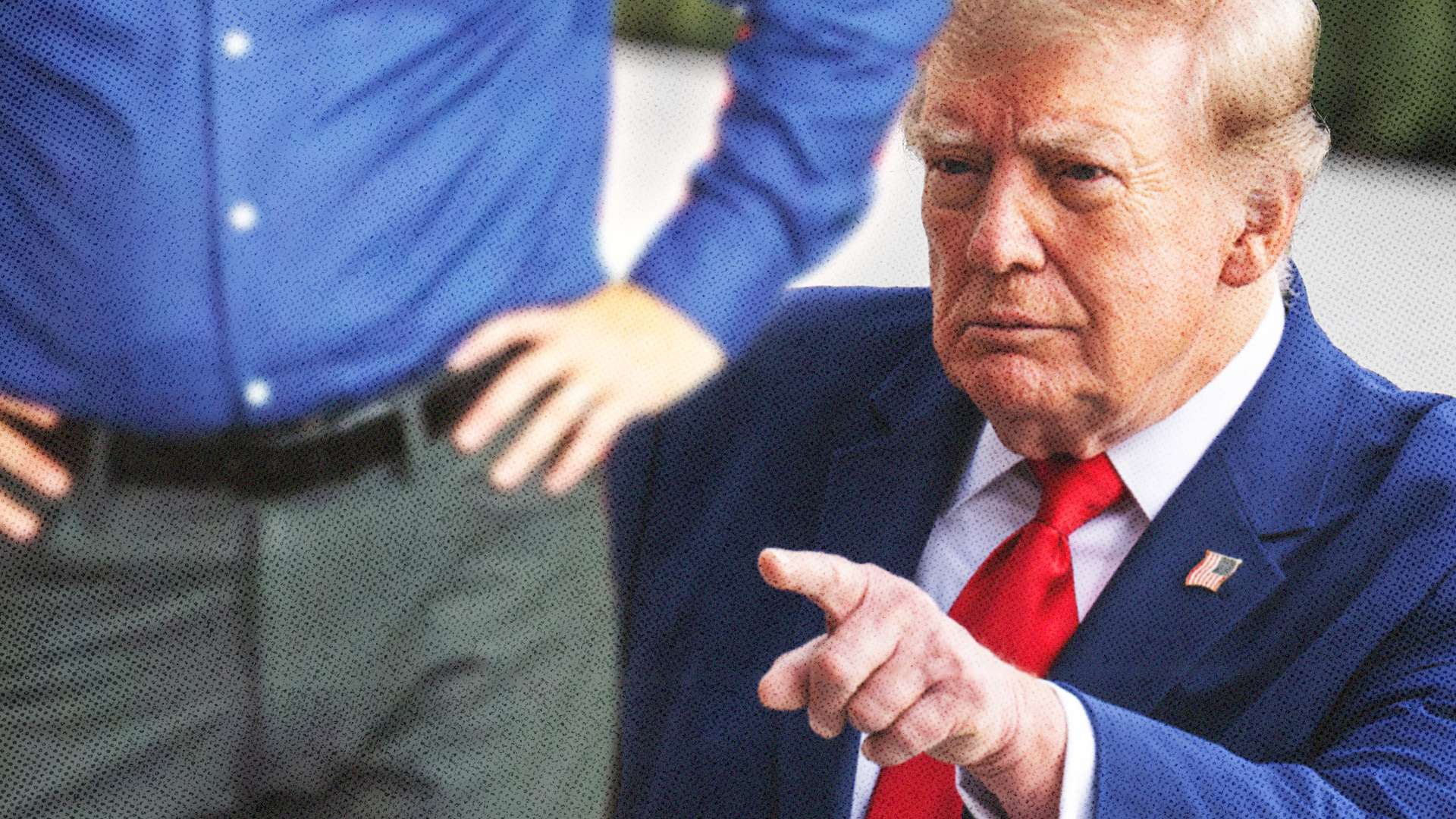
I spoke with John Stagliano, the veteran adult-film director best known by the alias Buttman, to get his take on the president’s latest fixation.
One thing you can say about President Donald Trump’s peculiarly offbeat press moment yesterday beside the Lincoln Memorial Reflecting Pool, where he rambled about algae and the Obama and Biden administrations’ alleged failures to restore the site, is that it hardly compares to the president’s growing obsession with men’s bodies—especially the butt, described as “a pile of muscle” by a senator—an obsession that has intensified over the past couple of weeks on the campaign trail. As USA Today reported, Trump kept returning to remarks about Sen. Jon Husted’s backside. They even assembled a quick-cut reel of Trump’s comments specifically about the embattled Republican, who had stepped into the Senate seat vacated when J.D. Vance moved up to the vice presidency and who now trails in the polls for today’s election. In North Carolina on October 20, Trump stated, “I’m studying his body. I’ve never studied the body of a man before. It’s not my thing. Nothing wrong with that, of course. But I looked at his butt. And then I looked at his legs, and I said, his butt is… it’s like a pile of muscle.”
An October 22 episode of The Fifth Column podcast cheekily captured the moment with the headline “Donald Trump Is Gay,” offering a supercut of Trump admiring the physiques of various politicians and members of the military. It plays more like a vintage outtake from the 1967 film Reflections in a Golden Eye than a typical stump speech.
Following this strange streak of remarks from the president, I reached out to John Stagliano—the filmmaker whose notoriety rests on the Buttman persona—after a character he introduced in a 1989 film resurfaced in the conversation. Who better to illuminate the appeal of a notable butt than Buttman himself? The 74-year-old Stagliano, whose home in Southern California was swept away by the 2025 Pacific Palisades wildfires, owns Evil Angel and was once pursued in a federal obscenity case that began under the George W. Bush administration and continued under Obama. (All charges were dismissed; Reason’s archive on the case and related issues is here.) Stagliano has been a reader of Reason since the early 1970s and has supported the Reason Foundation, the nonprofit that publishes this site. His political leanings are clearly libertarian, favoring free speech, the right of adults to choose their own paths, lower taxes, less regulation, minimal foreign intervention, and generally limited government. He notes that he voted for the Libertarian Party’s presidential nominee in all three elections when Trump was a candidate.
“Are you asking whether I think he’s a repressed homosexual?” Stagliano asks. “There may be a hint of that in the way he smiles at the end of his remarks about Husted’s butt… but what good would it do to dwell on that? Is it useful as a taunt? I don’t think so. We don’t care whether Trump is gay or harbors some homosexual feelings.”
Stagliano says that while Trump’s apparent libertinism in private life is noticeable, it’s not the core issue with the president. “He’s certainly not going to shape policy from those private impulses, at least I don’t think so,” he quips with a laugh. “I don’t want a society that imposes libertinism. I want people to behave the way they would normally.”
I ask whether Trump’s remarks might be less about anything distinctly sexual and more about an older person’s dwindling filters and fading focus as age advances. “You do lose certain things as you get older,” he replies. “One of the things that can go is inhibition.” He seems surprised to learn Trump is 80 years old. “I didn’t realize he was that old. Christ.”
He stresses that he can’t speak for the president, but says his own fixation on buttocks feels preprogrammed. When he began making adult films, he explains, “People were comfortable discussing breasts but reluctant to talk about the butt. I was drawn to the butt because it stirred me physically. And the more I studied it, the more aroused I became, which may sound silly, but the body doesn’t lie.”
Later in the day, Stagliano said he would cast his ballot for Libertarian candidates where available. “I couldn’t care less,” he adds. “I vote Libertarian. That’s what I do. I think the time and effort required to learn about specific contenders is a poor return on investment.” He suggests that Trump and other politicians would do well to leave “the voluntary interactions of adults” alone, not just in the sexual sphere.
Born in Chicago in 1951, Stagliano relocated to California in the late 1960s, studied at UCLA, and cut his teeth as an early Chippendales dancer. He muses on how California has become increasingly taxed and regulated, but also maintains that the state possesses undeniable positives—its natural beauty, its culture, and its tolerance—that he doubts can be matched by states like Florida or Texas, which lean more toward social conservatism. He believes it’s healthy for places to have different atmospheres, so long as constitutional limits constrain what governments can do. “Freedom works in ways people don’t always understand,” he says. “The outcomes have been plentiful.”
Stagliano agrees that freedom cannot be measured by the simple tally of tax spending or the sheer number of laws on the books. This conviction comes from someone who is actively working to rebuild his home amid one of the most labyrinthine regulatory ordeals imaginable (as of July 2026, out of roughly 5,000 single-family homes destroyed in the Palisades fire, only 28 had been completely rebuilt and issued final occupancy certificates). He stresses that the less government does, the fewer problems he sees.
“In the end, it comes down to how regulation is distributed,” he contends. “If property is a mix of public and private, the fault often lies in that very mix; if everything were privately owned, there would typically be a straightforward solution. These are classic libertarian arguments I first learned in the early ’70s, when I began to grasp what it meant to pontificate.”
