
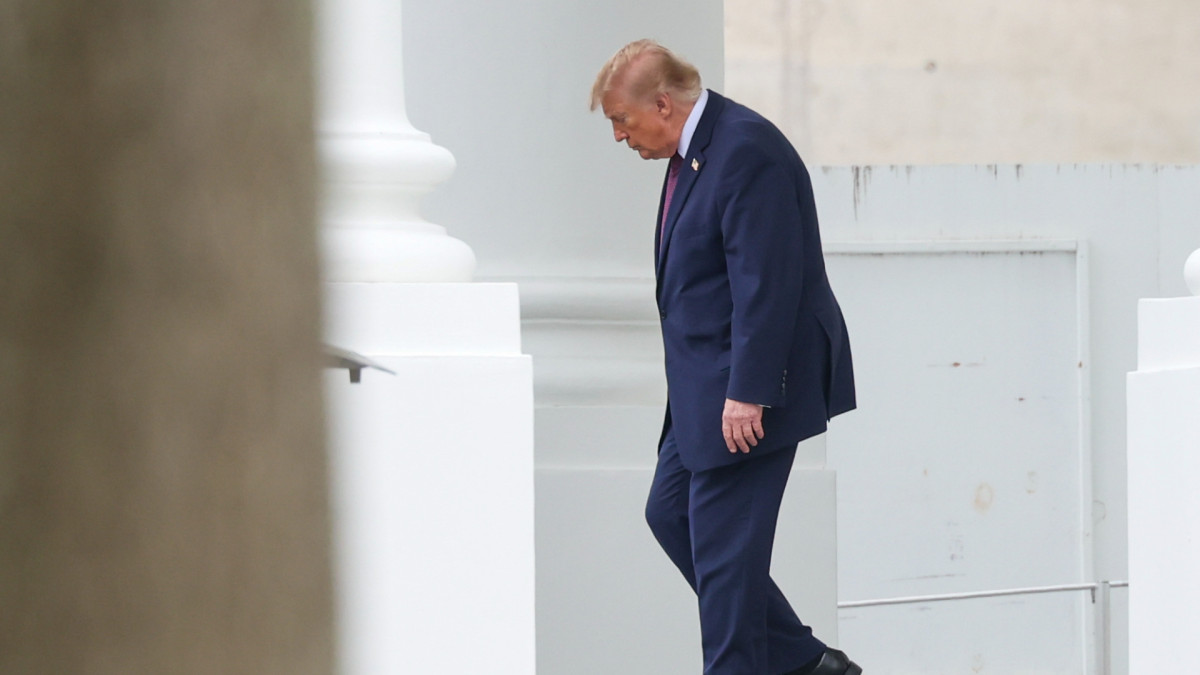
Y la noche tan esperada llegó: la que, finalmente, le puso fecha de caducidad al trumpismo.
There was a time not long ago when Donald Trump seemed to have secured something more durable than a (second) electoral victory: a way of inhabiting American politics (and its institutions, and power).
His rhetoric became doctrine; his grievances, an agenda; his enemies, an imagined community. And, for two years, Republicans repeated that that force remained intact. But the results of the midterms — the great test of every presidency — told a different story.
The narrative, translated from the vote-count of the November 3 election, was written in the suburbs of Pennsylvania, in Michigan’s industrial counties, in the multicultural neighborhoods of Arizona, and in all the vulnerability belts surrounding the great southern cities. And, as is well known, upon completion of the count, the Democrats not only reclaimed the House of Representatives (as expected), but also seized the Senate. It is not a parliamentary defeat for the red party; it is a national verdict.
“The Democrats not only reclaimed the House of Representatives (as expected), but they had also won the Senate”
The forecasts were fulfilled (even beyond the blue party’s most optimistic expectations): Donald Trump has been isolated and the end of his era, at least as an expansive political project, has begun. It was said in the polls for weeks; suggested by the public opinion measurements that recorded (and recounted) the steady deterioration inside the White House; anticipated, too, by some of the sharpest observers of American politics. Among them, Susan B. Glasser of the prestigious The New Yorker has stood out. Just a few days ago, in a piece titled “Finally, the Beginning of Trump’s End,” she argued that the president himself had done everything possible to ensure the failure of his party and movement. And the ballots spoke, clear and loud: millions of voters disapproved not only of their leader — who entered scrutiny with historically low popularity; around 30% — but also of the way he wielded power.
The scene bore something of those defeats that are announced long before they appear in headlines. The deterioration and erosion of the president’s support were visible, but the truly essential thing was something else: a sense of exhaustion. The unavoidable contrast between the grandeur of presidential rhetoric and the harsh economic reality shown by inflation on the streets ended up becoming an unhideable crack. While Trumpism spoke of epic images of the country, of endings to futile wars, of growth and prosperity, people kept asking about rental prices, about the unjust rise in the cost of coffee, gasoline, and food, and continue (as they do) to question when healthcare in the United States will stop being a privilege (and a business) and become a right. And there were months of the president’s virulence, attacking journalists, making misogynistic remarks at public events, and uttering rhetorical excesses that bordered on insulting, to the point that even some moderate wings of the Republican Party anticipated the president’s wear and tear.
“The unavoidable contrast between the grandiose rhetoric of presidential speeches and the raw economic reality shown by inflation on the streets ended up becoming an unhideable crack”
And then, election night arrived. On the screens appeared first the most contested states, the uncomfortable territories where the United States usually decides what it will want in the years to come. The Republicans hoped to resist there their first line of defense. As if any slight victory were oxygen in choking times. But it did not happen that way. One after another, margins narrowed; then they tilted, and finally fell. Pennsylvania confirmed the turn (granting Democrats a comfortable victory); Michigan deepened the trend (Abdul El-Sayed defeated Mike Rogers even with the betrayal of the moderate Democrat whom he had defeated in the primaries); and Arizona (proving to be blue territory) ended up consolidating the sense that something important was happening. In short, the will of the people spoke louder than the noise of Trumpist populism.
What happened in the rest of the country? As expected, in New York the vote was Democratic: that has been and remains a territory hardly disputed. In California, another indisputably blue state, the story was the same: Xavier Becerra defeated the Republican Steve Hilton; he won 64.4% of the votes, versus 35.6% for his rival. In Florida something particular occurred: while it is a Republican state and the election confirmed that hypothesis, the percentage gap between the winner Ashley Moody and her formidable rival Angie Nixon was almost three points: 50.9% to 48%. That, beyond the numbers, is another proof of the discontent generated both by the president’s verbiage and by the devastation of the domestic economy.
And Georgia? As we have already discussed in Agenda Publica, this is a state that represents, on a scale, what the United States essentially is. In this swing state, the Democrat Jon Ossoff won. He did so with 59% of the votes. That was a key state for Republicans to stem the blue wave that threatened their power and legislative control for the rest of Trump’s term. They did not manage it.
Kansas and Texas also leaned toward the Democrats. Neither is usually considered classic swing states, but they are genuine surprises of this election. The Texan James Talarico won the Senate race. And in Kansas it was the Democrat Adam Hamilton. These cases are good examples of why the elections ended with these results. The probability of a Republican victory there was high.
What does this midterm reconfiguration of the legislature mean?
This nationwide Democrat victory is historic because it breaks one of the premises of the Trump era: the idea that perpetual polarization was politically profitable.
For a decade, the Trumpist movement built power from constant confrontation and controversy. Each conflict fed the next. However, like everything, that ran out. The insults to journalists, the culture wars and wars, as well as the perpetual theatrization of public life, ended up producing the opposite effect: erosion of institutions and of Trump’s own image.
“The insults to journalists, the culture wars and wars, as well as the perpetual theatrization of public life, ended up producing the opposite effect: erosion of institutions and of Trump’s own image”
In short, this election says more about the Republicans than about the Democrats themselves. The victors did not offer an epic and ridiculously glorified narrative like that of the MAGA leader; they did not conjure up the idea of a country that few can believe in anymore; they offered something less spectacular and, therefore, more effective. They won because a large portion of the country concluded that Trump’s radical and polarizing experiment had already shown all it could show, had broken the little solid ground left, and exposed the undeniable failures. The Democrats triumphed now because they dared to tell things as facts and not as fantasies; they denounced the health-care failures in a country that does not know public services; they exposed the causes of inflation that only the hardest workers pay for; they highlighted the pacts between Trump and Israel, and the devastating consequences of them such as the Epstein papers and the war in Iran. And people, despite what Trump may think, are guided more by the facts than by the words of a leader. In other words, the magnitude of the Republican defeat makes the night of November 3, 2026 more than a simple change of majorities: it becomes the first major electoral rebuke of the political project that dominated the United States in recent years.
What will happen now? It is anticipated that Washington will again become a battlefield, but now one that is different. When both chambers come under Democratic control, the White House will face a much more hostile scenario and one that will constrain it from virtually every angle. Every executive initiative will be subject to scrutiny, to negotiation, or to outright blocking. The president will remain the inevitable focal point of political life, but he will no longer be its absolute director: his whims (for his approach is more of a whim than a policy or rule) will be scrutinized and debated meticulously.
The institutional machinery that for years seemed unable to contain him will regain part of its operating capacity and resilience. And the names that have emerged in this election horizon are not only Democrat, but presidential contenders for 2028: Jon Ossoff, Abdul El-Sayed and, of course, Alexandria Ocasio-Cortez, among many others. Perhaps that will be the image that remains after the euphoria of victory and the confusion of the defeated: a country that did not change its identity in one night, but did decide to correct its course in the face of a project that could no longer go further, that had nothing left to erode, that could no longer find something else to corrupt or to divide.
“The institutional machinery that for years seemed unable to contain him will recover part of its operating capacity and resilience”
This Democratic triumph, of course, has not resolved the cultural fractures or their inequalities. For that, a long time and the continuity of a project, of any project, are needed. But it has put a sufficient majority in the chambers to remind that no leadership survives indefinitely without coherence between what it promises and what it delivers. Trumpism turned grievance into identity and confrontation into method, and the ballots responded in the only way they can: with democratic correction and the reminder that rulers are servants of the people. Because, as last Tuesday showed, there are moments when reality, silent for years, ends up voting. And when it does, no slogan, boast, or threat is strong enough to silence it.
The only remaining question. A very important one: what will be Trump’s reaction to this new horizon? Not a few voices have floated the hypothesis that he may react with unprecedented virulence. Like a wounded animal that has nothing left to lose. His psychological profile, endlessly described with narcissistic overtones, will probably not bend in the face of Tuesday night’s events. The publication ‘Active Diplomacy’ suggests that this will be his reaction, that is, to manipulate mass information to present himself as a victim in situations such as the Iran war, for example, and that, instead of a more moderate second term, he will deploy all his power to attack his adversaries on all fronts. Only time will tell. Two years remain. Two years in which the leader who dared to upend the world will not have it easy to continue imposing his rule.
