
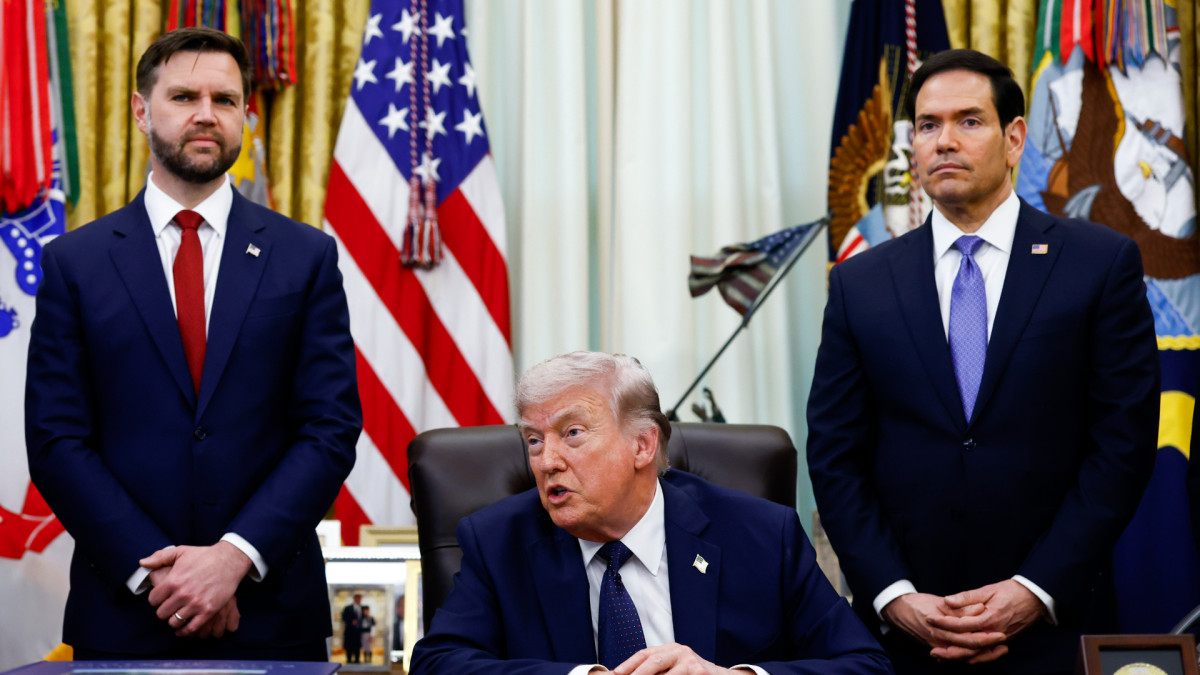
U.S. midterm elections have returned the country to a familiar situation: a president compelled to share power with a hostile Congress. The prospect that Democrats would regain the House of Representatives had seemed almost certain, yet the Senate remained an open question. Their victory in the House, paired with wins in traditionally Republican states like Texas, Kansas, and South Carolina, has transformed a foreseen defeat into a setback of far greater proportions. Although vote counts remain to be finalized in places, the Democrats have regained control of both chambers. The last time a Republican president faced a wholly Democratic Congress was in 2007 and 2008, during the last two years of George W. Bush.
The magnitude of the swing is almost without precedent. Since World War II, the two chambers had only changed hands at the same time in a few midterm elections—1946, 1954, 1994, and 2006. Kansas had not elected a Democratic senator since 1932, and Texas had not done so for decades. Yet it would be hasty to read the punishment of Trump as a wholesale ideological shift of the country. Midterm elections tend to penalize the president, and this time factors such as rising costs of living, the Iran conflict, and the weariness of a leader whose image, increasingly unpopular, was placed at the center of the campaign converged.
The cost of living and institutional discontent outweighed the culture-war agenda. According to an Associated Press poll, about half of voters cited the rise in living costs and government corruption as decisive factors. In September, year-over-year inflation reached 3.7%, largely driven by energy, on a price level that had already been pinching family budgets since the pandemic. Tariffs, pitched as a tool to revive domestic industry, have also raised costs for consumers and businesses. Discontent has even touched rural areas and parts of the Hispanic male electorate that helped Trump win in 2024, although their motives are not identical.
“The Democrats’ conquest of Congress, paired with wins in traditionally Republican states, has turned a foreseen defeat into a setback of much greater proportions”
The most immediate change to be felt in the Capitol will be the staging of the shift of legislative power. When the new Congress convenes in January, Democrats will chair its committees, can demand documents and witness appearances from the Administration, and scrutinize its decisions more vigorously. Senate control is particularly important because it allows blocking appointments of federal judges, senior officials, and ambassadors, and it would hinder Trump from filling a potential vacancy on the Supreme Court, which currently comprises six conservatives to three liberals. The contrast will be evident when considering the two years during which the Republican majority offered little resistance to the White House. The mere possibility of hearings and investigations could also alter the calculus of officials and companies that have hitherto been reluctant to oppose the president.
That said, controlling Congress does not equal ruling. Trump retains the presidential veto and much of the executive powers he has wielded so far. Furthermore, in the Senate, sixty votes are typically required to overcome parliamentary obstruction (the so-called filibuster) and to advance many laws. Without cross-party agreements, Democrats will have a greater ability to block new Republican initiatives than to push through their own. There will be more checks and balances, though not necessarily more capacity to solve the problems that voters still care about.
“The control of the Senate is important because it allows blocking appointments of federal judges, senior officials, and ambassadors, and also makes it harder for Trump to fill a future vacancy on the Supreme Court”
The first test will come with the budgeting process. The United States enters this phase with a federal deficit the Congressional Budget Office estimated at $1.9 trillion for 2026, around 5.8% of GDP, and a publicly held federal debt equivalent to about 101% of GDP. Losing control of Congress effectively deprives Republicans of budget reconciliation, the mechanism that allowed them to pass large tax packages by simple majority. But blocking further tax cuts will not by itself close a deficit driven by already committed spending and debt service.
There will likewise be inevitable negotiations. The debt ceiling will be reached again in 2027, bringing with it the risk of a spending paralysis, and several tax cuts approved during this term will expire at the end of 2028. An antagonistic Congress could curb new stimulus (i.e., tax cuts favored by Republicans), but persistent deficits and a bungled debt deal could prompt investors to demand a higher risk premium, thereby pushing up long-term Treasury yields.
The markets have taken note. The dollar has weakened and Treasury prices rose (yields fell), in anticipation of a more contained fiscal expansion and fewer rate hikes. But those trajectories in 2027 will depend mainly on inflation, the Fed, funding needs, and budget negotiations.
“The debt ceiling will be reached again in 2027, with the accompanying risk of spending paralysis, and several tax cuts enacted during this term will expire at the end of 2028”
Wall Street is also grappling with its own worries. Historically, midterm elections have given way to periods favorable to equities, in part because they clear political uncertainties. This time they coincide with doubts about the profitability of vast AI-related outlays and the economic consequences of the conflict in the Middle East. The new Congress could intensify scrutiny of big tech and of electricity consumption and the deployment of data centers. The Democratic win in Texas, a major destination for such investments, also adds a state-level dimension to the debate. Global demand for computing capacity will continue to grow, even as the regulatory cost of expanding it may rise.
On the trade front, the majority shift promises less than some U.S. partners might expect. After courts struck down portions of tariffs imposed under emergency powers, the Administration turned to other legal bases to maintain levies without congressional vote. Democrats will be able to repeatedly examine their consequences and hold the Executive to account, but they are unlikely to dismantle tariff policy with a single stroke. Renewed cooperation with Europe and Asian allies on strategic supply chains would be more plausible. The ongoing review of the trade treaty with Canada and Mexico will now take place with a less revisionist Congress, although negotiations will continue to depend heavily on the White House.
“Democrats will be able to repeatedly examine their consequences and hold the Executive to account, but they are unlikely to dismantle tariff policy with a single stroke”
In foreign policy, a similar constraint is evident. Democrats will be able to scrutinize the aims and funding of the Iran war, in addition to pushing a resolution demanding the withdrawal of U.S. troops. But, facing a presidential veto, they would need a two-thirds supermajority in both chambers to compel it. Trump thus retains a broad margin to continue or intensify operations, though the electoral result could also push him toward seeking a negotiated exit. In the prediction market Kalshi, the probability that traffic through the Strait of Hormuz would recover in the first half of 2027 has barely moved—from about 33% to 37% after the elections. The scant shift suggests traders do not expect a fundamental shift in such an entrenched conflict. For the global economy, as oil drives inflation and central-bank decisions, orders to the Pentagon with their direct effects on energy and maritime transport will weigh more than Capitol Hill debates.
In Ukraine, the new majorities open the possibility of pushing for more military and financial aid, tightening sanctions on Moscow again, and reconsidering a Trump strategy that has yielded few results so far. But approving funds does not guarantee they reach their destination, and any initiative vetoed by the president would require enough Republican votes to pass. Regarding China, the competition in technology and strategy counts on support from both parties. A tighter look at Trump’s deals with Beijing is likely, though not a fundamental shift in the enduring rivalry between the two powers. Moreover, China may continue to exploit the diplomatic advantage created by the doubts about U.S. reliability that have spread among Washington’s traditional allies and non-aligned countries.
Europe should avoid two hasty conclusions. One is to celebrate the Democratic victory as if it restored some certainty about the old transatlantic relationship. The other is to think nothing has changed because Trump retains broad powers. The Capitol will again be a key interlocutor on Ukraine defense, trade, and steering foreign policy, while immediate decisions on tariffs and military operations will remain in the White House’s hands. European governments will have to work with both branches without neglecting their own defense, energy, and competitiveness priorities.
“The Capitol will again be a relevant interlocutor on Ukraine defense, trade, and steering foreign policy, while immediate decisions on tariffs and military operations will remain in the White House”
In Washington, meanwhile, the next electoral battle is already looming—the 2028 contest. A Democratic majority earned through wins in conservative-leaning states will have to decide how much weight to give to moderate candidates versus the progressive currents seeking to redefine the party. The Republicans, for their part, will face Trump’s succession with a base that is not as solid as it seemed after the 2024 victory: does it favor Marco Rubio or J. D. Vance? Meanwhile, those who voted out of concern about rising costs will have to stay vigilant about their purchasing power during the two years left in Trump’s term, who remains, after all, the occupant of the White House, increasingly flamboyant, lavish, and audacious.