
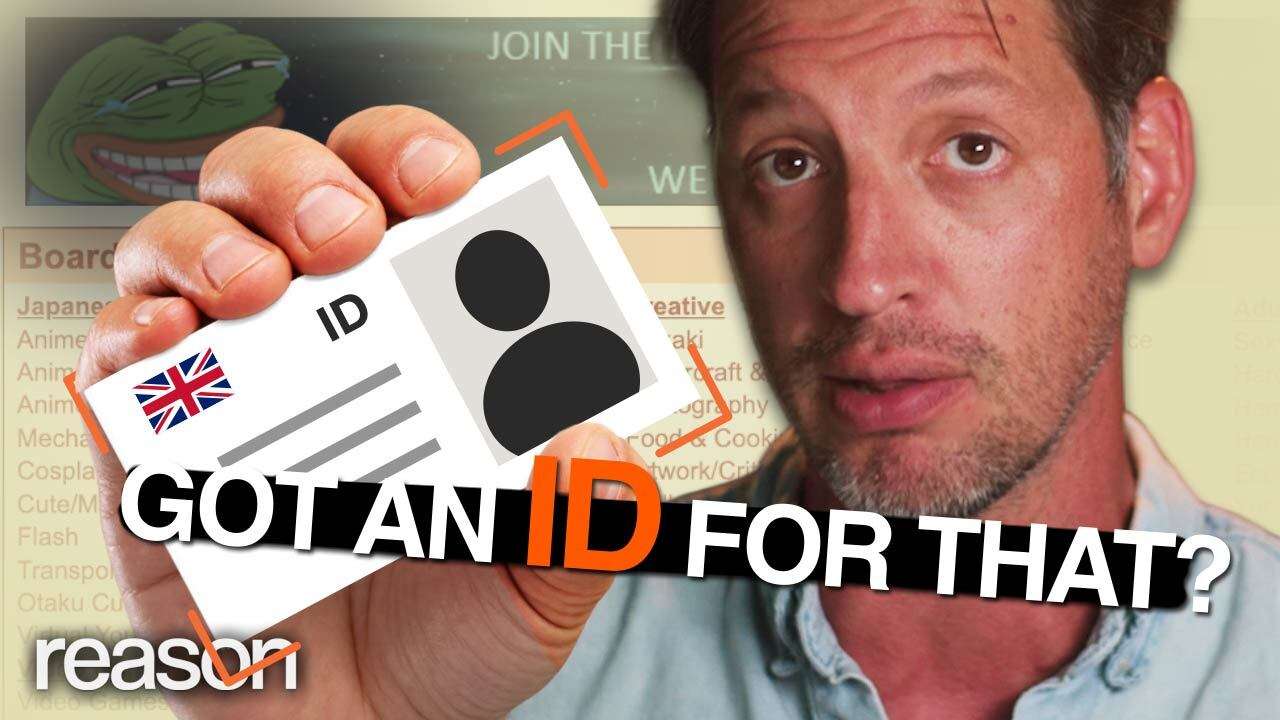
The fight over anonymity is intensifying across Europe, and its shadows are stretching toward the American internet.
“The online witch-hunt atmosphere feels like a mob—if enough people call the authorities, the authorities respond,” remarks Bernie Spofforth, a UK political activist who was detained by police after a social-media post.
The momentum is crossing the Atlantic too, aided in part by lobbying from a broad network of NGOs tied to the British government, according to Brian Chau, the founder of a new AI-driven investigative platform called Effort.news. The strategy, Chau explains, involves embedding speech-restriction concepts and effectively dismantling online anonymity under the banner of “child safety.”
Their ascent could imperil free expression online. The hopeful note is that there is a way to push back.
The U.K.’s War on ‘Misinformation’
In England, a single provocative post on the internet can carry jail time.
“Three police cars, a police van, several officers—it’s hard to count,” Spofforth recalls of the night of August 8, 2024. “They entered my home and arrested me.”
What was he accused of? Spreading misinformation.
After the death of three children at a Southport dance studio, rumors circulated online alleging that a Muslim asylum seeker was the perpetrator. Spofforth admits he reprinted the rumor on X and added: “If this is true, then chaos is coming.”
The claim was false, yet the uproar persisted.
“I noticed the post was flying around—many reshared it,” he says. “When a post becomes highly retweeted and you haven’t done your own verification, it’s hard to judge whether it’s smart or reckless. I deleted it.”
Local politicians and the police chief attributed the disorder in Southport to misleading online content.
“The root cause of the turmoil lies with conspiracy theorists disseminating disinformation online,” asserted the police chief.
Prime Minister Keir Starmer, in a subsequent press briefing after the riots, tied social media to inflaming the situation and warned that social-media platforms and their operators bear responsibility when violence erupts online—insisting that the law must be upheld wherever disinformation fuels wrongdoing.
Spofforth contends the riots were not merely the product of social posts.
“What truly sparked the crisis was the murder of three children and the brutal stabbing of others at the Taylor Swift-related event,” she contends. “The government’s response is to claim, ‘If we clamp down on disinformation, this would not have happened, and those responsible must be silenced.’
Spofforth acknowledges it was wrong to speculate about a real victim’s name and to insinuate a triple homicide. Yet the arrest and 36-hour detention she endured illustrate the gulf between First Amendment protections and regimes lacking such safeguards.
“In the U.K., you don’t even need a crime to be committed to face arrest,” she notes. “If someone says they were harmed by your words or that what you posted is deeply offensive, you can be detained. It’s a bizarre state of affairs.”
Arrests of this kind are not unusual in Britain. Police have detained comedian Graham Linehan at Heathrow on suspicion of inciting violence for posts about perceived hostility toward certain groups, and other cases—such as individuals lampooning or reacting to events—have led to legal action or punishment under the Online Safety Act and related norms.
According to Preston Byrne, an American free-speech attorney, “There are likely tens of thousands of arrests each year in the U.K. for speech and conduct that would be plainly protected in the U.S. What the Online Safety Act does is move the domestic regime online, treating acts that would be illegal in the real world as illegal on the internet as well.”
4Chan Pwns Britain
Byrne represented 4chan in its clash with Britain’s online-speech regulator, Ofcom (the Office of Communications).
In April 2025, Ofcom issued a notice to the site, demanding that it curb access to material deemed “harmful” to British citizens—an ultimatum that carried fines of up to roughly £18 million ($24.1 million) if ignored.
“This case marked a watershed moment—the first instance of a foreign regulator attempting to enforce a censorship levy on an American company,” Byrne observes. “Foreign governments rarely target popular speech in this way; the battle largely centers on expressions that don’t enjoy broad support.”
In response to Ofcom’s threats, Byrne teased with a hamster photograph and warned that future communications would be “shredded and repurposed as bedding” for his pet. When Ofcom persisted, he countered with AI-generated images of increasingly oversized hamsters.
“The humor is not just whimsy,” commented a British observer, prompting the technology minister to respond that the exchanges underscored the need for stronger action.
“It occurred to me that these actors aren’t taking this seriously, not America, not our Constitution,” Byrne reflects. “So I decided not to treat them as serious players.” He explains that while a cartoonish hamster may seem trivial, it is part of a broader strategy to alert Washington decision-makers to what’s happening.
Legislation echoing Byrne’s approach—various versions of the GRANITE Act (Guaranteeing Rights Against Novel International Tyranny and Extortion)—has surfaced in committees on both sides of Congress.
“The U.K. aim is to claim that content hosted within any country’s borders must obey that country’s laws,” Byrne contends. “The U.S. Constitution, however, guarantees broad First Amendment protections for Americans on American soil using American infrastructure. If those protections falter under British pressure, the online First Amendment could erode altogether.”
Europe’s Scheme To Regulate the American Internet
The British strategy to bend American speech habits does not end with the crackdown at home.
“From the outset, Europe declared itself the regulatory trendsetter—to craft rules that would compel foreign platforms to comply,” notes Chau. “That ambition has been realized more than once.”
Chau, who runs the AI-powered news outfit Effort.news, helped uncover a UK-based lobbying push to introduce online age-verification measures in the United States.
“State-by-state laws are notoriously tangled to monitor, with each legislature’s rules differing,” he explains. “I built a data-processing pipeline to collect state statutes and other filings (including Foreign Agents Registration Act entries) and asked it to identify the strongest signals of foreign influence on U.S. tech policy. The system surfaced the story on its own.”
Chau’s team turned the data into a feature that, according to him, was authored by humans rather than pulled from an AI; it traced the lobbying activities of nonprofits like 5Rights—launched by Baroness Beeban Kidron of the UK Parliament—and Reset Tech, which is described as part of a five-member consortium led by the Institute for Strategic Dialogue. The consortium reportedly received 4.9 million pounds from the European Commission, and Effort’s tally shows the ISD has attracted more than $17 million in support from EU and UK agencies as well as the U.S. government, including the State Department.
5Rights and Reset Tech did not respond to interview requests from Reason. The ISD answered by email, stating the group does not seek to restrict free expression but rather to expose “industrial-scale manipulation by hostile state actors like Russia, Iran, and China…to prevent radicalization and to deter supporters of nihilistic violence from carrying out attacks.”
“Think of it as an international pipeline funded by U.S. government money during the Obama and Biden eras, alongside funds from various foreign governments,” Chau says.
Why would these foreign-linked nonprofits target age-verification efforts in the United States? Chau argues the motive is strategic: to erode online anonymity, a long-standing shield for free speech. “If users remain anonymous, authorities have a harder time enforcing rules,” he notes. The envisioned outcome is a de facto digital ID for nearly everyone online—where visits to regulated sites are tied to a verifiable identity rather than a pseudonym. This would effectively extend identity controls beyond minors and into the broader digital ecosystem.
Previously, many of these groups spent more resources policing misinformation and what they deemed hate speech than protecting children. The Center for Countering Digital Hate, for instance, championed boycotts against Twitter after Elon Musk’s takeover.
“There is substantial evidence that these NGOs aren’t solely focused on child safety,” Chau asserts. “Their core objective is to influence online discourse, justifying whichever policy narrative supports tighter control.”
Byrne believes the European NGOs and regulators harbor a broad vision: a world where online life is under constant supervision, everyone is identified, and dissenting ideas struggle to gain traction in the political mainstream.
A prominent political rumor of the era involved a proposed digital ID scheme named BritCard, floated by then-Prime Minister Starmer in 2025. The rhetoric was stark: participation would be a prerequisite for employment in the UK.
Backlash within Starmer’s Labour Party cooled the plan, and the proposal stalled. Spofforth observes that while authorities publicly claim broad safeguards, the government’s internal data projects are already in motion—the system ready to deploy, if called for.
Even as the Online Safety Act requires platforms deemed potentially harmful to children to deploy strong age-verification measures—possibly including photo IDs or facial-recognition checks—the European Union is pursuing parallel directions under the Digital Services Act.
A practical obstacle for regulators remains the existence of VPNs, which allow users to mask locations and circumvent geographic controls.
When age-verification rules started to bite, Proton VPN reported a surge of downloads and a dramatic spike in sign-ups, underscoring the difficulty of stamping out anonymous access.
Spofforth insists that attempts to ban VPNs are technologically naive, and that individuals will find other routes to preserve privacy. “Once you’ve established a process to identify users—or to identify IP addresses—the power to limit activity follows,” she warns. “That is a frightening prospect.”
Byrne, however, believes Britain faces significant constraints at the domestic level unless it embraces more sweeping governance approaches, potentially bordering on totalitarian control.
Chau speculates that Europe is accelerating toward a governance model at either end of the spectrum: either near-total control or broad freedom, with the middle ground becoming increasingly unstable as authorities clamp down on information flow in pursuit of political aims.
Liberty’s Technological Edge
There is a silver lining: even a centralized state like China has not eliminated every privacy tool, with VPNs remaining a persistent challenge to total surveillance.
Chau sees the technological landscape tilting in favor of free expression as tools evolve.
“The most perilous phase has already passed,” he contends. “Concentration of power during the social-media era raised valid concerns about censorship, but that risk was more about awareness than about the technology itself. Now the key is understanding what the technology makes possible.”
He notes that AI-enabled journalism and other innovations empower people to counterbalance gatekeepers who would otherwise suppress inconvenient information. No government can easily suppress a locally run AI instance designed to surface evidence that a regime would rather keep hidden.
“Over the long haul, the ability of illegitimate regimes to maintain political control looks weaker than ever,” Chau argues. “There are many reasons to be hopeful, even for those who typically see little prospect beyond pessimism. The rapid spread of knowledge could outpace political efforts to restrain it.”
Yet for advocates of a free and open internet, that optimism must be matched with concrete political action.
“Legislation alone doesn’t obligate us to comply with policies rooted in delusion,” Byrne emphasizes. “We assert our constitutional rights and expose the absurdity of excessive controls.”
In his view, the United States may be the catalyst for real change: “The UK is unlikely to yield to reason until America asserts its authority.”
“There is too much at stake for them to back down,” Byrne adds. “Ultimately, if the U.S. demonstrates its sovereignty—saying, ‘Our businesses, our citizens, and our infrastructure are off-limits’—it could force Britain to reconsider its approach.”
America’s tradition of robust free-speech protections remains a crucial bulwark, and preserving that legacy will require firm legal, political, and technological defense alongside vigilant advocacy.
Photo Credits: Cover Images via ZUMA Press (Newscom), The Peter McCormack Show
Music Credits: Salience Bias by Art Against Agony/ Pursuit by Brianna Tam/Particles by Nobou/Suburban Living by Adam Dib/Above the Clouds by Theatre of Delays/Outer Limits by Theatre of Delays/No Memory by Jimmy Svensson/Day Dreaming by Diamonds And Ice
