
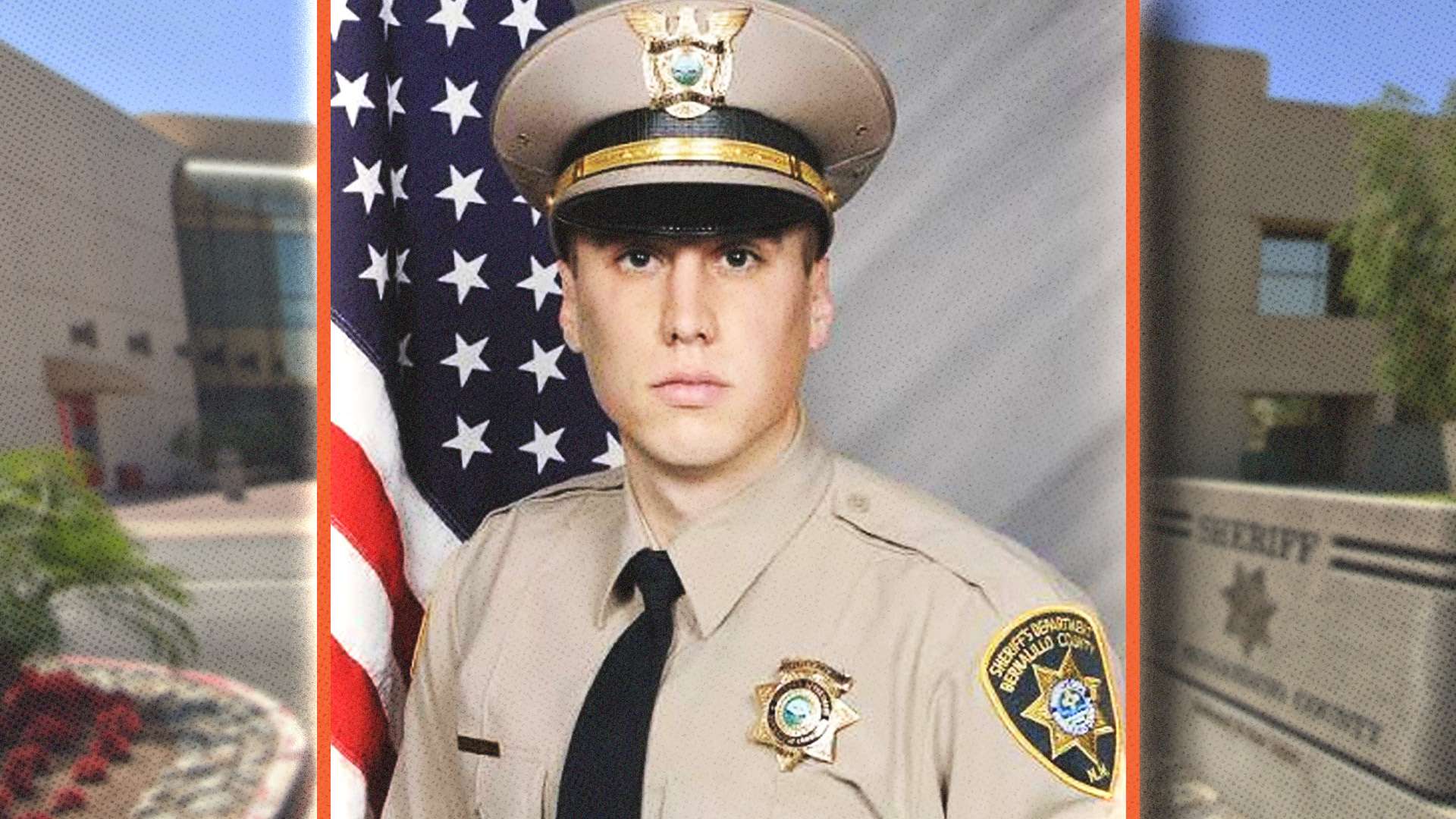
Paul Jessen, a former deputy with the Bernalillo County Sheriff’s Office, was convicted of obstructing justice for his attempts to shield a DEA confidential informant.
Like many other law enforcement officers in New Mexico, Paul Jessen Jr., a Bernalillo County sheriff’s deputy, was open to taking bribes from Albuquerque defense attorney Thomas J. Clear III in exchange for undermining DWI cases against Clear’s clients. Yet, according to a federal indictment filed this week, Jessen hesitated at the idea of accepting cash. After consulting with a supervisor who was part of the long-running bribery scheme, the indictment alleges, Jessen agreed to receive other forms of compensation, including a large-screen television, a Craftsman tool cabinet, a power generator, gift cards, hotel stays, and “free legal services.”
Jessen stands accused of conspiring to interfere with commerce by means of extortion, a federal felony that carries up to 20 years in prison under 18 U.S.C. 1951. The indictment represents the latest turn in what has been described as the most extensive law-enforcement scandal in New Mexico’s history, tracing back roughly thirty years: Clear would tell DWI arrestees that hiring him could erase their cases, which he accomplished by bribing officers to miss crucial administrative and criminal proceedings where their testimony mattered.
To date, thirteen individuals, including Clear, his paralegal, and several former officers, have pleaded guilty to taking part in the lucrative conspiracy. Jessen’s case is notable for another reason as well. The “free legal services” he received from Clear in 2022 were tied to an investigation that produced criminal charges unrelated to the described scheme. Those charges stemmed from hostility between local and federal narcotics investigators, offering a glimpse into the petty infighting and questionable tactics bred by the war on drugs.
Jessen, who joined the Bernalillo County Sheriff’s Office in 2013, served in the DWI unit from 2016 to 2020 before moving to narcotics work. In July of last year, a federal jury found him guilty of obstructing justice, conspiring to obstruct justice, and making false statements to FBI agents, offenses with a combined maximum penalty of 65 years behind bars. The core allegation was that Jessen and another sheriff’s deputy, Kyle Linker, repeatedly tipped off a drug dealer, Rod White, about imminent federal raids.
Why did they do it? Unlike in the bribery scenario, Jessen and Linker were driven by a mix of professional rivalry and personal grievance rather than the lure of flashy prizes. They sought to shield White because he was a confidential informant who had helped implicate other drug suspects. They also resented the Drug Enforcement Administration (DEA) for intruding on their cases and were thus inclined to disrupt its operations.
That motive came through in text messages prosecutors presented at Jessen’s trial. When Linker proposed alerting White about a planned DEA raid, adding “hahahaha,” Jessen urged him: “Go ahead and do it!” Jessen added that “it would be a shame if there’s nothing there.” Linker replied, “Gonna be a real shame.”
In December 2021, as cited by federal prosecutors in a subsequent press release issued after Jessen’s conviction, “the DEA executed a search warrant at [White’s] residence and recovered more than 470 grams of methamphetamine, fentanyl pills, and a firearm. During the follow-up interview, [White] admitted to agents that he had been previously tipped off by Linker. The DEA devised a plan to corroborate [White’s] statement.”
A DEA agent “contacted Linker to inform him the DEA was planning to conduct a controlled purchase” from White, the press release explains. “Although the agent explicitly instructed Linker not to contact the informant, Linker messaged the informant to ‘call me ASAP.’ Unbeknownst to Linker, [White] remained in the presence of law enforcement. The informant called Linker, who told him he was ‘on the DEA’s radar’ and instructed him to have someone else deliver the drugs to the DEA.”
In a subsequent text message, Jessen urged that Linker tell White “not to sell to anyone” and to “go to a hotel or stay with someone else for a bit.” Linker told Jessen that he should deliver that message himself so “I can show them my call logs and be like I haven’t talked to him since this morning.” Jessen agreed, though prosecutors say Linker ultimately delivered the message, using Jessen’s cellphone.
Linker pleaded guilty to obstruction in September 2024 and was later sentenced to 30 days in federal prison. Jessen, however, pressed to force the government to prove its case at trial.
During Jessen’s trial, his defense lawyer, Joel Myers, contended that his client’s role in shielding White from the DEA was peripheral and urged jurors to doubt White’s story, portraying him as someone who would say whatever the government wanted in return for a shorter sentence. Myers also argued that the case against Jessen amounted to revenge by DEA agents who were waging a turf war with local police in the drug war.
Remarkably, the U.S. Attorney’s Office for New Mexico stepped aside from the obstruction case against Jessen, with federal prosecutors in the Northern District of Texas taking the case instead. The Albuquerque Journal noted that the switch aimed to “avoid a potential conflict,” since federal prosecutors in New Mexico handle “cases involving the DEA and other law enforcement agencies.” Texas prosecutors do the same, so the claim of eliminating bias by moving the case is open to question, according to observers.
Myers questioned the government’s public-safety justification for pursuing Jessen, pointing out that the DEA allowed White to remain active while it investigated Linker and Jessen. He added that New Mexico Attorney General Raúl Torrez had recently begun a criminal probe into DEA operations in the state, prompted by a whistleblower’s claim that the DEA knowingly let hundreds of thousands of fentanyl pills reach New Mexico consumers from 2023 to 2025 to aid prosecutions against higher-level traffickers.
According to “current and former DEA agents,” the Associated Press reported in June, “the strategy amounted to gambling with public safety and may have violated U.S. Department of Justice rules intended to protect the public.” The AP noted that “the fentanyl went unseized amid the deadliest drug epidemic in U.S. history while the DEA led a public-awareness drive—‘One Pill Can Kill’—emphasizing that even a few milligrams can be lethal.”
New Mexico Governor Michelle Lujan Grisham, who urged Torrez to examine the DEA, voiced dismay at the agency’s calculated indifference. “There are no words to describe how reckless and dangerous these decisions were,” she said in June. “Make no mistake: the DEA knew people would die if these pills reached New Mexico communities, and the agency let it happen anyway.”
The reasoning here is debatable, since Lujan Grisham appears to assume that traffickers do not compensate for seized pills by sending more. Yet Myers believed the DEA’s alleged recklessness was relevant to Jessen’s case because it suggested the agency cared more about chalking up big busts than protecting the public from potentially deadly drugs.
The jury did not seem swayed by that argument. Still, it is difficult to see how shielding a single drug dealer who was providing information to local police could constitute a crime when tolerating numerous other dealers in the pursuit of bigger targets is standard practice at the DEA.
