
The midterm elections held on November 3 in the United States will be the subject of numerous analyses in the coming weeks. There will be no shortage of observers examining the causes of the Democratic tsunami, the scale of the Republican defeat, or the consequences for the last two years of Donald Trump’s presidency. And there is every reason for that. The results have represented an extraordinary upheaval in the American political balance, with the Democrats reclaiming control of both chambers of Congress and victories in states that just a few weeks earlier had seemed virtually out of reach for the party.
However, beyond the numbers, the electoral maps, and the implications for the Trump Administration, these elections also deserve a different reading. That of those who, with their victory, have achieved something that no one had accomplished before. For the first time, an African American woman will govern a U.S. state (Georgia); a Native American woman will become a governor (New Mexico); a Muslim will reach the federal Senate, and a man who is openly gay will join that same body. In addition to these milestones, there are numerous records of female representation and wins that end decades of political hegemony.
American democracy has something special about it: despite its contradictions, its inequalities and the deep divisions that run through its society, it retains the ability to make us believe that anything is possible. The firsts of the 2026 elections provide a compelling demonstration of that.
1. An unparalleled electoral tsunami in recent history
To grasp the scale of these events, it helps to situate them in their context. The midterm elections (midterm elections) tend to function as a corrective mechanism for presidential power. They are held every four years, at the midpoint of the president’s term, i.e., two years after the presidential elections. It is worth remembering that members of the House of Representatives are elected to two-year terms, while senators serve six-year terms. Therefore, every two years the entire House and one-third of the Senate are up for reelection.
“Members of the House of Representatives are elected to two-year terms, while senators serve six years”
Historically, the president’s party tends to lose seats in the House. The exceptions are few: Franklin D. Roosevelt in 1934, Bill Clinton in 1998, and George W. Bush in 2002 managed to increase their party’s representation. By contrast, Clinton’s defeat in 1994, Barack Obama in 2010, Trump in 2018, or Joe Biden in 2022 show how these elections can become a referendum on presidential governance.
What happened in 2026, however, exceeds that usual dynamic. According to estimates published by Nate Cohn in The New York Times, the Democrats could win by thirteen percentage points in the aggregated popular vote for the House. If confirmed, we would be facing the largest margin of victory since the Watergate scandal, in 1974 and 1976.
Even more striking is the voting behavior in certain traditionally Republican states. Democrats have managed to flip at least five Senate seats in territories that had favored the Republican Party by more than ten points in the previous presidential elections, with the possibility of raising that figure to seven. In the past fifty years, no party had achieved more than two such wins in a single election cycle.
“In the last fifty years, no party had achieved more than two wins of such characteristics in a single election”
Texas and Kansas symbolize this transformation. But South Carolina, Iowa, and Ohio also illustrate the breadth of a Republican defeat that is hard to explain by a single cause. The rising cost of living, tariffs, the Iran conflict, and the wear on Trump’s immigration policy appear to have contributed to undercutting part of the electoral coalition that brought him back to the White House in 2024.
In this landscape of change, the first occurrences worth our attention have occurred.
2. The first female governors: barriers once deemed insurmountable
Probably, the most significant milestone among the governor races held on November 3 is Democrat Keisha Lance Bottoms’s victory in Georgia. The former mayor of Atlanta, who held the office from 2018 to 2022, will become the first Black woman to govern a U.S. state.
The historical significance of her election is hard to exaggerate. The United States has had Black women governors and Black male governors, but never before had a Black woman attained the highest executive office of one of its fifty states. Georgia, moreover, had never elected a Black person or a woman to that post. Its 83 previous governors had been white men.
“The United States has had Black women governors and Black governors, but never a Black woman had managed to reach the highest executive office of one of its fifty states”
The Bottoms victory takes on added meaning because it occurs in one of the Southern states, where the legacy of racial segregation and the battles for civil rights continue to occupy a central place in the collective memory. It also marks the Democrats’ return to the governor’s mansion after more than two decades of Republican domination.
Another striking development occurred in New Mexico. Deb Haaland, a member of the Laguna Pueblo Indigenous community, will be the first Native American woman to hold a governorship.
Her path illustrates how institutional changes can unfold in a relatively short period. In 2018 she was one of the first two Native American women elected to the House of Representatives. In 2021 she became the first Indigenous person to hold a federal Cabinet post, heading the Interior Department during Joe Biden’s presidency. Five years later, she reaches another historic milestone.
Texas also writes an unprecedented page. Gina Hinojosa, a civil rights attorney, will be the first Latina woman to govern the state and the third woman to hold the office, following Miriam “Ma” Ferguson and Ann Richards. Her victory also ends more than thirty years of Republican governorships, since George W. Bush succeeded Richards in January 1995.
This is no ordinary territory. Texas is one of the most populous and influential states in the country and has long been a major Republican electoral stronghold. Hinojosa’s victory, aided by the electoral momentum of James Talarico, demonstrates that demographic and political transformations can ultimately disrupt seemingly entrenched balances.
In Ohio, Amy Acton defeated the Republican Vivek Ramaswamy and will become the first woman elected governor of the state. She will also be the first Democrat to reach that office through the ballot in twenty years. In Minnesota, Senator Amy Klobuchar will be the first woman to govern the state.
These developments are not limited to the Democratic Party. Republican Marsha Blackburn will also make history by becoming the first governor of Tennessee. The expansion of female representation, therefore, is not a phenomenon exclusive to one political faction.
“The expansion of female representation, therefore, is not a phenomenon exclusive to one political faction”
What is truly significant is the collective dimension of the change. According to data published by the Center for American Women and Politics (CAWP) at Rutgers University, in 2027 there will be at least seventeen women leading state governments, an unprecedented figure in the country’s history. For the first time, more than a third of the fifty state governorships will be held by women.
3. The Senate: new identities in a historic institution
If the governorships have seen important advances, the United States Senate has not fallen behind.
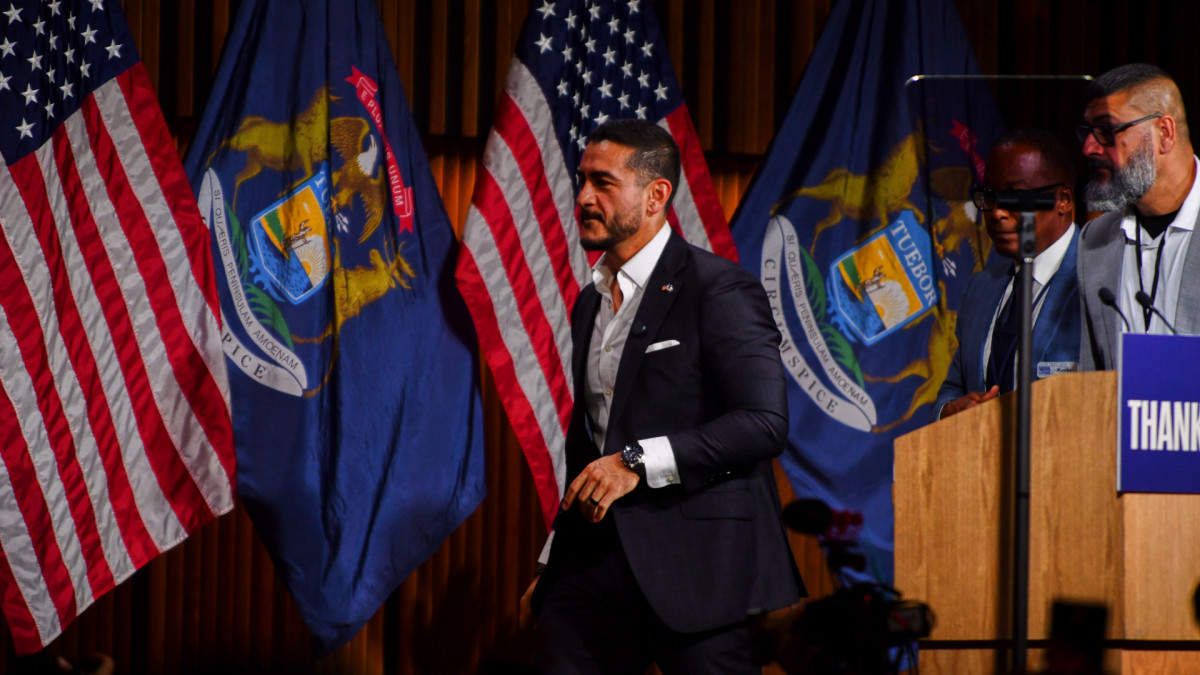
In Michigan, Abdul El-Sayed has become the first Muslim elected to the U.S. Senate. A physician and public health specialist, the son of Egyptian immigrants, he managed to defeat Republican Mike Rogers in a highly polarized race.
His election has a clear constitutional dimension. The First Amendment protects freedom of religion and Article VI of the U.S. Constitution prohibits requiring religious tests for federal public offices. El-Sayed’s arrival in the Senate, after a campaign in which his faith was subjected to political attacks, highlights the distance that can exist between formal recognition of a right and its full social normalization.
“El-Sayed’s arrival in the Senate, after a campaign in which his faith was subjected to political attacks, highlights the distance that can exist between formal recognition of a right and its full social normalization”
In New Hampshire, Chris Pappas will be the first openly gay man elected to the federal Senate. His victory represents another step forward in the political visibility of LGBTQ+ people. The fact requires a correction: Tammy Baldwin had already become in 2012 the first openly gay person elected to the Senate. The novelty of 2026 is that Pappas will be the first man to achieve that status.
Also to be noted is Peggy Flanagan’s victory in Minnesota. A member of the White Earth Ojibwe community, she will be the first Native American woman elected to the federal Senate.
In South Carolina, Annie Andrews will become the first woman elected to the state’s federal Senate. It should be noted, however, that she will not be the first woman to occupy the post. That milestone belonged to her Republican rival, Darline Graham, sister of the late Senator Lindsey Graham, who was named by Governor Henry McMaster in July 2026 to fill the vacancy left by her brother’s death. The historic novelty of Andrews lies, therefore, in having reached the Senate through an electoral process, not by gubernatorial appointment. Her victory also presents a surprising partisan dimension: Democrats had not won a Senate race there since 1998. Donald Trump had carried that territory by eighteen percentage points in the 2024 presidential election.
Illinois will also feature a historic first. Following Democrat Juliana Stratton’s victory, who will succeed veteran Senator Dick Durbin, Illinois will be represented in the federal Senate at the same time by two women from racial minorities: Stratton herself, Black, and Tammy Duckworth, of Asian descent. Stratton will also become, the sixth Black woman to hold a seat in the U.S. Senate and the second for Illinois, after Carol Moseley Braun, who in 1992 became the first Black woman elected to the Senate in the country’s history.
4. Diversity also arrives in state governments
Progress in racial representation does not stop at Georgia.
Aaron Ford will be the first Black governor of Nevada, while David Crowley will reach that same status in Wisconsin. Both join a historically small who’s-who of African Americans who have managed to be elected state governors.
The Republican Party also participates in this transformation. Byron Donalds has been elected governor of Florida and will become the state’s first Black governor and the first Black Republican elected governor by popular vote in the United States.
California offers another example. Xavier Becerra will be the first Latino governor elected by popular vote in the state’s history and the first of Latino origin to hold the office in more than a century and a half.
5. A more female House of Representatives and a historic presidency
Beyond individual results, the elections have established a record of enormous significance. According to CAWP data, at least one hundred Democratic women will be serving in the House from January 2027. The figure surpasses the previous historic high of 95, reached in 2025, and could still rise as pending recounts are completed.
The importance of this figure becomes clearer when one examines its historical trajectory. In the early decades of the 20th century, female presence in Congress was almost token. Although women earned constitutional recognition of their voting rights in 1920, their effective incorporation into representative bodies advanced much more slowly. Katherine Clark, the Democratic leader from Massachusetts, has highlighted the importance of surpassing the barrier of one hundred representatives and of citizens being able to see Congress as an institution in which they see themselves reflected. A timely remark coming from someone who is, in turn, destined to make history by aiming to become the first woman to hold the position of House majority leader.
“Although women won constitutional recognition of their right to vote in 1920, their effective incorporation into representative bodies progressed much more slowly”
To this record could be added another with historic significance. Hakeem Jeffries, the current Democratic leader in the House, is slated to become the first African American president of the institution. It is worth recalling that the Speaker of the House is not merely a ceremonial figure. He oversees parliamentary proceedings, plays a key role in organizing the majority, and occupies the second spot in the presidential line of succession, immediately after the Vice President.
6. An election to be remembered
The 2026 elections will be remembered, above all, for the scale of the Republican defeat and the consequences it will have for the last two years of Donald Trump’s second term. The loss of control of Congress, the electoral setback in traditionally conservative states, and the reshaping of parliamentary majorities will shape much of the American political debate in the coming months.
Yet reducing these elections to a Democratic victory would provide an incomplete picture of what happened. The results have also produced an extraordinary sequence of unprecedented events in the country’s history. Some have ended decades of one-party dominance; others have meant, for the first time, certain individuals reaching roles they had never occupied before. And not all of these milestones carry the same political sign, as the Republican victories of Marsha Blackburn in Tennessee or Byron Donalds in Florida demonstrate.
“Reducing these elections to a Democratic victory would provide an incomplete picture of what happened”
The political-constitutional history of the United States is filled with firsts that, viewed from the present, seem natural, but at the time represented important novelties. The 2026 elections have added a few more to that list.
And, speaking of firsts, these elections have also marked a first for the person writing these lines. For the first time I have had the opportunity to follow U.S. elections from within the country, specifically from Stanford University in California, where I am currently conducting a research residency. An experience that has allowed me to observe up close a voting day that, because of its results and its numerous historical milestones, I will hardly forget.
