
This is a conversation with Juan Luis Manfredi, a professor at the University of Castilla-La Mancha, who held the Prince of Asturias Chair at Georgetown University from 2021 to 2024. The interview took place in February in Washington, D.C., and has been edited for brevity and clarity.
He lived in the United States between 2021 and 2024; what are his reflections on that experience? How does he view the changes that have occurred in the country since that period?
The United States is living in a moment of acceleration. This is typical of the Trump era. Each day brings a flood of events, there is a great deal of news, and that affects politics, technology, international relations, and economic policy. It is a factor that shapes polarization. Public life has also become more politicized: every political identity is reflected in daily life, unlike the years I spent there.
“The imperial presidency of Trump is different from the federalist tradition of the American presidency. Tariffs reflect the legacy of Alexander Hamilton’s economic vision”
Now, what I observe is politics, politics, and more politics. There is constant intervention by the Trump Administration in various institutions, whether in the courts or the universities. This is causing some strain on those institutions, which weakens both the institutions themselves and public trust. The imperial presidency of Trump is distinct from the federalist tradition of the American presidency. Tariffs reflect the legacy of Alexander Hamilton’s economic vision and contrast with Thomas Jefferson’s anti-monarchical vision.
How do you perceive the transatlantic relationship right now? What does it mean for Spain?
We will see far fewer emotional bonds grounded in shared values, identity, and common projects. The United States’ transactional diplomacy and security conceived as a service are very demanding for Europe, because they require investments in defense, shifts in industrial policy, and the liberalization of the digital market to allow American competitors to enter. This matters for the United States, but the European Union is not prepared to address these issues quickly.
The relationship between the United States and Europe will revolve mainly around security, geoeconomics, energy, and immigration policy. That is where I believe Spain must better articulate its own voice and focus on how it can contribute something distinct to the European project. The country has an energy opportunity as a gateway. Given its geography, it connects Europe with North Africa. And then there is the Mediterranean. But all of this must be developed with greater investments. In that sense, Spain has three souls: the American soul, the Mediterranean soul, and the European soul.
Manfredi is a university professor at the University of Castilla-La Mancha. Photo: Juan Luis Manfredi
As a cofounder of a major transatlantic network of professionals — the SPPN (Spanish Public Policy Network) — and as an academic, how do you view the role of civil society and nonprofit organizations in the transatlantic discourse?
Nonprofit actors and civil society organizations, such as the SPPN, are essential. As a professor, a journalist, and a member of the SPPN, I want to give meaning to transatlantic relations and open a space for dialogue.
“Transatlantic networks are essential to the United States’ relations with Europe and Spain, because they offer opportunities for exchange and coordination of narratives”
In the realm of civil society, we can be the strategic infrastructure needed, because we have the capacity to connect talent and mobility on both sides of the Atlantic. Joint research can also be promoted, for instance on scientific issues. In short, transatlantic networks are essential for the U.S.’s relations with Europe and Spain, because they provide opportunities for exchange and coordination of narratives.
What is your view on emerging technologies such as artificial intelligence (AI) and social media and their impact on public discourse? How do you assess the differences in this debate between the United States and Europe?
Emerging technologies, from artificial intelligence to social networks, are the space in which meanings are negotiated and where political links are formed. AI helps us assemble information from multiple sources, but decisions must be made by people. In social networks, we need a better understanding of how to regulate freedom of expression, because the line between free speech and hate speech is very thin.
The Europeans tend to favor more regulation, while the United States prefers a framework more conducive to free markets. But this is something that warrants further discussion, and diplomats must stay informed about these issues at this moment in transatlantic relations.
How do you view the 250th anniversary of the United States?
The celebration of the Republic’s 250th anniversary allows me to point out that the United States has been the architect of the liberal international order as we have known it. It has promoted democracy and liberal values, free trade, and cosmopolitanism. These have been the core values of the country’s involvement in building the liberal international order. Yet, in the current scenario, under the second Trump term, we see a world of spheres of influence and multipolarity.
It seems the United States has accepted that its capacity has diminished in competing with China and other powers, and it has shown less interest in being the global hegemonic power. Therefore, it prefers to concentrate its power in the “Vertical Power” that runs from the Arctic to Patagonia, rather than preserving its historic role as a power looking east and west through globalization. It remains to be seen how the United States redefines its strategic alliances around four pillars—economy, technology, trade, and energy—the four cornerstones of Trump’s second-term foreign policy.
RELATED ARTICLES
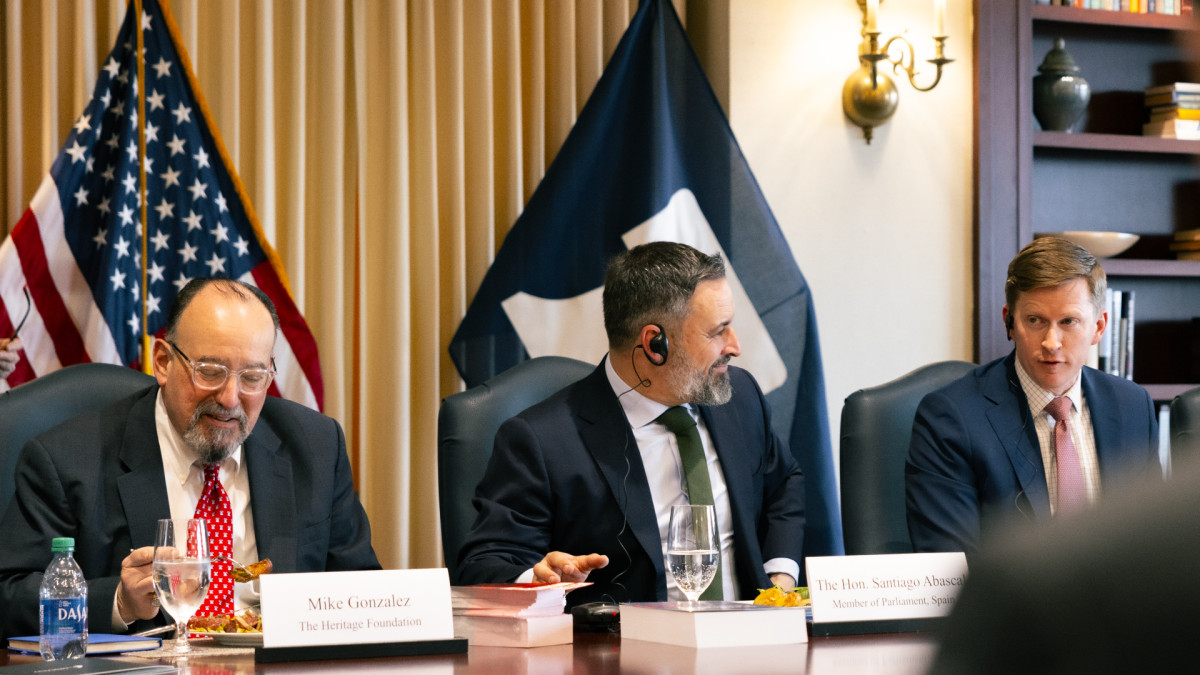
Santiago Abascal, líder de Vox, junto a Mike Gonzalez en The Heritage Foundation el pasado 2024.Vox Spain
Exterior del Congreso de los Estados Unidos en Washington D. C.Unsplash / Quick PS
What would you say is something Europe does not understand about the United States?
Europe struggles to grasp that, under Trump, but also after Obama, during Trump’s first term and Biden’s presidency, the United States has detached itself from its role as a hegemonic power and is now definitively apart from the liberal international order. We must accept that this is the new reality of the transatlantic partner, and therefore offer a more pragmatic relationship, based on results through energy and trade, and less on ideals and values. At this moment, the United States is not interested in the ideological and political offer that comes from Europe.
“The United States regards the European regulatory system as an attempt to protect consumers and sees it as a weakness”
Meanwhile, the United States views Europe as unable to change, perceiving it as a political and economic space that is very complex and not very innovative. The United States regards the European regulatory system as an attempt to protect consumers and sees it as a weakness, not as a strength.
Hopefully any misunderstandings that exist today between Europe and the United States can be resolved through a redefining of the transatlantic relationship that abandons nostalgia and leans toward curiosity and the exploration of new political, educational, or civil society projects. If civil society is the channel through which European and American citizens articulate their relations, we will have a better political environment.
What would be the ideal way for Spain and Europe to address the United States at this moment of redefinition?
My suggestion for the governments of Spain and Europe is to accept and embrace once and for all the political realism that comes from the United States. I do not mean Europe should become a realist actor that abandons its principles, but rather that it understands that the euro, Schengen, and the Erasmus programs belong to a distinct European model.
As of today, that model cannot be exported to the United States. If we assume these realist principles, we can better define our objectives and interests, which will result in a better relationship with the new Atlantic partner.
“We must abandon nostalgia and catch up: with energy policy, with inflation, with the strengthening of the single internal market”
We must stop waiting for the Trump era to end and talk about changes in Europe. I no longer want to talk about those changes; I want to see action. We must abandon nostalgia and catch up: with energy policy, with inflation, with the strengthening of the internal single market. These are things that need to be done. It is time to act, not to keep analyzing.
Tell me about your new book, How Disinformation Ruins Public Diplomacy. What is it about?
The book is a proposal that sums up one of the courses I taught at Georgetown as the Prince of Asturias Chair. It centers on a scenario of de-globalization and the transition of public diplomacy, long understood as a tool associated with the values defended by scholars like Joseph Nye. Today we see that those values are no longer dominant: there is no broad support for democratic and liberal values or for journalism. Consequently, we encounter difficulties in practicing public diplomacy without those instruments that once facilitated it. Now we have less space to hold public conversations.
This book seeks to analyze how we arrived at the current situation, in which there is less confidence in the institutions that sustain public diplomacy. There is a need to renew interest in the importance of this diplomacy, even in a world where priorities and values are shifting in many places.
Thank you.
