
It’s not the same to govern a city that keeps growing as it is to lead a village where attracting new families already feels like a small victory. But in Spain we tend to speak of depopulation and urban concentration as if they were two independent phenomena, when much of their causes and consequences are related. Cities need the resources that come from other territories, and villages depend, to a large extent, on the opportunities concentrated in the large population centers. Perhaps the problem isn’t so much where people live, but to what extent they can choose where they want to live.
Seeking answers to these questions, I spoke with Alberto Escribano, mayor of Arganda del Rey, and Kike Collada, mayor of El Recuenco, during the latest micro-session of Agenda Pública at CaixaForum Madrid dedicated to the demographic challenge. The former governs a Madrid city whose population, as he explains, has doubled in a little over two decades. The latter heads a small municipality in Guadalajara where keeping the number of inhabitants already requires a considerable effort. The two belong to a new generation of mayors, although their experiences and their approaches to public intervention do not always coincide. Escribano emphasizes individual decisions and cultural shifts; Collada recalls that much of these decisions are conditioned by how we have organized the territory.
From there, the conversation led us to some of the big demographic problems in Spain: the housing shortage, the difficulties of starting a family, immigration, aging, and the provision of public services. Escribano believes that behind the low birth rate there is also a question of priorities: “I think there has been a total generational change.” Collada, for his part, points to the difficulties of governing with an eye to the next twenty years when neighbors expect results before the next elections. “The art of politics lies in prioritizing, because the challenges are inexhaustible,” he says. In short, they are two mayors managing very different realities, but facing a similar challenge: how to ensure their municipalities remain places where people want to live, and can, build their future without inequality.
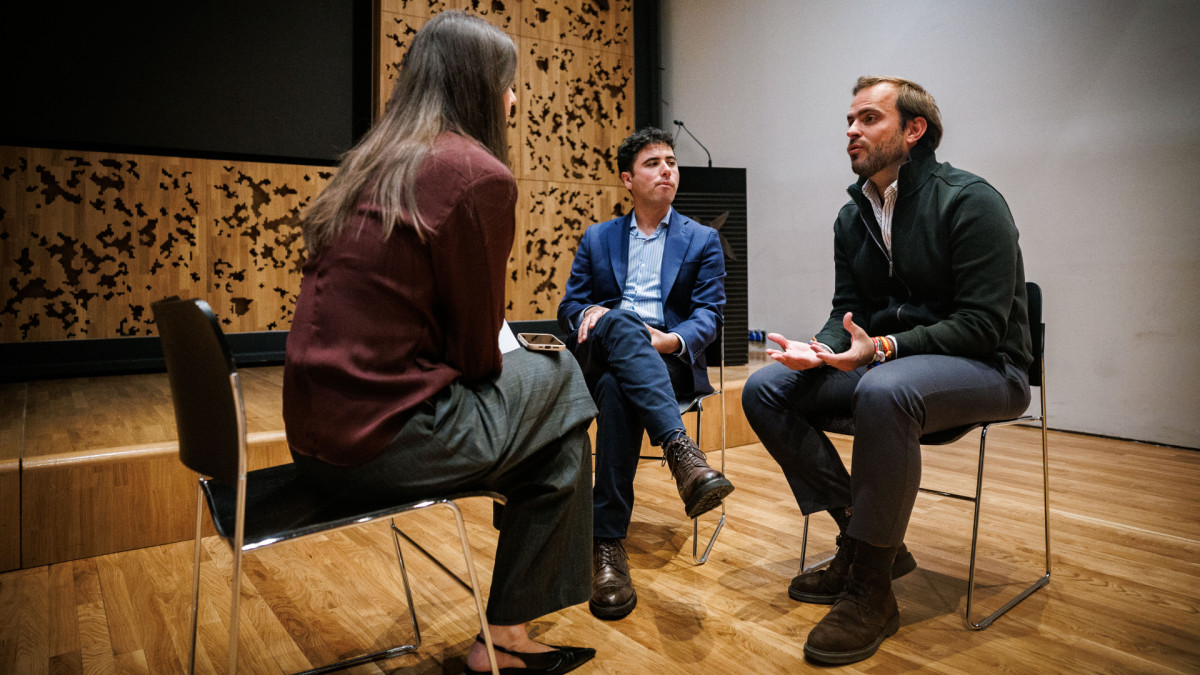
Kike Collada (left) and Alberto Escribano exchange views on the future of towns and cities during the CaixaForum Madrid meeting. Photo: Agenda Pública / Tania Sieira
How can two apparently opposing phenomena—the depopulation of rural areas and the growing concentration of population in cities—be managed simultaneously?
Alberto Escribano (A. E.): We always try to direct everyone’s life. Times change, priorities shift, and younger generations’ tastes are different. We don’t have to do the same as our parents did. That is the first thing we must respect.
“Times change, priorities change, and the tastes of the generations are different. We don’t have to do the same as our parents did”
It is incongruent that, on one hand, we talk about policies to promote birth rates or a return to the villages, and yet, without having done much in that direction in recent years, we see that since COVID people are returning to rural areas. That is a fact, though we don’t know to what extent or for how long it will last.
I think life presents circumstances that lead us to make certain decisions. My personal reflection is that they are usually natural, social, or cultural, and that anything a Government or a State tries to steer will, almost always, fail in that sense, because people have their own customs.
Kike Collada (K. C.): Well, yes and no. When we do urban planning, we decide where to place a hospital or where to locate a park. That is also a way of guiding. If everything were done without planning, what would happen? The question is to what extent we can control something and which things we can and cannot control.
In the era of my grandparents, going to the city was a form of social ascent against the subsistence economy that existed in many villages. Today the situation is different and presents other challenges. My view is focused on how the territory can be part of the solution, even if I don’t have all the answers. What does the territory contribute to society as a whole? If we guarantee minimum services and the possibility of living in certain places, we will have more opportunities and we can manage our resources better.
A few months ago, in Guadalajara, two reservoirs were joined for the benefit of farmers in the area. And where is the demand for that water now? In Madrid, because it is needed there. There is also a debate about resources: Madrid can continue growing because it receives energy and water from elsewhere.
I don’t want to frame it in terms of cities needing us. I am talking about interdependence, about understanding the territory, both cities and villages, as a continuum. What happens in one place affects others. Just as many solutions lie in cities, others can lie in rural territory.
To what extent should keeping every municipality alive be a political priority, even those that have been losing population for decades? Should there be limits to the resources allocated to combat depopulation, or should territorial balance be guaranteed regardless of the cost?
A. E.: We are living the consequences of how we were taught to live. All families, wanting the best for their children, told them to go to university. That means starting to work later, earning money later, and forming a family later.
And we have also inherited that movie-like idea: go to a big city to fulfill your dream, whatever it may be. We must be honest when reflecting on this, because it did not happen by chance. It is the consequence of the decisions and guidelines of previous generations.
“We have inherited the idea from movies: go to a big city to fulfill your dream, whatever it may be. We must be honest when reflecting on this”
Now there are those who view the building of highways or AVE lines with suspicion. To me, that seems a bit hypocritical. No one can see as a bad thing that traveling three hundred kilometers now takes two and a half hours instead of five. We must judge those decisions with the eyes of that time, not of today. When a highway was built near someone’s home, everyone felt they had hit the lottery. Judging it now in that way is somewhat opportunistic. Judging the past is very easy.
K. C.: We need to step away from Disney, from the good and the bad. We make decisions that have advantages and costs. The question is what costs we are willing to bear. There was a natural tendency for people to move to cities that generated other dynamics and synergies: companies cluster, talent attracts talent. And today we have problems that also originated from that.
When we think about the future, who can predict it? Are we oracles? No. I like the idea that the future is not predicted, but designed. That does not mean we can steer the future to our liking, but we can work so that the future reality resembles, as much as possible, what we want it to be.
“When we talk about the future, who can predict it? Are we oracles? No. I like the idea that the future is not predicted, but designed”
Of course there are dynamics that can push villages toward disappearance. I often say that it’s no longer depopulation, but disappearance. But what costs does that entail? Have we calculated them? We don’t know what might happen tomorrow. A war somewhere, for example, could alter trends. We can analyze what is more probable, but also view the future as a scenario we can influence and shape. What future do we want? That is the question we must ask as a society regarding the territory as a whole.

Alberto Escribano, mayor of Arganda del Rey, reflects on how economic opportunities condition the choice of where to live. Photo: Agenda Pública / Tania Sieira
They have said that this situation results from a series of personal choices made throughout history. But today, how much of a choice remains when one decides where to live? To what extent is it conditioned by economic circumstances?
A. E.: The choice, strictly speaking, is increasingly narrowed because one makes decisions based on factors that already exist and are almost fixed. I’m not only talking about where to live, but for example where to work or where to set up a business.
“The choice, strictly speaking, is narrowing, because one chooses based on factors that already exist and are largely fixed”
It is much easier for an industry to establish itself where there are complementary existing industries nearby, which can make it more competitive and provide nearby services, as is the case in Arganda del Rey, than in a small Guadalajara village where it would be alone and without access to those resources. Humans do choose, yes, but they choose under pre-established circumstances. That doesn’t have to be bad; it is reality.
K. C.: Work is important, of course. In Castilla-La Mancha there are industries that want to grow and have energy nearby, but there are many factors that determine whether an industry can settle in a location.
In El Recuenco, for example, you won’t find a large company that will hire you as a wage employee. Now, if we forget that entrepreneurship and starting a business is also a labor option and only consider working for others, we greatly limit what can be done. Most of us who work in El Recuenco are self-employed or run our own small company. Then there is technological transformation too.
There are jobs, such as hospitality, that can be done in either a city or a village. And the differences in living conditions are today much smaller than before, when a city could have running water and a village could not. Agriculture has also been mechanized and livestock farming transformed, for example, with the use of drones and other technologies.
I think that, as we are a society born and raised mainly in cities, we view the village as a place to summer, but we don’t know what it means to live there or the opportunities it offers. I was born in Alcalá de Henares and moved to live in a village when I was twenty. There I learned to look at productive sectors, the country’s challenges, and the possibilities of entrepreneurship from a different angle. If I hadn’t lived there, I wouldn’t have realized it.
“We see the village as a place for summer vacation, but we do not know what it means to live there nor the opportunities it offers”
There is a Ministry program, Campus Rural, which is like a rural Erasmus: students who go to villages to work in companies or town halls. I would extend it to state civil servants as well, so that they work for a while in a village before legislating on certain issues. I really like a reflection: we cannot love what we do not know, and we will not care for what we do not love.
We need to teach people to rediscover the territory and its resources. We spend a lot of money saving water or decarbonizing, and sometimes we lose resources by not managing a natural infrastructure that provides services that few technologies can offer. We all lack understanding of some realities, but if we lived only in urban surroundings, we would be completely unaware of life outside them.

Kike Collada, mayor of El Recuenco, raises the need to plan the future of the villages beyond municipal terms. Photo: Agenda Pública / Tania Sieira
Many of the policies needed to tackle the demographic challenge require thinking twenty or thirty years ahead, but municipal terms last four years. How do you govern with a generation that does not vote yet or isn’t even born?
A. E.: It is a human issue, not just a political one. When a measure is taken, short-term results are sought, because you are going to be judged by the results you can deliver. The first time someone may vote for you out of the trust you inspire or because they believe your word, but they cannot sustain unlimited trust if they do not see results.
“The first time they may vote for you for the trust you inspire or for believing your word, but they cannot sustain unlimited trust if they do not see results”
We need quick results, but so do the people. It is fine to say that we must think long term and legislate for many years; probably true. But the reality is that we have a system in which elections occur every four years and we evaluate what has been done or what has been fulfilled of what was promised.
Many projects require years of processing. As mayor, when people stop you in the street, you have to explain what is happening with them. They say: “It seems you are doing nothing, did you forget about it?” And no, we are working, but the processes are like that. Often they do not depend on the politician, but on administrative procedures or on civil servants. The absence of something visible does not mean that work is not being done.
K. C.: The art of politics consists in prioritizing, because the challenges are inexhaustible. And by prioritizing you must balance short and long term. Sometimes it will have more electoral impact to fix a street than to work to attract an industry, even if that project requires a huge amount of time and perhaps ends up not going ahead.
Here it may seem that everything you do works out well. But people fail, and that is how you learn. When something goes ahead it is because many other things were tried.
I believe true leadership has a lot to do with pedagogy. I must be able to explain to my neighbors that there are issues that will surpass my term. Perhaps in my village it is easier to convey because we are talking about survival. If we want our children or grandchildren to enjoy what we have enjoyed, we need more families. And for there to be more families we must work on housing, entrepreneurship, and other long-term issues.
“I think true leadership has a lot to do with pedagogy. I must be able to explain to my neighbors that there are issues that will surpass my term”
We must continuously explain the direction. But there are also immediate urgencies. You can’t govern thinking only about what will happen in a few years. It is a constant balance.
I also think there is sometimes a lot of short-termism. There are people who live off politics and whose job depends on it. That creates certain incentives. There may be decisions that one understands would be good in the long term but would be harmful personally or to one’s party in the short term, and for that reason they are not taken. That also happens.
Is there a generational conflict in municipal politics?
A. E.: I argue that there is conflict. I believe the conflict we are living is more generational than ideological or partisan. It is very clear when you look at who has housing and who does not. Those who have housing tend to be people of a certain age, while those who come later have more difficulty accessing it.
“Those who have housing tend to be people of a certain age, while those who come later have more difficulty accessing it”
We complain a lot about rents, but those who set those prices are not the young: they are, often, their parents or grandparents, who are the owners and set the price that benefits them. I think society is sometimes hypocritical because we criticize something in which we are also participants.
And in politics there is another issue. When you meet with large businessmen or people of a certain age and station, you notice they do not take you seriously. That is painful, but over time it changes.
Now I go to places I tried to visit three and a half or four years ago and where I was given little attention. Today the opposite happens. You should not believe it when they treat you badly or well. It is the reality of the position you hold.
K. C.: Low expectations have an advantage: it is very easy to surprise. It seems that they take you one way until you open your mouth and they think, “Wow, this guy has something to say.”
A. E.: In Arganda, the change has been very big, both in the way of acting and in the way of communicating it. We came from a traditional mayor and have moved toward something different. Let everyone judge whether it is better or worse, but the expectations were what they were.
When I was announced as a candidate, the mayor at the time said: “Arganda does not deserve a young mayor who has not worked in his life.” That sentence is on Twitter. But when you begin to work like anyone else, that changes. For someone to go into politics, no one tells you how old you must be. It benefited me not to enter that absurd age debate, because I also did not talk about the age of the previous mayor, and people ended up receiving him in a completely different way.
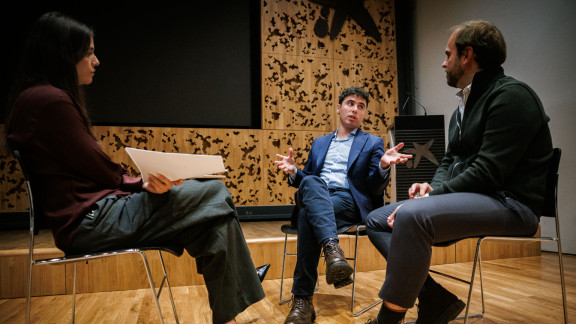
Clara Esteban, Kike Collada and Alberto Escribano. Photo: Agenda Pública / Tania Sieira
Immigration is often presented as one of the answers to aging and population loss. But to what extent are we treating immigrant people as a statistical solution, rather than considering the conditions they need to build a life and put down roots?
A. E.: There are different interpretations among experts about the role of immigration in facing the demographic challenge. While some consider it can help solve the problem, others point out that its impact on birth rates largely reflects a statistical issue, since immigrants tend to arrive at childbearing age, without necessarily having more offspring than the native population.
From my personal experience, Arganda is a young city that has grown a lot; its population has doubled in the last twenty-some years. We have received thousands of people from other countries, especially from Eastern Europe and, specifically, Romania. Many settled in Alcalá, Coslada, San Fernando and Arganda del Rey.
For us it has been an example of integration. But we are now also seeing another phenomenon: of the 14,000 people who came from Romania, about 8,000 remain. I think when living conditions improve in the country of origin, many people prefer to return home, unless they have already formed a family here. There we are talking about another situation.
K. C.: Do parents return, or also the children born here and who have lived their entire life in Spain?
A. E.: I think the returnees are mainly people who have not formed a family here. The children are almost our age, and for them, this is their life.
K. C.: In El Recuenco I also see it: immigration represents an opportunity, certainly. There are negative aspects associated, especially poverty and the difficulties it can generate. We have to acknowledge that it poses other challenges.
In El Recuenco we have managed to increase the population. We have gained neighbors, although there have also been deaths. Simply maintaining the population already costs a lot. A significant part of that increase is due to immigration.
“We have gained neighbors, although there have also been deaths. Simply maintaining the population already costs a lot. A significant part of that increase is due to immigration”
I don’t like reducing people to the services they provide, as if they were merely labor. But it is also true that thanks to some of them we can cover services that benefit the whole population. When someone arrives in the village, I don’t ask where they come from. I care to know what they plan to do, how they want to settle, and to meet them as a neighbor.
There is often talk about aging of the population in economic terms. You, who manage municipalities, how do you experience aging in daily life and socially?
A. E.: In a city like ours, services for the elderly are needed, elderly centers, social services, activities, programs against loneliness, home-delivered meals… All of that has to be scaled as the population grows and ages.
There is one question I like to raise. We have nine schools that stay closed when not in use, with no access for other activities, while sometimes the elderly do not have a place to carry out activities. And building new facilities is not easy.
“We have nine schools that stay closed when not in use, with no access for other activities, while sometimes the elderly do not have a place to carry out activities”
I think in the future we will have to use spaces more dynamically: multi-purpose centers that can be used by some people in the morning and others in the afternoon. There doesn’t have to be a center dedicated solely to the youth and another to the elderly. The challenge is significant.
K. C.: The first thing I see is that we should not present the villages only as places for old people. I think that narrative is part of the problems we have. Certainly, elderly people have a strong connection to the village; many were born there, even if they left for years. And we have a very aging population.
That doesn’t only mean we need more services. The problem is who provides them. We need home care and assistance, but we don’t have anyone to do it. It’s a huge challenge because those services, at least for now, are not provided by a robot: they are provided by people.
“We need home care and assistance, but we have no one to do it. It’s a huge challenge, because those services, at least for now, are not provided by a robot: they are provided by people”
That’s why we try to explain to older people, who are often owners of family homes, how important it is for families and young people to come to the village. We also need people who can provide those services, even for those who do not live there year-round and return from time to time.
In a place like El Recuenco, with the current demographic structure, either we rejuvenate the census or, beyond the need for services, there will be no one who can provide them.

Alberto Escribano addressing Kike Collada and Clara Esteban during the debate on birth rates, housing, and work-family balance. Photo: Agenda Pública / Tania Sieira
The policies to promote birth rates tend to focus on financial aid and, increasingly, on work-family balance. But often the problem is structural: living in rent, not being able to shoulder daily costs… How can this be tackled from another perspective?
A. E.: Work-family balance and housing are problems, and there are many more. But there is also something that is not necessarily a problem: the change in priorities of our generation. I don’t know if my parents had more difficulties than I in having children, but I don’t think their grandparents had more facilities. Probably everything was more difficult. What existed was another habit and another way of understanding life.
There are aids for work-family balance, for maternity, for school meals and kindergartens in almost all administrations. We can create all the scholarships we want, but when deciding whether to have children, many other aspects come into play: what life we want, what future we imagine.
“We can create all the scholarships we want, but when deciding whether to have children we take many more aspects into account: what life we want, what future we imagine”
It’s not reduced to receiving a grant. We see it among people our age who are in a situation to have children. I think there has been a total generational shift.
K. C.: Of course preferences influence. But there is also the anxiety of not being able to secure the first thing that gives security: housing. Perhaps wages in Spain are too low for the rising cost of living.
And with housing there is another problem: in certain places construction begins to stop being profitable. Between materials, labor, and what people can pay, the numbers don’t add up. We encounter this in many villages that have housing problems.
There the villages do offer advantages. Many families arriving in El Recuenco have young children. I can give two examples: a family from Seville and another from Barcelona, both with three children. They have gone from paying over a thousand or two thousand euros a month where they lived to paying 250 euros in El Recuenco. The cost of living is lower, there is more tranquility, it is a safe environment and the park is nearby.
Where do we make the effort? So that these children can also have English classes, tutoring, or music. From the Town Hall we make a big effort to offer it even if there are only four children, because we want it to be a place where families can live.
At first I thought they had to come young people like me, without responsibilities, who could start from scratch. But no: those who take most advantage of these benefits are families with children, because they organize their lives around them. Being able to let kids play outside, having balancing programs, and spending less on housing makes the village more desirable for them.
“Those who take most advantage of these benefits are families with children, because they organize their lives around them”
Is it a panacea? No. Probably their children will have contact with fewer children or have fewer services. But there are also new options via the internet. These are aspects we can work on and that can make villages more competitive than cities for certain families.
Thank you very much.
In collaboration with the Fundación “la Caixa”
