
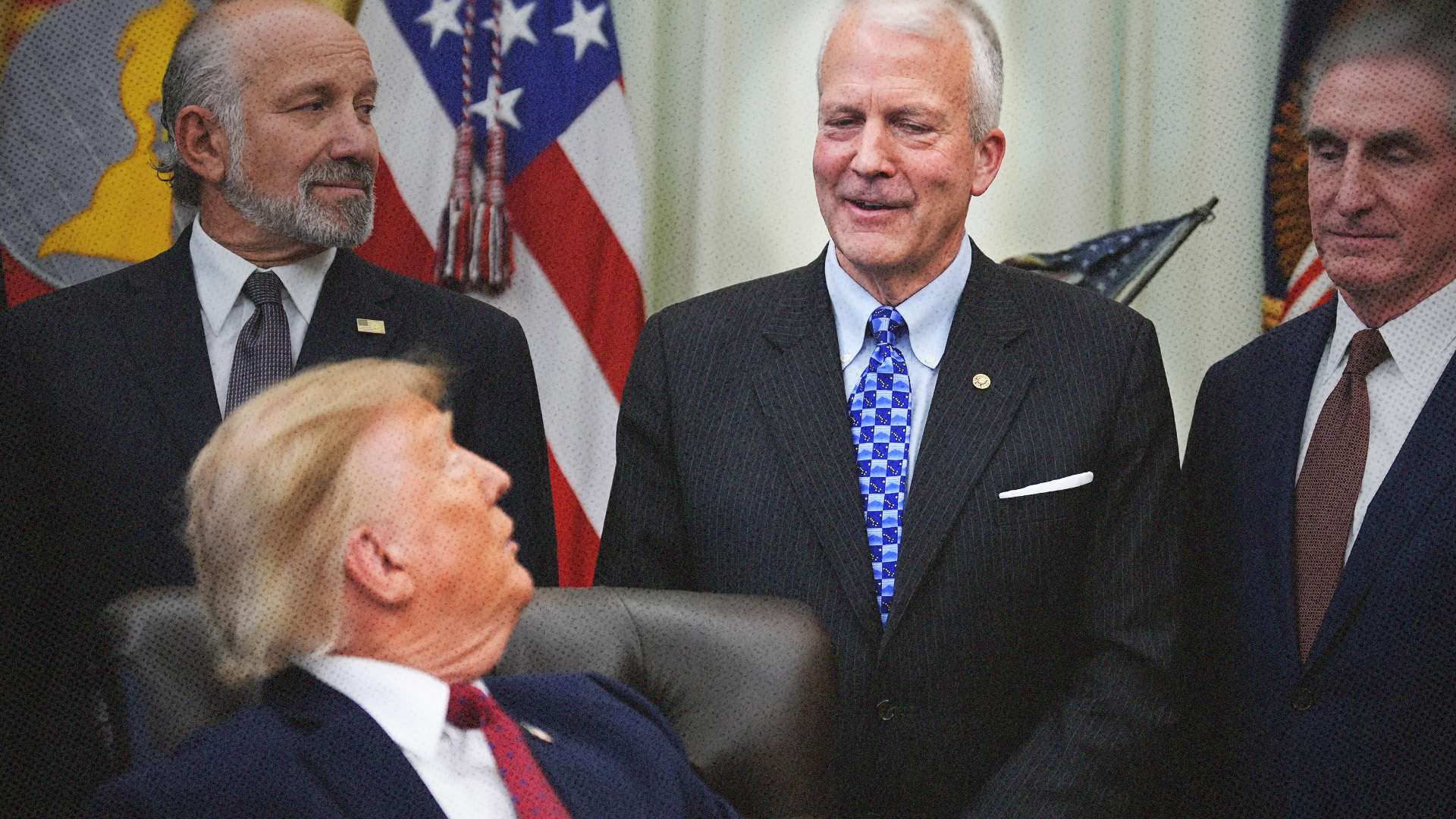
Meanwhile, President Donald Trump made an ineffectual plea for the state to award Sullivan every remaining ballot and declare him the winner.
In the days following the midterm elections, one of the few nationwide contests still unsettled was Alaska’s U.S. Senate race. At the moment of reporting, with roughly seventy-five percent of the votes tallied, incumbent Republican Dan Sullivan trailed Democratic challenger Mary Peltola by a little over six hundred votes—about 0.3 percentage points—with the two other contenders significantly behind, each needing only a few percentage points to gain ground.
The contest drew sharp attention near the end after it emerged that the Peltola campaign, along with other Democrats, had recruited Daniel J. Sullivan Jr., who was then in fourth place, with the aim of diverting votes from Republicans uncertain about which Dan Sullivan to back.
Trump urged that Peltola and the other Sullivan be criminally charged. The Department of Justice sued, seeking to discard ballots cast for the non-incumbent Sullivan. (A federal judge dismissed that lawsuit earlier in the week.)
Although many ballots remain to be counted, it seems unlikely that Sullivan—of either version—will emerge as the victor. More broadly, it appears he is not prevailing through an unfair advantage, but through the normal, competitive process.
Alaska conducts general elections using ranked-choice voting, presenting up to four candidates for each office irrespective of party. Voters order the candidates by preference. If no candidate reaches a majority on the initial count, the candidate with the fewest votes is eliminated, and their ballots are retallied and redistributed to the voters’ next choices.
Beyond that, simply gathering and processing ballots in such a vast and largely rural state takes time. Ballots must be counted by November 18—fifteen days after Election Day—and results must be certified within seven additional days.
Early results released this week from about 215,000 ballots indicate that voters who backed the other Sullivan did so to oppose the incumbent rather than from confusion about the choice.
“Mr. Sullivan might not gain even half a point back in the ranked-choice tally, which would not be enough to overcome Ms. Peltola’s expected edge,” The New York Times observed. “A contributing factor is that a larger share of the supporters of the other Dan Sullivan ranked Ms. Peltola as their second preference rather than Sullivan.”
The Times examined the available data, which covers all but roughly 10,000 ballots that could not be scanned digitally and must be counted by hand.
Only about four percent of ballots listed a candidate other than Peltola or Sullivan as the top choice. Among those who chose the other Sullivan, more than one-third left the remainder of the ballot blank, nearly thirty percent selected Peltola as their second choice, and 16 percent and 18 percent chose the incumbent Sullivan and fellow Republican Gerald Heikes, respectively.
This implies that at least 16 percent, and perhaps as many as 34 percent, of voters followed the senator’s suggestion to simply list all candidates except Peltola and let the process determine the outcome.
It also indicates that nearly three in ten voters who chose the spoiler Sullivan actually intended to vote for Peltola and ranked her second.
Among those who picked Heikes first, 36 percent placed Sullivan second, with a similar share leaving the rest unranked; 14 percent selected the other Sullivan, and 12 percent chose Peltola.
Of course, questions remain about the 36 percent who supported the other Sullivan exclusively—were these protest votes or merely confused voters?
Fortunately, there is reason to believe the Peltola campaign’s alleged tactic did not actually tilt the outcome: “Even if every voter who cast a ballot for Daniel J. Sullivan Jr. and did not rank a second choice had intended to support the incumbent,” the Times added, “the gain would be about one percentage point, a margin insufficient to erase the anticipated gains from uncounted mail ballots.”
That, however, has not stopped Trump from venting about the results.
“The tallies for the Fake Dan Sullivan, plus the other ‘slug’ the Dems placed on the Ballot, should be promptly assigned to the REAL Dan Sullivan, and the Election is over — He wins easily,” the president posted on Truth Social. “There is no other fair solution!”
Why stop there? Why not also award Sullivan the 695 write-in votes? And why not just hand him Peltola’s votes as well and declare a unanimous victory?
This feeble bravado is Trump’s typical reaction when he falls short in elections.
After winning the 2016 race but losing the national popular vote, Trump complained that had it not been for “the millions of people who voted illegally,” he would have won both standings. (There was no evidence substantiating the claim.)
Then, ahead of the 2020 contest, he reportedly indicated he planned to declare victory before all ballots were tallied—which he did, as state totals trended away from him.
Even in this campaign cycle, while he is not on the ballot, the Trump administration has attempted to intervene in how states conduct their vote counts: before Election Day, the DOJ sought to compel Alaska to segregate all ballots cast for the other Dan Sullivan to pursue some form of inquiry into whether each voter intended to vote for the incumbent.
And this week, lawyers for Sen. Cindy Hyde-Smith (R–Miss.) sent a letter to Mississippi officials, where Democratic challenger Scott Colom currently leads Hyde-Smith by roughly two-tenths of a percentage point.
In that contest, estimates put the number of provisional ballots yet to be tallied at between 15,000 and 20,000. Hyde-Smith’s lawyers demanded the immediate separation, secure custody, and preservation of all provisional ballots in case a lawsuit challenges the result.
As Madeline Nguyen reported for Mississippi Today in April, Mississippi Secretary of State Michael Watson hired Experian to verify voter eligibility even though the company warned it could not guarantee the reliability of the data. Consequently, thousands were likely removed from the rolls in error and had to cast provisional ballots.
Both before and after the election, Trump continued his criticisms of the Alaska Senate race, alleging fraud by the Peltola camp and calling for punishment. In the end, it appears Peltola will prevail not because of misconduct, but because voters simply favored her over her opponent.
