
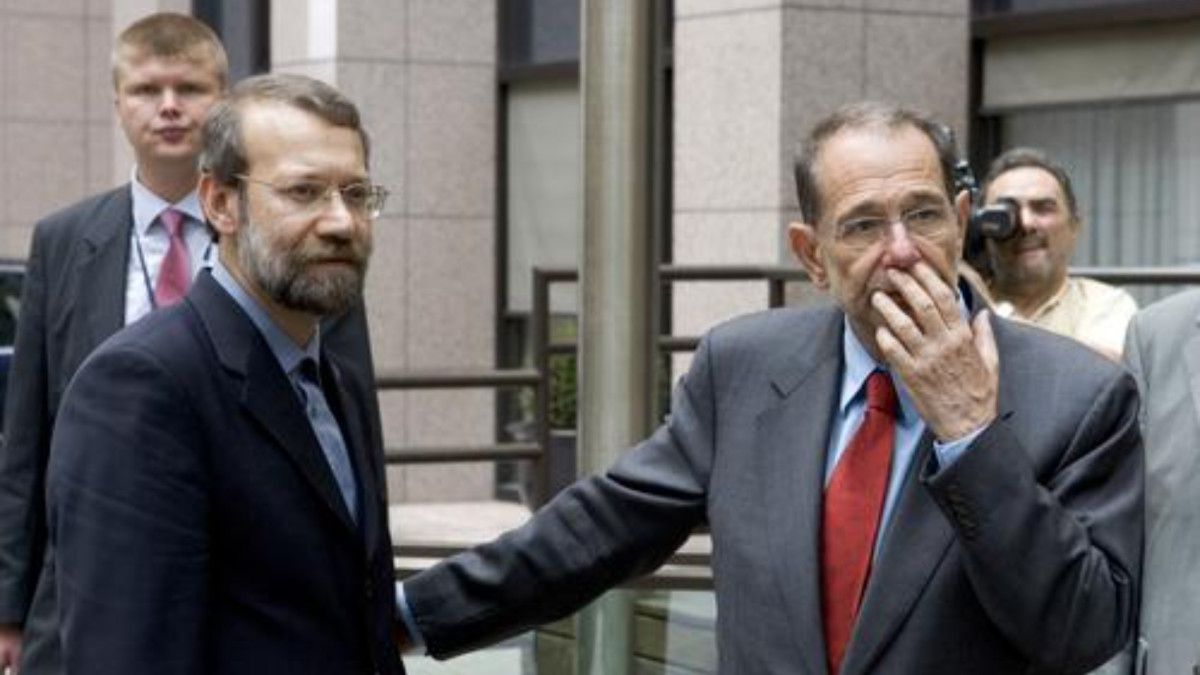
In the labyrinthine politics of the Islamic Republic, there are men who wield swords and men who wield silences. Ali Larijani, who died today amid the smoke of an attack on Tehran attributed to Israel, was an unusually adept practitioner of both arts, though he always preferred the precise edge of the scalpel to the blunt force of the mace. His death, occurring less than a month after the death of Supreme Leader Ali Khamenei, does more than remove a veteran statesman from the chessboard: it de facto destroys the last bridge between a revolutionary past and a viable future for the Iranian state.
For those who followed the mid-2000s nuclear poker game, Larijani will be remembered alongside Javier Solana, then head of European diplomacy. They were a strange pair in the high politics of the time: Solana, the Spanish physicist-diplomat, and Larijani, the political-philosopher with a penchant for Kant and a PhD in Western logic. Their meetings in Ankara, Madrid, or Rome represented the last moment when the Iranian regime spoke a language that—dialectical or frustrating as it was—Western powers could decode.
The duel of intellects: who was Ali Larijani really?
Unlike the sterile encounters that would follow, at the summits between Solana and Larijani there was a clear debate about the nuclear future of two very different blocs. It was, therefore, a duel of intellects that transcended the points of a treaty. Larijani, with his dry humor and cryptic responses, found in Solana an interlocutor who respected his academic background. They could discuss the logic of power and the nature of sovereignty from a theoretical perspective before descending into the mud of uranium enrichment.
“Solana acted as the bridge toward a skeptical Washington, while Larijani sought to tell Tehran that a ‘technical pause’ was not an ideological surrender”
Under the leadership of both, the ambitious project of the “dual suspension”: the idea that Iran would halt its nuclear centrifuges at the same time that the UN Security Council would freeze sanctions. Solana acted as the bridge toward a skeptical Washington, while Larijani sought to sell in Tehran that a “technical pause” was not an ideological surrender, but a masterful chess move. It was a white-glove diplomacy in which Larijani’s constructive ambiguity allowed both sides to save face.
However, this fluidity ended in 2007 due to internal sabotage by Iranian President Mahmoud Ahmadinejad. When Larijani was publicly disavowed while negotiating in Rome, he resigned. With his departure, the rhetoric of the “knights” was replaced by the monologue of the ideologues, and the world lost the most skilled translator Teherán has ever had.
The architect of the middle path
Larijani was the paradigm of the insider. Born into clerical aristocracy — his father was a leading ayatollah — he belonged to the nomenklatura that emerged from the 1979 revolution. As speaker of Parliament (Majlis) for twelve years, he mastered the art of what is possible within an impossible system.
It was his pragmatism that, years after his stint with Solana, provided the internal cover crucial to the 2015 Joint Comprehensive Plan of Action. He was the man who could whisper in the Supreme Leader’s ear and persuade the IRGC that a tactical retreat could actually be a strategic victory.
“The moment of Larijani’s death could not be more catastrophic. Iran is currently a ship without a rudder sailing a sea of fire”
The exotics-named 2015 agreement marked a turning point in Iran’s relations with the West. As Josep Borrell, the former EU high representative for foreign affairs and security policy, explains in conversation with this outlet, “Iran committed not to develop military nuclear capabilities in exchange for the lifting of sanctions“. Yet, the “kick to the table” of Donald Trump in 2018 broke a framework of understanding that never recovered.
Josep Borrell during his tenure at the head of European diplomacy alongside Ali Larijani. Photo: European Council
A State Without a Strategy
The moment of Larijani’s death could not be more catastrophic. Iran is currently a rudderless ship navigating a sea of fire. With the elderly Khamenei offstage and the succession of his son, Mojtaba, wrapped in uncertainty due to his physical condition, the IRGC’s “deep state” has shifted from guardian of the regime to its absolute owner.
Larijani represented the “civil-rights” or civil-right wing: a faction that believed in a strong state, but governed by institutions and a certain degree of bureaucratic competence. With his disappearance, in Tehran’s corridors of power, the balance of power tilts decisively toward the “boots-on-the-ground” men.
The regional vacuum and the Kantian revolutionary
In European capitals, Larijani’s death will feel like the loss of the last emergency channel. His assassination, attributed to Israel, marks a shift from a shadow war to a strategic decapitation war. By removing Larijani, the attackers have ensured that when Iran responds, it will do so directly.
Larijani used to say that the West understood the “logic of power” but not the “power of logic.” He spent his life trying to synthesize the certainties of Shiite Islam with the realities of 21st-century geopolitics. He failed, of course. The system he helped build ended up deeming him dispensable. Yet in his failure lies a warning: without the “Larijanis” of the world — those frustrating yet brilliant negotiators — the international community is left dealing with a regime that has lost the ability to think two moves ahead.
The Empty Chair
Iran’s label on analysts’ desks today is no longer about reformists versus hardliners. It is about collapse versus military consolidation. Without Ali Larijani, the prospect of a negotiated deal on any front has shifted from unlikely to nearly impossible.
“Jonathan Powell, the United Kingdom’s National Security Adviser, considered Tehran’s February offer to be ‘sufficient to prevent entering into war’
The striking example comes from Washington. Larijani’s death coincides with the resignation of the director of the National Counterterrorism Center, Joe Kent. In a forceful letter that Agenda Pública translates into Spanish at the end of this piece, Kent addresses President Trump and points to Israel: “Iran did not pose a direct threat to our nation and it is clear that we started this war due to the pressure coming from Israel and its powerful lobby in the United States”, Kent writes.
These assertions align with reports from the United Kingdom. The Guardian notes that Jonathan Powell, the UK’s National Security Adviser, considered Tehran’s February offer as “sufficient to prevent entry into war.” Yet, two days after that negotiation, Israel and the United States attacked Iran.
Now, the Islamic Republic has entered its most volatile chapter. It is a regime that has lost its paternal figure and its most capable strategist within weeks. As history shows, when bridges like the one Solana and Larijani built disappear, the only way to cross the river is to swim through blood. The world should prepare for a Tehran that cares no longer for logic, but only for cold and violent survival. Years later, even when Larijani was no longer the chief negotiator, Solana still referred to him as the true barometer of what the Iranian establishment thought. In fact, when the 2015 agreement was negotiated, the spirit of those 2006 talks revived the idea that Iran needed a guarantee of dignity as much as an economic guarantee.
After much reflection, I have decided to resign from my post as director of the National Counterterrorism Center, effective immediately.
I cannot, in good conscience, back the ongoing war in Iran. Iran did not pose an imminent threat to our nation, and it is clear that we started this war due to the pressure from Israel and its powerful lobby in the United States.
I share the values and the foreign policy you campaigned on in 2016, 2020, and 2024, and that you pursued during your first term. As of June 2025, you understood that wars in the Middle East were a trap that cost the United States the valuable lives of our fellow citizens and drained the wealth and prosperity of our nation.
In your first administration, you understood better than any modern president how to apply military power decisively without dragging us into endless wars. You demonstrated this with the killing of Qasem Soleimani and the defeat of ISIS.
At the start of this administration, senior Israeli officials and influential members of the American media launched a disinformation campaign that completely undermined your America First platform and fostered a war-ready climate to push a conflict with Iran. That echo chamber was used to convince you that Iran posed an imminent threat to the United States and that, if attacked at that moment, there would be a clear path to a quick victory. That was false and mirrors the tactic Israel used to drag us into the disastrous Iraq War, which cost our nation the lives of thousands of our best men and women. We cannot repeat that mistake.
As a veteran who was deployed in combat eleven times and as a Gold Star widower who lost his beloved wife Shannon in a war promoted by Israel, I cannot endorse sending the next generation to fight and die in a war that benefits the American people nor justifies the cost in American lives.
I pray you reflect on what we are doing in Iran and for whom we are doing it. The moment to act decisively is now. You can set things right and chart a new course for our nation, or you can permit us to drift toward decline and chaos. You hold the cards.
It has been an honor to serve in your Administration and to serve our great nation.
Joseph Kent.
