
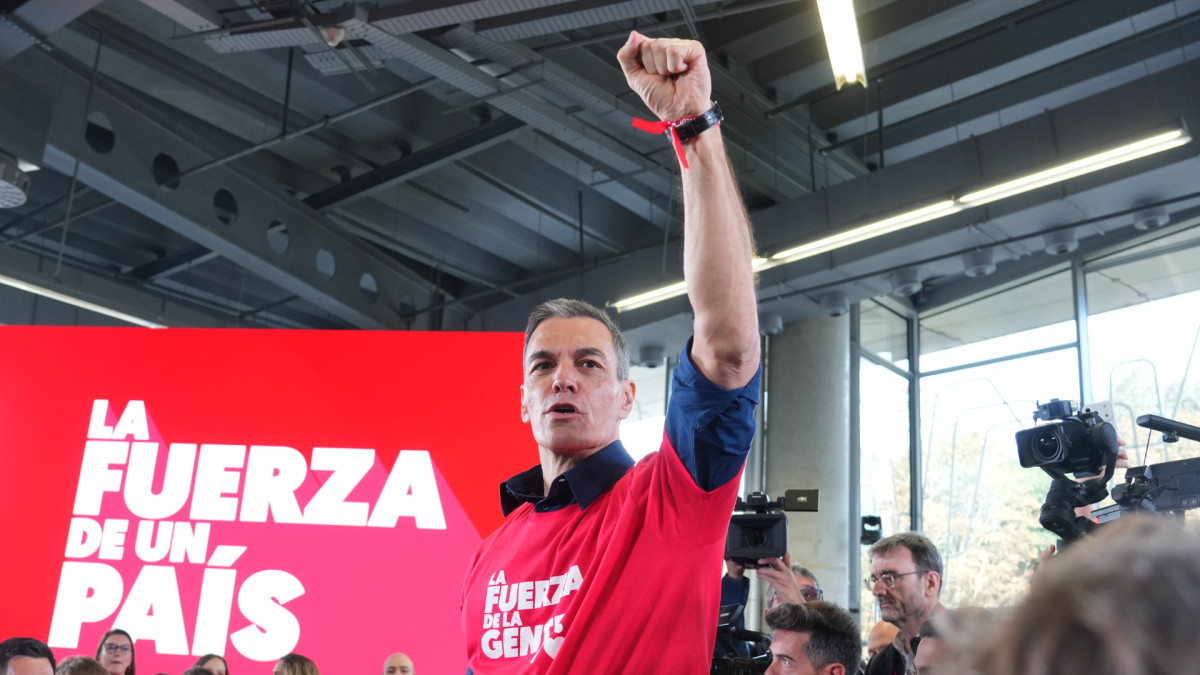
In sailors’ slang, arrancada is the speed a ship can carry. A vessel without arrancada cannot steer even if the helmsman wields the tiller: the rudder only acts if there is water running past it. In politics, something similar happens when a project loses its own momentum and is left at the mercy of the context. The current weeks have implanted the sense that every wind is blowing toward a bloc change in the government and that change is inevitable. The left’s ship, which had begun to gain speed with the call for elections and the housing protests, was once again at the mercy of the tides after the Urda incident.
“The current of these weeks has installed the perception that all winds blow toward a bloc change in the Government and that such a change is inevitable”
The exits being considered by the PSOE keep the ship afloat without restoring speed. One of the maneuvers with room to maneuver for a party that presents itself to continue governing is the one that, adapted to the Spanish scene, turned the Canadian electoral landscape in 2025: to offer a horizon of succession. At this juncture, a leadership change is late. The adaptation must be a promise: one final term for Pedro Sánchez to finish his project, without setting a date or naming a successor. It is a gamble with risks that comparative politics knows well, and its effectiveness depends on how it is framed.
The Current
Polls published after the Urda incident place the PSOE between 24.6% (Sigma Dos) and 27.6% (More in Common), with the PP between 28.3% and 33% and Vox around 20%. Among the fifteen pollsters with surveys in the last month cataloged by Mapa Electoral, all give victory to the PP, which would achieve an absolute majority with Vox in the thirteen that publish seat estimates. But the most revealing data concerns expectations and predates Urda. SocioMétrica measured for El Español, in the first week of the pre-campaign, a record lead of 21.1 points for Alberto Núñez Feijóo over Sánchez in the question of who would be the next president, and 20.3% of those who preferred Sánchez admitted that the PP candidate would ultimately govern. When one in five party supporters writes off the race as lost, inevitability stops being a forecast and begins to shape the bloc that relies most on mobilization.
“The adaptation has to be a promise: one final term for Pedro Sánchez to finish his project, without setting a date or naming a successor”
The media and cognitive pressure today borne by the electoral body leave little space for reflection, and the average voter tends to take refuge among their own. Lluís Orriols described in Democracia de trincheras (Península, 2023) a politics in which polarization appears more as alignment than extremism. To that alignment is added the confirmation bias, as human as it is dangerous, which makes each news item read from one’s own trench as a reinforcement of one’s own convictions. A second deadly high-speed accident within nine months, after Adamuz in January, is read as the confirmation of what was already thought and, for the left’s disenchanted voter, as another argument to stay home.
A Favorable Breeze
The right currently has a clear course and axis. The breeze is favorable. Its narrative contrasts chaos and institutional wear with a classic offer of stability, law, and order. Feijóo has condensed this into the slogan of “national reconstruction” and the appeal to his governance experience. I find more significant what the PP has kept off the showroom floor: the cultural wars over minority rights or setbacks in social advances, issues that re-activate left-wing voters who have become demobilized. Those voters emerge from a harsh and frustrating legislative session, marked by the contradiction between the principles of the different lefts and the realpolitik of a majority that ended up breaking with Junts. They have plenty of reasons to stay home. Hamalgama Métrica calculates for Vozpópuli that 40.7% of those who voted in 2023 and would now abstain voted for PSOE.
Six Days Without Momentum
After Urda, the PSOE spent a few days without arrancada, stunned, focused on dousing a fire that altered the campaign framework: from hope to disappointment. Óscar Puente’s resignation on November 3, after giving explanations before the Congress’s Permanent Deputation, proved useful because it offered the public the acceptance of responsibilities that they demanded. It arrived, however, after six days of unnecessary uncertainty. Those considering voting again for the governing party need certainty: they are trapped between disappointment at the seeming inevitability of a right-wing victory and facts that appear to confirm it.
“That voter leaves a harsh and frustrating legislature, marked by the contradiction between the principles of the different lefts and the ‘realpolitik’ of a majority that ended up breaking with Junts”
This week the ship has moved again: Sánchez resumes the pre-campaign on Friday the 6th in Valencia and the first deputy prime minister, Carlos Cuerpo, has temporarily assumed the Transport portfolio. Moving still does not mean reclaiming control of the course.
What the Anti-Vote Gives
The PSOE’s temptation is to rely on the familiar levers in the weeks ahead. The first is the anti-vote. In political science terms, what is known as negative partisanship describes the voter who is driven more by opposition to the other party than by attachment to their own. Alan Abramowitz and Steven Webster showed in 2016, based on American electoral studies, that the more party identities align with social, cultural, and ideological divides, the more negative are the sentiments toward the rival party and its candidates. That rejection weighs on vote loyalty more than affinity for one’s own party. The call to curb the far right is its Spanish version, and it works: it retains the voter who already fears Vox and, according to the reading after 23J, explained much of the left’s mobilization in 2023.
These appeals have limits that weigh more in this campaign than in 2023. The Socialist voter who, according to Sigma Dos, has begun shifting to the PP after the Urda incident does not see Feijóo as a threat. They vote for him to punish a leadership that does not represent them and in which they do not see a horizon of change. They identify more with the PSOE of Felipe González and Juan Carlos Rodríguez Ibarra than with the current one. For that voter the anti-vote does not speak to them. And useful voting requires that the vote actually count, so asking someone who is convinced that the right will win to cast their ballot is asking for a bet that their own reading of the campaign deems lost. The memory of governance convinces mainly the satisfied voter, who is not the one you need to win back. All three levers hold the electoral floor. It seems unambitious for a governing party to rely entirely on them: none offers the betrayed voter a reason to return that goes beyond fear.
A Horizon and a Face
That voter needs a transition horizon and a figure who embodies hope. The data suggest that their disengagement is aimed more at the leader than at the project. The October Opina 360 barometer scored Cuerpo at 7.77 among Socialist voters, versus 7.18 for Sánchez, and the gap widened among the undecided or those who have decided to switch parties, with 6.33 versus 4.72. And the Socialist electorate is already thinking of what comes after. When SocioMétrica asked Socialist voters in September about a successor if Sánchez did not run, one in four did not choose any of the five names proposed: there is demand for the future, but no obvious heir.
“I find it unambitious that a governing party leaves everything to them: none offers the betrayed voter a reason to return that goes beyond fear”
That is where the president’s role for Cuerpo becomes clear, as first vice president since March, as an intermediary technical figure that fits the voter seeking stability. In a moment of scarce ideological charge, transitional profiles are particularly useful. For the most exposed ministry of the campaign, and without taking away Economy, Sánchez has chosen a vice president who is averse to confrontation, to whom the opposition only directed questions in six of thirty control sessions between February 2025 and March 2026. They still need to turn that face into a horizon.
The Last Term
On January 6, 2025, Justin Trudeau announced his resignation with the Conservatives of Pierre Poilievre more than twenty points ahead; on March 9, Mark Carney won the Liberal leadership with 85.9% of the votes, and on April 28 the Liberals won the elections. Tariffs and threats of annexation from Donald Trump contributed greatly to the turn. The replacement of Trudeau by Carney carried central weight: the election ceased to be a referendum on a worn prime minister.
In Spain, at this point in the campaign, that prior turnover is not within reach. The adaptation must be done in a staged way. It is what we could call “doing an Aznar.” José María Aznar announced in June 1994, in a radio interview at the end of the European elections campaign, that if he ever became prime minister, he would only run for re-election once. He kept to it in 2004, though, according to his memoirs, few believed he would. The version that fits a president still in office is Tony Blair’s, who on September 30, 2004 announced that if he won, he would serve a full third term and would not seek a fourth; in May 2005 he revalidated the government with a majority reduced to 66 seats.
I would not carry the explicit announcement of a turnover to November 29. What could work is to say it without saying it, with a line like this: “I need one more legislature to finish my project for the country: a democratic renewal that guarantees social rights like access to housing and returns to the coming generations the hope of a dignified life.” That extra term turns the vote into the closing of a project. The voter’s question after disappointment shifts from the person to what remains to be done in those four years. In addition to the fear of the far-right, there is a positive reason, a bounded mandate that can be verified at the end.
What Bennelong Teaches
The most serious objection bears the name of an Australian district. In 2007, John Howard, prime minister since 1996, had promised to cede the office mid-term to his treasurer, Peter Costello. He lost the election to Kevin Rudd and also his Bennelong seat. Costello himself later said he would have helped to make the transition before voting. Blair, who did win, admitted in March 2006 that he had been wrong to expect the announcement would quell speculation about his departure. His allies had already warned him that he would be seen as a leader with an expiry date. In Spain, credibility weighs too: if Aznar, promised from opposition, few believed him; if a president with eight years of governance behind him would probably be believed even less.
“The fear of the far right is complemented by a positive reason, a bounded mandate that can be checked at the end”
Hence the message must remain implicit. Without a named successor or a set exit date, there is no expiry-date leader nor a succession fight in full swing during the campaign. What the voter has before them is a mandate. That mandate must be translated into dates and conditions. Its natural axis is democratic renewal and the fight against corruption. The best-understood example is Romania, which the European Commission, in the verification mechanism that accompanied its entry into the Union in 2007, required to set up an integrity agency that checked assets, incompatibilities, and conflicts of interest of public officials, with the power to issue binding decisions. It is the same axis that mobilized the 15M. That movement also rose up in 2011 against a socialist government. That is why the PSOE can only claim that legacy with verifiable commitments. I believe it remains an emotional trigger for a generation that has accumulated unfulfilled promises. The natural showcase for that proposal would be a high-audience setting: the November 16 face-to-face debate.
The double warning applies to both sides. A PSOE that makes that legislature into a name-and-calendar turnover, tempted to use it as a contrition gesture, could unleash in the middle of the campaign the succession fight that already shows up in polls among its voters. A right that continues to present November 29 as a referendum on Sánchez, tempted not to touch a framework that works for them, may discover that Sánchez himself has embraced it if he asks for one final term. That’s why my option does not involve the president stepping out to say “one more legislature and only one”: the most effective is to pose indirectly that he needs one more legislature for democratic renewal and let the voter infer the rest.
“The effective approach is to pose indirectly that one more legislature is needed for democratic renewal and let the voter understand the rest”
Polls measure the present. The future is shaped in discussion groups, where it is tested which promise moves each voter. What I propose cannot be measured today by any poll: it is a bet on the direction signaled by the surveys. With that deferred promise, the socialist ship could regain Arrancada. Sánchez would return to the national debate as the president asking for time to finish what he began. The rudder would again have water to turn a defeat, in the sailors’ sense of the word, which today seems to push him inevitably toward the other side.
